
Integrating Commercial Solar and Battery Storage in California: A 2026 Strategic Guide

In 2026, a commercial solar array without a battery isn't a strategic investment; it's a stranded asset. If you're still relying on the grid to buy back your excess power for a measly five cents while you pay ten times that during peak hours, you're losing money by design. Successfully integrating commercial solar and battery storage California requires moving past the outdated mindset of simple energy generation. It's about capturing that massive value gap. Most executives see their utility bill as an inevitable, fixed cost of doing business. With the right hardware, it becomes a managed financial asset you can actually control.
It's exhausting to open a PG&E statement only to find demand charges that defy logic and billing structures that feel intentionally opaque. You know the 2026 NEM 3.0 landscape has changed the math, and you're likely tired of the wait and see approach while Northern California rates continue to climb. This guide will show you how to dismantle those high demand charges and secure a clear ROI path under five years. We'll break down the 2026 regulatory shifts, the technical requirements of Title 24, and the specific operational steps needed to turn your rooftop into a high-yield power plant.
Key Takeaways
- Stop letting utilities profit from your solar exports. Integrating commercial solar and battery storage California allows you to store your own power rather than selling it back for pennies under NEM 3.0.
- Master the 15-minute peak to kill demand charges. We'll show you how BESS targets those short, expensive bursts of energy that drive up your monthly overhead.
- Move from guesswork to data with a detailed load profile analysis. Identifying whether your building has needle peaks or a sustained belly is the only way to size your system for a real return.
- Stack the 30% Federal ITC with 2026 SGIP funding tiers. These incentives aren't just bonuses; they're the engine that drives a sub-five-year ROI for your energy assets.
Table of Contents
- The Financial Logic: Why Integrate Solar and Storage in California Now?
- How to Integrate Commercial Solar and BESS: A Step-by-Step Implementation
- Financing and ROI: Stacking Incentives in 2026
The Financial Logic: Why Integrate Solar and Storage in California Now?
Think of your energy bill as a plumbing problem. Energy use (kWh) is the total volume of water you use in a month, but demand (kW) is the size of the pipe required to deliver it. Northern California utilities don't just charge you for the water; they charge you a massive premium for the pipe. If you turn on every piece of heavy machinery or your warehouse cooling system at 10:00 AM, you've just demanded a massive pipe. Even if you turn it off 15 minutes later, PG&E has already logged that peak. Integrating commercial solar and battery storage California is the only way to stop paying for a pipe you only use for a fraction of the day.
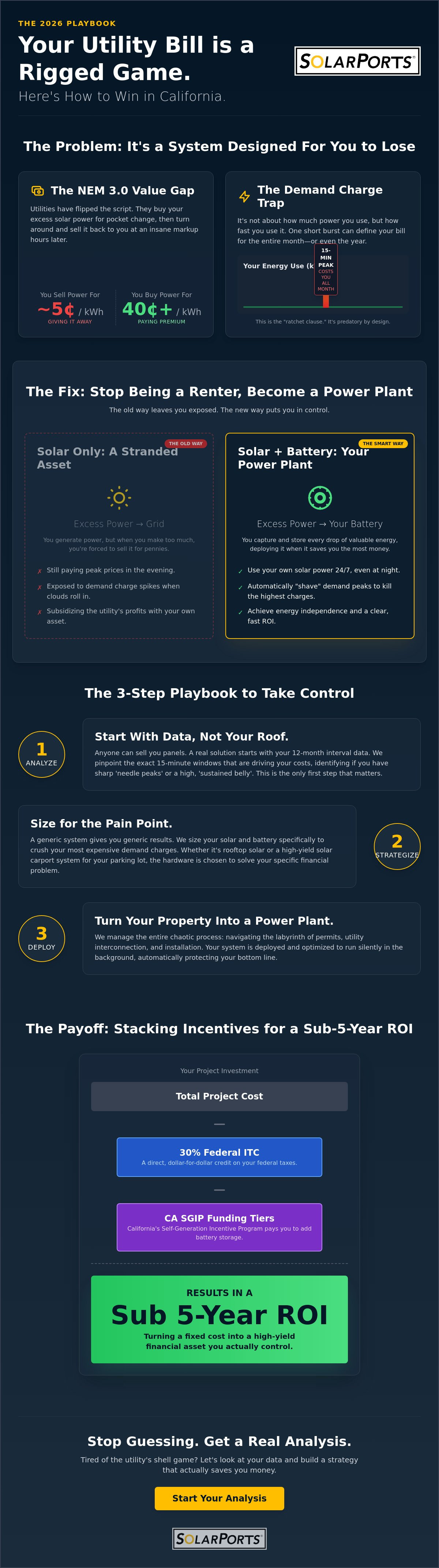
The financial pain deepens with the "ratchet clause" found in many California commercial tariffs. This is a predatory mechanism where one 15-minute spike in demand can set your billing floor for the next eleven months. You're effectively paying for your worst day of the year, every single month. Standalone solar can't solve this because clouds or late-day production drops leave you exposed. You need a buffer.
The NEM 3.0 Reality for Commercial Assets
Under the current Net Billing Tariff, the value of sending solar power back to the grid has cratered. Export rates now average between $0.05 and $0.08 per kWh. If you're selling power at five cents only to buy it back at forty cents during the evening peak, you're subsidizing the utility's profits. This is why battery energy storage systems (BESS) are no longer optional. A battery captures "clipped" energy, power your solar panels produce that exceeds your immediate needs, and keeps it on-site where it's worth full retail value.
Peak Shaving: Your Daily Revenue Protection
Peak shaving is your daily revenue protection. Intelligent software monitors your building's load in real-time. When it detects a demand spike that would trigger a high 15-minute charge, it automatically discharges the battery. This smooths out your profile and keeps you under the utility's expensive thresholds. It's a silent, automated way to protect your bottom line without changing your operational schedule. For more detail on these mechanics, you can explore strategies to lower commercial electricity bills in California through a professional analysis of your specific interval data.
How to Integrate Commercial Solar and BESS: A Step-by-Step Implementation
Most property owners start by looking at their roof. That's the wrong first step. Integration doesn't begin with hardware; it begins with a cold, hard look at your 12-month interval data. A commercial energy cost saving analysis is the only way to identify your specific load profile. You need to know if you're a "needle peak" user, someone who hits massive demand spikes when heavy machinery kicks on, or a "sustained belly" user with a flat, high load. Sizing a system for total energy capacity is a common mistake that leads to overspending. You must size for the duration and intensity of your peak to actually kill those demand charges.
Analyzing Interval Data (The 'Thinking Fix')
You can pull your "Green Button" data directly from your utility portal to see exactly where the waste happens. This raw data exposes the 15-minute windows that are driving your costs through the roof. Be wary of "solar cowboys" who try to quote a system based on your total annual spend or a blurry photo of your utility bill. If they aren't analyzing your 15-minute demand windows, they aren't integrating commercial solar and battery storage California correctly. They're just selling you a generic product that won't solve your specific financial pain.
Hardware Selection and Turnkey Deployment
Rooftop solar is the standard, but it's not the only option. If your roof is aging or cluttered with HVAC units, solar carport systems can turn an underutilized parking lot into a high-yield power plant. This hardware needs to feed into a battery system that is strategically sized to maximize your standing in California's Self-Generation Incentive Program (SGIP). Getting these projects done requires navigating a labyrinth of local permitting and utility interconnection rules. For an unfiltered look at the logistics, read our guide on Commercial Solar Project Management in CA. If you're ready to see how these numbers look for your specific site, you can schedule a technical bill review to get the process moving.
Financing and ROI: Stacking Incentives in 2026
The math for energy in California has shifted from a simple utility expense to a complex tax and asset management play. You aren't just buying panels. You're building a hedge against utility rate hikes that historically hit 5 to 8 percent every single year. By integrating commercial solar and battery storage California, you stop being a passive victim of the grid's pricing volatility. The goal is to stack every available incentive to drive down the effective cost of the asset before the first watt is even generated.
Your primary tool is the Federal Investment Tax Credit (ITC), which currently sits at 30 percent. This doesn't just apply to the solar panels; it covers the entire battery storage system as well. When you combine this with MACRS (Modified Accelerated Cost Recovery System), you can front-load the depreciation of the asset. This effectively lets you write off a massive portion of the system value in the first year, providing a significant cash flow injection when you need it most. Then there's the Self-Generation Incentive Program (SGIP). While general market funds are often depleted, 2026 funding tiers still offer substantial rebates for projects in specific equity or high fire-threat zones, often reaching approximately $850 per kWh for non-residential equity projects.
Future-Proofing for EV Charging
If you're planning for fleet electrification or tenant EV charging, a battery is your best friend. High-speed chargers draw massive amounts of power in short bursts, which would normally trigger a new, much higher demand tier from your utility. A BESS acts as a buffer. It discharges to meet that EV demand so the grid never sees the spike. For a deeper dive into the logistics of this, see our comparison on Commercial Solar Carport with EV Charging in California. It's about building infrastructure that scales without increasing your monthly overhead.
The CFO’s Roadmap to a 5-Year Payback
When you align the 30 percent ITC, the SGIP rebates, and the aggressive tax benefits of MACRS, the numbers start to move quickly. Most of our projects see a sub-five-year ROI. This happens because you aren't just saving on energy; you're eliminating those 15-minute demand spikes we discussed earlier. It is a predictable financial path that turns a volatile liability into a controlled asset. You can schedule your free solar consultation to see the specific math for your property and verify how these 2026 incentives stack up for your bottom line.
Stop Treating Energy as a Fixed Expense
It's time to stop treating your utility bill like an unavoidable tax. The 2026 landscape in California is punishing for those who ignore their data, but it's incredibly rewarding for owners who treat energy as a managed financial asset. By integrating commercial solar and battery storage California, you aren't just putting panels on a roof. You're building a defensive wall against those 15-minute demand spikes and the predatory "ratchet clauses" that keep your overhead high for months after a single surge.
Success here requires a move away from generic quotes toward data-driven sizing. We've shown how to pull your interval data to find the waste and how to stack the 30 percent ITC with current SGIP funding tiers. This isn't about engineering for its own sake; it's about a clear, sub-5-year path to ROI. If you're tired of opaque billing and unpredictable monthly spikes, let's look at your actual load profile. Book Your Free Commercial Energy Cost Saving Analysis to get a turnkey deployment plan designed specifically for Northern California commercial real estate. Taking control of your energy costs is the smartest operational move you'll make this year.
Common Questions About Commercial Energy Integration
How much can battery storage actually reduce my demand charges?
Battery storage typically reduces demand charges by 20% to 40% depending on your specific load profile. It targets the 15-minute peaks that California utilities use to set your monthly billing floor. If your facility has sharp "needle peaks" from heavy equipment or HVAC cycles, the savings are often on the higher end because the battery only needs to discharge for short, strategic bursts to keep you in a lower, cheaper billing tier.
Do I need solar to use battery storage for demand charge management?
You don't strictly need solar to run a battery, but integrating commercial solar and battery storage California is how you actually maximize your ROI. A standalone battery can charge from the grid during cheap off-peak hours and discharge during the afternoon peak. However, adding solar allows you to charge that battery with free energy and unlocks the 30% Federal ITC for the entire integrated system. It's the difference between a decent project and a high-performance financial asset.
What is the Self-Generation Incentive Program (SGIP) and do I qualify in 2026?
SGIP is the state's main rebate for batteries, and your 2026 eligibility depends on your specific "Equity" status or location. General market funds are mostly depleted, so the program now focuses on high fire-threat districts and low-income areas. For non-residential equity projects, the rebate can be approximately $850 per kWh. It's a complex system, so verifying your specific census tract is the first step to seeing if that incentive capital is still on the table for your property.
Is BESS only for backup power during outages?
Blackout protection is a secondary benefit; the real money is in daily demand management. Most commercial operators use their BESS every single day to shave off expensive afternoon utility peaks. Waiting for a power outage to use your battery is a wasted opportunity. It's a workhorse that should be protecting your bottom line every afternoon when utility rates are at their highest, regardless of whether the grid is up or down.
Frequently asked questions
The NEM 3.0 Reality for Commercial Assets
Under the current Net Billing Tariff, the value of sending solar power back to the grid has cratered. Export rates now average between $0.05 and $0.08 per kWh. If you're selling power at five cents only to buy it back at forty cents during the evening peak, you're subsidizing the utility's profits. This is why battery energy storage systems (BESS) are no longer optional. A battery captures "clipped" energy, power your solar panels produce that exceeds your immediate needs, and keeps it on-site where it's worth full retail value.
Peak Shaving: Your Daily Revenue Protection
Peak shaving is your daily revenue protection. Intelligent software monitors your building's load in real-time. When it detects a demand spike that would trigger a high 15-minute charge, it automatically discharges the battery. This smooths out your profile and keeps you under the utility's expensive thresholds. It's a silent, automated way to protect your bottom line without changing your operational schedule. For more detail on these mechanics, you can explore strategies to lower commercial electricity bills in California through a professional analysis of your specific interval data. Most property owners start by looking at their roof. That's the wrong first step. Integration doesn't begin with hardware; it begins with a cold, hard look at your 12-month interval data. A commercial energy cost saving analysis is the only way to identify your specific load profile. You need to know if you're a "needle peak" user, someone who hits massive demand spikes when heavy machinery kicks on, or a "sustained belly" user with a flat, high load. Sizing a system for total energy capacity is a common mistake that leads to overspending. You must size for the duration and intensity of your peak to actually kill those demand charges.
Analyzing Interval Data (The 'Thinking Fix')
You can pull your "Green Button" data directly from your utility portal to see exactly where the waste happens. This raw data exposes the 15-minute windows that are driving your costs through the roof. Be wary of "solar cowboys" who try to quote a system based on your total annual spend or a blurry photo of your utility bill. If they aren't analyzing your 15-minute demand windows, they aren't integrating commercial solar and battery storage California correctly. They're just selling you a generic product that won't solve your specific financial pain.
Hardware Selection and Turnkey Deployment
Rooftop solar is the standard, but it's not the only option. If your roof is aging or cluttered with HVAC units, solar carport systems can turn an underutilized parking lot into a high-yield power plant. This hardware needs to feed into a battery system that is strategically sized to maximize your standing in California's Self-Generation Incentive Program (SGIP). Getting these projects done requires navigating a labyrinth of local permitting and utility interconnection rules. For an unfiltered look at the logistics, read our guide on Commercial Solar Project Management in CA. If you're ready to see how these numbers look for your specific site, you can schedule a technical bill review to get the process moving. The math for energy in California has shifted from a simple utility expense to a complex tax and asset management play. You aren't just buying panels. You're building a hedge against utility rate hikes that historically hit 5 to 8 percent every single year. By integrating commercial solar and battery storage California, you stop being a passive victim of the grid's pricing volatility. The goal is to stack every available incentive to drive down the effective cost of the asset before the first watt is even generated. Your primary tool is the Federal Investment Tax Credit (ITC), which currently sits at 30 percent. This doesn't just apply to the solar panels; it covers the entire battery storage system as well. When you combine this with MACRS (Modified Accelerated Cost Recovery System), you can front-load the depreciation of the asset. This effectively lets you write off a massive portion of the system value in the first year, providing a significant cash flow injection when you need it most. Then there's the Self-Generation Incentive Program (SGIP). While general market funds are often depleted, 2026 funding tiers still offer substantial rebates for projects in specific equity or high fire-threat zones, often reaching approximately $850 per kWh for non-residential equity projects.
Future-Proofing for EV Charging
If you're planning for fleet electrification or tenant EV charging, a battery is your best friend. High-speed chargers draw massive amounts of power in short bursts, which would normally trigger a new, much higher demand tier from your utility. A BESS acts as a buffer. It discharges to meet that EV demand so the grid never sees the spike. For a deeper dive into the logistics of this, see our comparison on Commercial Solar Carport with EV Charging in California. It's about building infrastructure that scales without increasing your monthly overhead.
The CFO’s Roadmap to a 5-Year Payback
When you align the 30 percent ITC, the SGIP rebates, and the aggressive tax benefits of MACRS, the numbers start to move quickly. Most of our projects see a sub-five-year ROI. This happens because you aren't just saving on energy; you're eliminating those 15-minute demand spikes we discussed earlier. It is a predictable financial path that turns a volatile liability into a controlled asset. You can schedule your free solar consultation to see the specific math for your property and verify how these 2026 incentives stack up for your bottom line. It's time to stop treating your utility bill like an unavoidable tax. The 2026 landscape in California is punishing for those who ignore their data, but it's incredibly rewarding for owners who treat energy as a managed financial asset. By integrating commercial solar and battery storage California, you aren't just putting panels on a roof. You're building a defensive wall against those 15-minute demand spikes and the predatory "ratchet clauses" that keep your overhead high for months after a single surge. Success here requires a move away from generic quotes toward data-driven sizing. We've shown how to pull your interval data to find the waste and how to stack the 30 percent ITC with current SGIP funding tiers. This isn't about engineering for its own sake; it's about a clear, sub-5-year path to ROI. If you're tired of opaque billing and unpredictable monthly spikes, let's look at your actual load profile. Book Your Free Commercial Energy Cost Saving Analysis to get a turnkey deployment plan designed specifically for Northern California commercial real estate. Taking control of your energy costs is the smartest operational move you'll make this year.
How much can battery storage actually reduce my demand charges?
Battery storage typically reduces demand charges by 20% to 40% depending on your specific load profile. It targets the 15-minute peaks that California utilities use to set your monthly billing floor. If your facility has sharp "needle peaks" from heavy equipment or HVAC cycles, the savings are often on the higher end because the battery only needs to discharge for short, strategic bursts to keep you in a lower, cheaper billing tier.
Do I need solar to use battery storage for demand charge management?
You don't strictly need solar to run a battery, but integrating commercial solar and battery storage California is how you actually maximize your ROI. A standalone battery can charge from the grid during cheap off-peak hours and discharge during the afternoon peak. However, adding solar allows you to charge that battery with free energy and unlocks the 30% Federal ITC for the entire integrated system. It's the difference between a decent project and a high-performance financial asset.
What is the Self-Generation Incentive Program (SGIP) and do I qualify in 2026?
SGIP is the state's main rebate for batteries, and your 2026 eligibility depends on your specific "Equity" status or location. General market funds are mostly depleted, so the program now focuses on high fire-threat districts and low-income areas. For non-residential equity projects, the rebate can be approximately $850 per kWh. It's a complex system, so verifying your specific census tract is the first step to seeing if that incentive capital is still on the table for your property.
Is BESS only for backup power during outages?
Blackout protection is a secondary benefit; the real money is in daily demand management. Most commercial operators use their BESS every single day to shave off expensive afternoon utility peaks. Waiting for a power outage to use your battery is a wasted opportunity. It's a workhorse that should be protecting your bottom line every afternoon when utility rates are at their highest, regardless of whether the grid is up or down.