
Commercial Solar Carport with Battery Storage Cost: The 2026 California Reality

Building a commercial solar carport without battery storage in 2026 is essentially paying for half a solution while expecting a full return. It's a hard truth, but the math doesn't lie. You've likely seen the opaque quotes and felt the sting of rising peak demand charges, all while trying to make sense of how NEM 3.0 changed the game for California businesses. The reality is that the commercial solar carport with battery storage cost is no longer just an equipment expense. It's a strategic hedge against a utility market that's increasingly hostile to simple solar exports.
You're right to be skeptical of the vague pricing models floating around the industry. We agree that the financial landscape is shifting fast, especially with the 30% federal tax credit deadline approaching this July and the expiration of property tax exclusions at the end of the year. This article provides a pragmatic breakdown of the capital requirements and the specific financial benefits of integrating storage into your infrastructure. We'll examine the "all-in" cost structure, provide a framework for calculating your actual ROI under the Net Billing Tariff, and map out the 2026 tax incentives that make this the most critical window for investment we've seen in a decade.
Key Takeaways
- Stop looking at carports as just shade; the structural steel and silicon choices you make now dictate your maintenance and efficiency for the next twenty years.
- We break down the true commercial solar carport with battery storage cost to show why skipping the battery under NEM 3.0 is essentially throwing away your energy independence.
- Learn how peak shaving works in the real world to flatten those brutal utility demand spikes that solar alone can't touch.
- Get ahead of the 2026 California regulatory mess by understanding exactly what PG&E, fire marshals, and ADA inspectors are looking for before you break ground.
Table of Contents
- Breaking Down the Capital Expenditure: Steel, Silicon, and Storage
- The Battery Multiplier: Why Storage Redefines Your ROI in 2026
- Navigating the California Permitting and Interconnection Maze
Breaking Down the Capital Expenditure: Steel, Silicon, and Storage
The financial reality of a California energy project in 2026 is that the initial outlay involves far more than just buying panels. You're essentially building a small-scale power plant that must survive seismic activity and intense wind loads. This is where the commercial solar carport with battery storage cost starts to deviate significantly from standard rooftop installations. Steel is expensive. In California, seismic requirements mean your foundation costs can rival the price of the solar modules themselves.
The Structural Premium of Commercial Carports
A rooftop system uses the existing building as its foundation. A Solar canopy, however, requires massive concrete piers and heavy-duty structural steel. You're typically choosing between T-frame designs, which are often more cost-effective for double-row parking, and cantilever structures that offer better clearance but demand more steel. Over-engineering is a common budget killer. We recommend a commercial energy cost saving analysis early in the process to ensure structural specs match your actual energy needs without wasting capital on unnecessary metal.
BESS Hardware and Inverter Integration
The battery is the most volatile variable in the 2026 budget. While Lithium-Ion remains the standard for short-duration discharge, long-duration chemistries are becoming more viable for four-hour plus storage needs. In California, hardware costs currently hover around $1,074 per kWh. To keep labor costs down, many firms are moving toward integrated, all-in-one inverters that handle both DC-coupled solar and battery inputs. This simplifies the interconnection process with utilities like PG&E and reduces the physical footprint on-site.
Beyond the hardware, don't ignore the soft costs. Engineering for California's specific fire safety codes and ADA compliance adds layers of complexity that other states simply don't face. Permitting fees for large systems often range from $900 to $1,000. While the mandatory adoption of SolarAPP+ in many jurisdictions is finally starting to compress those timelines, the commercial solar carport with battery storage cost still reflects the high price of California's regulatory environment. You're paying for precision and speed in a market that doesn't tolerate errors.
The Battery Multiplier: Why Storage Redefines Your ROI in 2026
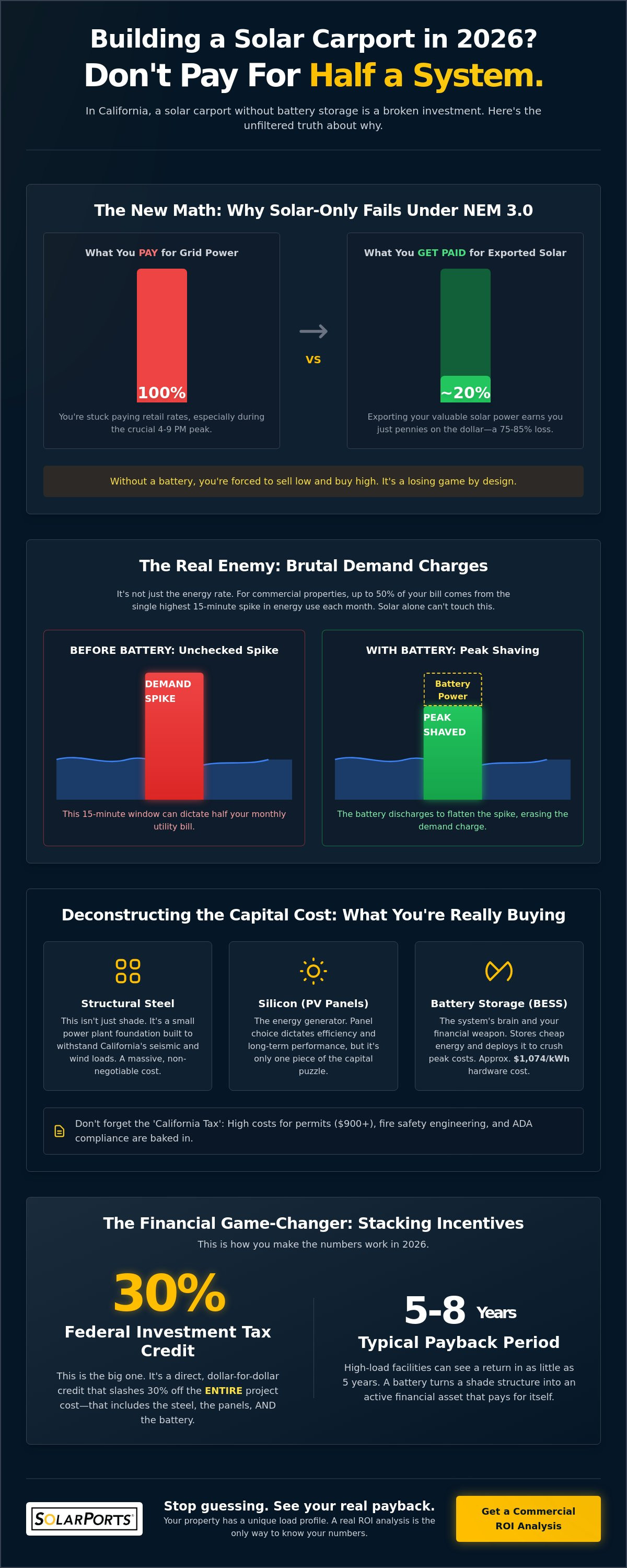
In 2026, building a solar carport in California without storage is like buying a bucket with a hole in the bottom. You generate power when the sun is at its peak, but under the NEM 3.0 Net Billing Tariff, the utility only pays you roughly $0.05 to $0.08 per kWh for that exported energy. That’s a 75% to 85% drop from retail rates. The commercial solar carport with battery storage cost is an investment in keeping your own electrons behind the meter where they’re actually worth something. If you don't store it, you're essentially donating your capital to the utility's bottom line.
Mitigating California Demand Charges
For most commercial properties, the real enemy isn't the energy rate; it's the demand charge. These fees can account for up to 50% of your total bill, triggered by the single highest 15-minute window of usage in a month. Batteries allow for peak shaving, where the system identifies these spikes and discharges stored power to flatten them. Demand charge management is the tactical release of stored energy during peak utility pricing. By targeting the 4 PM to 9 PM window when SCE and PG&E rates are highest, storage transforms a passive shade structure into an active financial asset.
Stacking Incentives for Maximum ROI
The math for 2026 is driven by the 30% federal Investment Tax Credit (ITC). This credit applies to the total project cost, meaning the battery system effectively gets a 30% discount alongside the solar array. While the Self-Generation Incentive Program (SGIP) general market budgets are largely closed, the federal 2026 commercial solar tax credit remains the primary driver. We always start with a commercial solar ROI analysis because the payback period isn't universal. A high-load facility might see a five-year payback, while a lighter load profile might push toward eight years. If you want to see where your specific property falls on that spectrum, you can book a technical review of your current utility data.
Navigating the California Permitting and Interconnection Maze
Interconnection is where ambitious energy projects often stall. You've likely modeled the equipment, but the timeline for utilities like PG&E to actually grant you permission to operate (PTO) is the variable that keeps most CFOs up at night. The commercial solar carport with battery storage cost includes these invisible soft delays. In 2026, despite state mandates for faster processing, the queue for commercial projects still requires a six to nine-month lead time. If you don't start the paperwork before the steel arrives, you're paying interest on an idle asset.
National research like the Solar Energy Cost and Data Analysis from the DOE shows that soft costs, specifically permitting and labor, are the most significant hurdles to scaling solar-plus-storage. In California, this is amplified by localized requirements that vary from one county to the next. You aren't just building a canopy. You're navigating a regulatory minefield.
Local Hurdles in Northern California
Zoning in the Bay Area and Central Valley is notoriously rigid. Fire marshals here focus on clear heights for emergency vehicles and "high-piled storage" risks if your BESS units are near property lines. ADA compliance is also a non-negotiable expense. If your carport foundations obstruct a path of travel or a parking stall's required slope, you'll be tearing up concrete before you ever see a watt of power. It's why we emphasize commercial solar project management in CA as a specialized discipline rather than a general contracting task.
The Turnkey Advantage
Hiring separate contractors for the steel frame, the solar panels, and the battery integration is a recipe for cost overruns. When the steel guy doesn't talk to the battery guy, you end up with conduit runs that don't match or foundations that interfere with high-voltage lines. A turnkey partner eliminates this friction by managing the "messy middle" of the project. You should look at past projects to see how these site-specific constraints were handled in real-world scenarios. Final commissioning is the last hurdle. It's the moment when the software, the inverters, and the grid finally sync up, turning your parking lot from a liability into a revenue-generating power plant.
Securing Your 2026 Energy Infrastructure
The window for maximizing the 30% federal tax credit and 100% bonus depreciation is closing fast. We've seen too many property owners wait until the fourth quarter only to find their projects pushed into the next fiscal cycle by utility interconnection delays. In Northern California, the intersection of seismic engineering and rigid fire codes means you can't afford a trial-and-error approach. While the commercial solar carport with battery storage cost represents a significant capital outlay, it's a fixed, predictable investment compared to the compounding volatility of utility demand charges.
We specialize in the granular nuances of Northern California commercial real estate, delivering turnkey integration from initial structural engineering to final commissioning. Our focus remains on small-scale commercial fiscal optimization because that's where we find the most significant operational waste. You deserve a partner who values data over persuasion and results over marketing fluff. If you're ready to move from confusion to a concrete financial plan, it's time to look at your actual load profile.
Request a Data-Driven Energy Cost Saving Analysis to see exactly how these numbers pencil out for your specific property. Taking control of your energy overhead is a strategic move that pays dividends for decades.
Frequently Asked Questions
How much does a commercial solar carport cost per parking space?
Most developers evaluate this through the lens of power density rather than just the asphalt footprint. A single parking space typically supports between 3 and 4 kilowatts of solar capacity depending on the module efficiency and tilt. The investment per space fluctuates based on the structural choice between a standard T-frame or a more complex cantilever design. While rooftop systems are cheaper because the building is the foundation, a carport requires massive concrete piers and structural steel that must meet California seismic codes.
Can I add battery storage to an existing solar carport system?
Yes, you can retrofit storage, though the integration is technically more demanding than a new build. This is usually done via AC coupling, where the battery system uses its own dedicated inverter to communicate with your existing solar array. It's a common move for California businesses that installed solar under older net metering rules but now face brutal peak demand charges. You'll need to verify that your current electrical switchgear has the physical clearance and the busbar capacity to handle the additional storage load.
What is the typical lifespan of a commercial BESS in California?
You should build your financial models around a 10 to 15 year operational life for the battery cells. While the steel carport structure will easily last 30 years, the chemical storage degrades based on how hard you cycle the system and the local ambient temperatures. Most Tier 1 manufacturers provide a capacity guarantee, which ensures the system retains roughly 70% of its original storage potential after a decade of daily use. It's a predictable degradation curve that we factor into the long term commercial solar carport with battery storage cost analysis.
Does a solar carport increase my property tax in California?
Currently, active solar energy systems are excluded from property tax assessments in California. This means the value added to your real estate by the system won't trigger an immediate bump in your tax bill. However, you need to watch the calendar closely. This specific property tax exclusion is set to expire after December 31, 2026. Projects placed in service before that deadline are generally protected, but the legislative landscape beyond that date remains a variable you should discuss with a tax professional.
Frequently asked questions
The Structural Premium of Commercial Carports
A rooftop system uses the existing building as its foundation. A Solar canopy, however, requires massive concrete piers and heavy-duty structural steel. You're typically choosing between T-frame designs, which are often more cost-effective for double-row parking, and cantilever structures that offer better clearance but demand more steel. Over-engineering is a common budget killer. We recommend a commercial energy cost saving analysis early in the process to ensure structural specs match your actual energy needs without wasting capital on unnecessary metal.
BESS Hardware and Inverter Integration
The battery is the most volatile variable in the 2026 budget. While Lithium-Ion remains the standard for short-duration discharge, long-duration chemistries are becoming more viable for four-hour plus storage needs. In California, hardware costs currently hover around $1,074 per kWh. To keep labor costs down, many firms are moving toward integrated, all-in-one inverters that handle both DC-coupled solar and battery inputs. This simplifies the interconnection process with utilities like PG&E and reduces the physical footprint on-site. Beyond the hardware, don't ignore the soft costs. Engineering for California's specific fire safety codes and ADA compliance adds layers of complexity that other states simply don't face. Permitting fees for large systems often range from $900 to $1,000. While the mandatory adoption of SolarAPP+ in many jurisdictions is finally starting to compress those timelines, the commercial solar carport with battery storage cost still reflects the high price of California's regulatory environment. You're paying for precision and speed in a market that doesn't tolerate errors. In 2026, building a solar carport in California without storage is like buying a bucket with a hole in the bottom. You generate power when the sun is at its peak, but under the NEM 3.0 Net Billing Tariff, the utility only pays you roughly $0.05 to $0.08 per kWh for that exported energy. That’s a 75% to 85% drop from retail rates. The commercial solar carport with battery storage cost is an investment in keeping your own electrons behind the meter where they’re actually worth something. If you don't store it, you're essentially donating your capital to the utility's bottom line.
Mitigating California Demand Charges
For most commercial properties, the real enemy isn't the energy rate; it's the demand charge. These fees can account for up to 50% of your total bill, triggered by the single highest 15-minute window of usage in a month. Batteries allow for peak shaving, where the system identifies these spikes and discharges stored power to flatten them. Demand charge management is the tactical release of stored energy during peak utility pricing. By targeting the 4 PM to 9 PM window when SCE and PG&E rates are highest, storage transforms a passive shade structure into an active financial asset.
Stacking Incentives for Maximum ROI
The math for 2026 is driven by the 30% federal Investment Tax Credit (ITC). This credit applies to the total project cost, meaning the battery system effectively gets a 30% discount alongside the solar array. While the Self-Generation Incentive Program (SGIP) general market budgets are largely closed, the federal 2026 commercial solar tax credit remains the primary driver. We always start with a commercial solar ROI analysis because the payback period isn't universal. A high-load facility might see a five-year payback, while a lighter load profile might push toward eight years. If you want to see where your specific property falls on that spectrum, you can book a technical review of your current utility data. Interconnection is where ambitious energy projects often stall. You've likely modeled the equipment, but the timeline for utilities like PG&E to actually grant you permission to operate (PTO) is the variable that keeps most CFOs up at night. The commercial solar carport with battery storage cost includes these invisible soft delays. In 2026, despite state mandates for faster processing, the queue for commercial projects still requires a six to nine-month lead time. If you don't start the paperwork before the steel arrives, you're paying interest on an idle asset. National research like the Solar Energy Cost and Data Analysis from the DOE shows that soft costs, specifically permitting and labor, are the most significant hurdles to scaling solar-plus-storage. In California, this is amplified by localized requirements that vary from one county to the next. You aren't just building a canopy. You're navigating a regulatory minefield.
Local Hurdles in Northern California
Zoning in the Bay Area and Central Valley is notoriously rigid. Fire marshals here focus on clear heights for emergency vehicles and "high-piled storage" risks if your BESS units are near property lines. ADA compliance is also a non-negotiable expense. If your carport foundations obstruct a path of travel or a parking stall's required slope, you'll be tearing up concrete before you ever see a watt of power. It's why we emphasize commercial solar project management in CA as a specialized discipline rather than a general contracting task.
The Turnkey Advantage
Hiring separate contractors for the steel frame, the solar panels, and the battery integration is a recipe for cost overruns. When the steel guy doesn't talk to the battery guy, you end up with conduit runs that don't match or foundations that interfere with high-voltage lines. A turnkey partner eliminates this friction by managing the "messy middle" of the project. You should look at past projects to see how these site-specific constraints were handled in real-world scenarios. Final commissioning is the last hurdle. It's the moment when the software, the inverters, and the grid finally sync up, turning your parking lot from a liability into a revenue-generating power plant. The window for maximizing the 30% federal tax credit and 100% bonus depreciation is closing fast. We've seen too many property owners wait until the fourth quarter only to find their projects pushed into the next fiscal cycle by utility interconnection delays. In Northern California, the intersection of seismic engineering and rigid fire codes means you can't afford a trial-and-error approach. While the commercial solar carport with battery storage cost represents a significant capital outlay, it's a fixed, predictable investment compared to the compounding volatility of utility demand charges. We specialize in the granular nuances of Northern California commercial real estate, delivering turnkey integration from initial structural engineering to final commissioning. Our focus remains on small-scale commercial fiscal optimization because that's where we find the most significant operational waste. You deserve a partner who values data over persuasion and results over marketing fluff. If you're ready to move from confusion to a concrete financial plan, it's time to look at your actual load profile. Request a Data-Driven Energy Cost Saving Analysis to see exactly how these numbers pencil out for your specific property. Taking control of your energy overhead is a strategic move that pays dividends for decades.
How much does a commercial solar carport cost per parking space?
Most developers evaluate this through the lens of power density rather than just the asphalt footprint. A single parking space typically supports between 3 and 4 kilowatts of solar capacity depending on the module efficiency and tilt. The investment per space fluctuates based on the structural choice between a standard T-frame or a more complex cantilever design. While rooftop systems are cheaper because the building is the foundation, a carport requires massive concrete piers and structural steel that must meet California seismic codes.
Can I add battery storage to an existing solar carport system?
Yes, you can retrofit storage, though the integration is technically more demanding than a new build. This is usually done via AC coupling, where the battery system uses its own dedicated inverter to communicate with your existing solar array. It's a common move for California businesses that installed solar under older net metering rules but now face brutal peak demand charges. You'll need to verify that your current electrical switchgear has the physical clearance and the busbar capacity to handle the additional storage load.
What is the typical lifespan of a commercial BESS in California?
You should build your financial models around a 10 to 15 year operational life for the battery cells. While the steel carport structure will easily last 30 years, the chemical storage degrades based on how hard you cycle the system and the local ambient temperatures. Most Tier 1 manufacturers provide a capacity guarantee, which ensures the system retains roughly 70% of its original storage potential after a decade of daily use. It's a predictable degradation curve that we factor into the long term commercial solar carport with battery storage cost analysis.
Does a solar carport increase my property tax in California?
Currently, active solar energy systems are excluded from property tax assessments in California. This means the value added to your real estate by the system won't trigger an immediate bump in your tax bill. However, you need to watch the calendar closely. This specific property tax exclusion is set to expire after December 31, 2026. Projects placed in service before that deadline are generally protected, but the legislative landscape beyond that date remains a variable you should discuss with a tax professional.