
Commercial Solar Installation Cost Per Watt: The Unfiltered 2026 Reality

Focusing solely on the commercial solar installation cost per watt might be the fastest way to blow your 2026 budget. Most executives treat that number as a fixed benchmark. It's not. In reality, it's often a distraction from the structural soft costs that actually move the needle on a California P&L. You're likely watching utility rates spike while trying to bridge the gap between record-low hardware prices and the reality of rising labor and permitting fees. It's a high-stakes environment, especially with the July 4, 2026, tax credit deadline forcing a decision on your fiscal timeline.
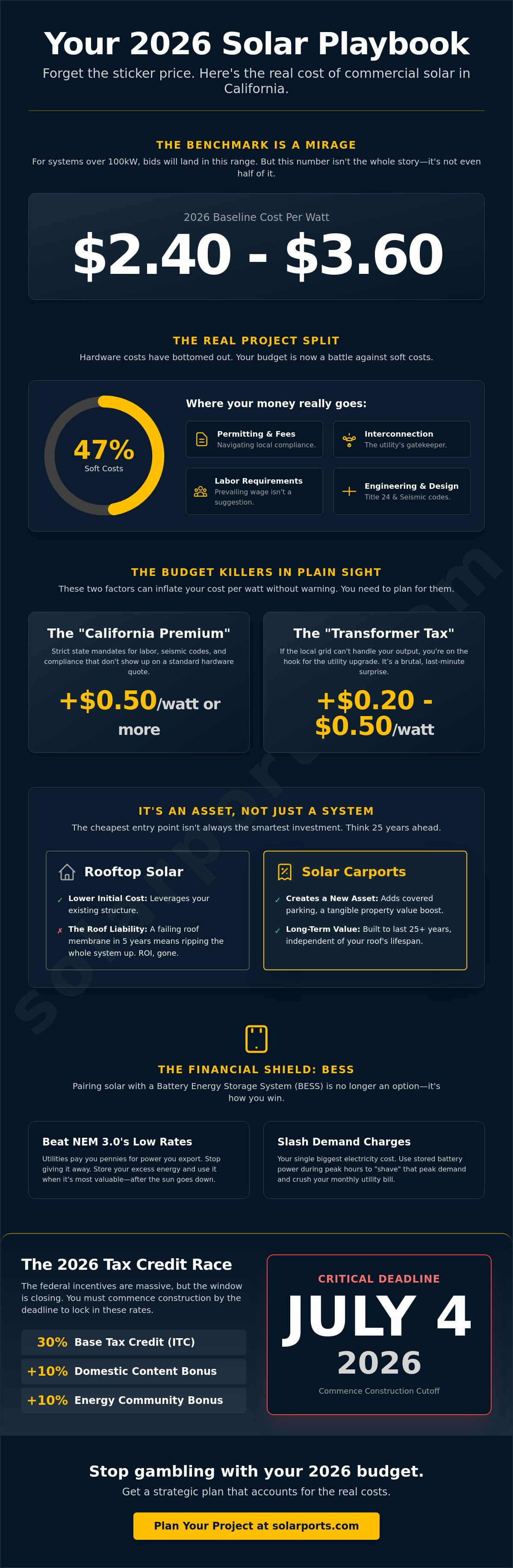
I'm going to give you the raw data on California pricing and explain why that single metric is only half the story for your bottom line. You'll learn why soft costs now account for nearly 47% of total project expenditures and how to evaluate the ROI of solar carports versus rooftop systems. We'll also break down the specific construction milestones you must hit to secure the 30% federal tax credit before the window closes for good.
Key Takeaways
- Establish a realistic 2026 baseline of $2.40 to $3.60 for systems over 100kW, while recognizing how industrial scale can significantly lower these figures.
- Account for California's "hidden" soft costs, like interconnection fees and labor requirements, which can inflate your commercial solar installation cost per watt by $0.50 or more.
- Evaluate why investing in a solar carport often yields better long-term asset value than a cheaper, standard rooftop installation.
- Understand how pairing solar with a Battery Energy Storage System (BESS) helps you bypass the low export rates of NEM 3.0 and slash demand charges.
- Map out your construction timeline now to ensure you hit the July 2026 milestones required to capture the full 30% federal tax credit.
Table of Contents
- The 2026 Benchmark: Decoding Commercial Solar Cost Per Watt
- Why California Soft Costs Eat Your Per-Watt Budget
- Strategic ROI: Why Carports and BESS Change the Math
The 2026 Benchmark: Decoding Commercial Solar Cost Per Watt
The term "cost per watt" refers to the total price of a project divided by its nameplate DC capacity. It is the most common metric used to compare bids, but it is also the most misunderstood. For systems over 100kW, the current 2026 market baseline typically ranges from $2.40 to $3.60 per watt. This range reflects a significant shift in the industry. We have reached a point where hardware prices for modules have essentially hit a floor; consequently, soft costs like labor, permitting, and interconnection are now the primary factors driving your total investment.
Industrial-scale projects still benefit from economies of scale compared to small-business rooftop solar, but those savings are being eaten by regulatory complexity. While a larger project allows you to spread fixed costs like engineering across more panels, the California labor market has made mobilization and specialized trade work more expensive. You aren't just paying for the glass on the roof. You are paying for the logistical machine required to get that glass permitted and interconnected before the 2026 tax deadlines expire.
Rooftop vs. Ground Mount: The Structural Cost Gap
Rooftop solar remains the most affordable per-watt entry point because you're utilizing an existing structure. You avoid the heavy civil engineering, land clearing, and massive steel foundations required for ground-mounted arrays. However, you have to be honest about the health of your roof. If you save $0.50 per watt today but have to rip the whole system up in five years to fix a failing roof membrane, your ROI just went up in smoke. Smart strategies to lower commercial electricity bills California property owners use always start with a structural audit to ensure the asset lasts its full 25-year lifespan.
The 2026 Hardware Market: Modules vs. Inverters
The hardware landscape has shifted toward high-performance bifacial modules. These panels capture light on both sides and have become the commercial standard in California because they maximize energy yield on limited footprints. While they might slightly increase your commercial solar installation cost per watt, the improvement in the levelized cost of energy is undeniable. You also have to navigate domestic content requirements. Sourcing hardware that qualifies for federal tax "adders" can be more expensive upfront, but the long-term tax benefits usually outweigh the initial premium. A look at the history of Solar power shows that we've moved past the era of buying the cheapest possible panel in favor of buying the most strategic financial asset.
Why California Soft Costs Eat Your Per-Watt Budget
Soft costs in California aren't just a line item. They are the project. While hardware prices are dropping, the "California Premium" is rising. It's the cost of doing business in a state with the strictest seismic codes and Title 24 compliance in the country. You're also dealing with prevailing wage and apprenticeship requirements that dictate your labor budget. These aren't just suggestions; they are mandates that can swing your commercial solar installation cost per watt by 20% or more depending on your local jurisdiction.
Then there's the "transformer tax." Many projects trigger a utility-side upgrade that the developer didn't see coming. If your local grid can't handle the export, you're on the hook for the new equipment. This alone adds $0.20 to $0.50 per watt to the bill. It's why the commercial solar installation timeline matters so much. If you miss the July 4, 2026, deadline to commence construction, you're gambling with your fiscal year and losing the leverage of the current federal incentives.
Utility Interconnection: The Hidden Budget Killer
Interconnection is where most projects stall. You're at the mercy of the utility's engineering review. If they decide your facility needs a new transformer to handle the load, the budget expands instantly. It's a brutal variable. This is why a deep Economics of Solar Photovoltaic Systems analysis must happen before you sign a contract. You need to know if the grid is ready for you before you commit capital.
The Tax Credit Factor: ITC and Bonus Adders
The federal government is offering a massive carrot to offset these costs. The 2026 commercial solar tax credit California businesses can access starts at 30%, but it doesn't stop there. If you meet domestic content or energy community requirements, you can stack 10% bonuses. You could turn a $3.00/watt project into a $1.80/watt net investment. It's a math problem that works in your favor if you move fast. If you're ready to see how these numbers apply to your specific facility, you can book a strategy session to review the data.
Strategic ROI: Why Carports and BESS Change the Math
If you're only hunting for the lowest commercial solar installation cost per watt, you're likely buying a system that won't pay for itself as fast as you think. In California's current regulatory climate, the cheapest sticker price often leads to the worst ROI. A $2.80 rooftop system looks great on a spreadsheet compared to a $4.20 carport, but that rooftop system doesn't protect your asphalt or create a platform for new revenue. You have to look at the total asset value, not just the cost of the glass and silicon.
Adding a Battery Energy Storage System (BESS) is the real multiplier. It pushes your per-watt price up significantly. There's no way around that. However, it slashes the payback period by attacking demand charges, which often make up over 50% of a commercial utility bill. Under NEM 3.0, exporting power to the grid is a losing game. If you aren't storing your energy to use during peak evening hours, you're essentially donating your generation to the utility for pennies. You can view SolarPorts Development services to see how we integrate storage into our cost-saving analyses.
Carports as Dual-Purpose Assets
Carports turn a passive parking lot into a high-yield power plant. They provide shade and security while simultaneously serving as the backbone for electric vehicle infrastructure. Combining commercial solar carport with EV charging California strategies allows you to monetize your parking spaces. It's a shift from just saving money to actually generating it, which is a logic most rooftop systems can't match.
The Real Goal: Right-Sizing for ROI
A lower cost-per-watt is a vanity metric if the system isn't tuned to your specific load profile. Oversizing was the standard move five years ago, but today it's a fiscal mistake. You need a system that covers your base load and uses storage to shave the peaks. This requires tight commercial solar project management CA to avoid scope creep that happens when contractors try to sell you more panels than your battery can handle. Check out our past projects to see how we've balanced these costs to maximize performance for our clients.
Securing Your 2026 Energy Strategy
Stop chasing the lowest bid. It's a trap in California's complex regulatory environment where soft costs and utility-side upgrades can easily derail a project. Your commercial solar installation cost per watt is a useful benchmark, but it's the strategic integration of storage and the precise timing of your tax credits that determines if the project actually succeeds as a financial asset. If you aren't planning for the July 4, 2026, construction milestones now, you're leaving the 30% federal credit to chance.
We specialize in California commercial real estate, providing turnkey BESS and carport integration with a deep understanding of OBBBA 2026 tax compliance. You need a partner who understands that a parking lot is more than just asphalt; it's a potential power plant. Get a data-driven Energy Cost Saving Analysis for your property to move past the marketing fluff and see the verified numbers for your specific facility. Let's get your property off the utility's volatile rate schedule and onto a predictable, high-yield path for the next twenty years.
Frequently Asked Questions
Is the federal tax credit still 30% for commercial solar in 2026?
Yes, the base Investment Tax Credit (ITC) remains at 30% for the 2026 fiscal year. To secure this rate, you must commence construction by the July 4, 2026, deadline. It's also possible to stack 10% bonus adders for projects using domestic content or those located in designated energy communities, which can significantly improve your net position.
How much does a 100kW commercial solar system cost per watt in California?
A 100kW system typically falls into the small-to-mid-scale category, where market benchmarks currently range between $1.80 and $2.55 per watt. This commercial solar installation cost per watt is a baseline for the hardware and labor but doesn't account for site-specific challenges. California properties often face unique structural or utility-side requirements that can push the final figure toward the higher end of that spectrum.
Does the cost per watt include battery storage (BESS)?
Standard industry quotes for the commercial solar installation cost per watt almost never include the price of a Battery Energy Storage System (BESS). Storage is a distinct asset with its own cost structure, typically ranging from $360 to $690 per kWh for a fully installed commercial system. While it increases the upfront price, storage is often the only way to make the math work under California's current export rates.
What are 'soft costs' and why are they higher in California?
Soft costs cover the non-hardware portions of your budget, including engineering, permitting, and interconnection fees. In California, these expenses account for approximately 47% of the total system price. The state's rigorous seismic requirements, Title 24 energy codes, and prevailing wage mandates create a higher floor for these costs compared to almost any other market in the country.
Frequently asked questions
Rooftop vs. Ground Mount: The Structural Cost Gap
Rooftop solar remains the most affordable per-watt entry point because you're utilizing an existing structure. You avoid the heavy civil engineering, land clearing, and massive steel foundations required for ground-mounted arrays. However, you have to be honest about the health of your roof. If you save $0.50 per watt today but have to rip the whole system up in five years to fix a failing roof membrane, your ROI just went up in smoke. Smart strategies to lower commercial electricity bills California property owners use always start with a structural audit to ensure the asset lasts its full 25-year lifespan.
The 2026 Hardware Market: Modules vs. Inverters
The hardware landscape has shifted toward high-performance bifacial modules. These panels capture light on both sides and have become the commercial standard in California because they maximize energy yield on limited footprints. While they might slightly increase your commercial solar installation cost per watt, the improvement in the levelized cost of energy is undeniable. You also have to navigate domestic content requirements. Sourcing hardware that qualifies for federal tax "adders" can be more expensive upfront, but the long-term tax benefits usually outweigh the initial premium. A look at the history of Solar power shows that we've moved past the era of buying the cheapest possible panel in favor of buying the most strategic financial asset. Soft costs in California aren't just a line item. They are the project. While hardware prices are dropping, the "California Premium" is rising. It's the cost of doing business in a state with the strictest seismic codes and Title 24 compliance in the country. You're also dealing with prevailing wage and apprenticeship requirements that dictate your labor budget. These aren't just suggestions; they are mandates that can swing your commercial solar installation cost per watt by 20% or more depending on your local jurisdiction. Then there's the "transformer tax." Many projects trigger a utility-side upgrade that the developer didn't see coming. If your local grid can't handle the export, you're on the hook for the new equipment. This alone adds $0.20 to $0.50 per watt to the bill. It's why the commercial solar installation timeline matters so much. If you miss the July 4, 2026, deadline to commence construction, you're gambling with your fiscal year and losing the leverage of the current federal incentives.
Utility Interconnection: The Hidden Budget Killer
Interconnection is where most projects stall. You're at the mercy of the utility's engineering review. If they decide your facility needs a new transformer to handle the load, the budget expands instantly. It's a brutal variable. This is why a deep Economics of Solar Photovoltaic Systems analysis must happen before you sign a contract. You need to know if the grid is ready for you before you commit capital.
The Tax Credit Factor: ITC and Bonus Adders
The federal government is offering a massive carrot to offset these costs. The 2026 commercial solar tax credit California businesses can access starts at 30%, but it doesn't stop there. If you meet domestic content or energy community requirements, you can stack 10% bonuses. You could turn a $3.00/watt project into a $1.80/watt net investment. It's a math problem that works in your favor if you move fast. If you're ready to see how these numbers apply to your specific facility, you can book a strategy session to review the data. If you're only hunting for the lowest commercial solar installation cost per watt, you're likely buying a system that won't pay for itself as fast as you think. In California's current regulatory climate, the cheapest sticker price often leads to the worst ROI. A $2.80 rooftop system looks great on a spreadsheet compared to a $4.20 carport, but that rooftop system doesn't protect your asphalt or create a platform for new revenue. You have to look at the total asset value, not just the cost of the glass and silicon. Adding a Battery Energy Storage System (BESS) is the real multiplier. It pushes your per-watt price up significantly. There's no way around that. However, it slashes the payback period by attacking demand charges, which often make up over 50% of a commercial utility bill. Under NEM 3.0, exporting power to the grid is a losing game. If you aren't storing your energy to use during peak evening hours, you're essentially donating your generation to the utility for pennies. You can view SolarPorts Development services to see how we integrate storage into our cost-saving analyses.
Carports as Dual-Purpose Assets
Carports turn a passive parking lot into a high-yield power plant. They provide shade and security while simultaneously serving as the backbone for electric vehicle infrastructure. Combining commercial solar carport with EV charging California strategies allows you to monetize your parking spaces. It's a shift from just saving money to actually generating it, which is a logic most rooftop systems can't match.
The Real Goal: Right-Sizing for ROI
A lower cost-per-watt is a vanity metric if the system isn't tuned to your specific load profile. Oversizing was the standard move five years ago, but today it's a fiscal mistake. You need a system that covers your base load and uses storage to shave the peaks. This requires tight commercial solar project management CA to avoid scope creep that happens when contractors try to sell you more panels than your battery can handle. Check out our past projects to see how we've balanced these costs to maximize performance for our clients. Stop chasing the lowest bid. It's a trap in California's complex regulatory environment where soft costs and utility-side upgrades can easily derail a project. Your commercial solar installation cost per watt is a useful benchmark, but it's the strategic integration of storage and the precise timing of your tax credits that determines if the project actually succeeds as a financial asset. If you aren't planning for the July 4, 2026, construction milestones now, you're leaving the 30% federal credit to chance. We specialize in California commercial real estate, providing turnkey BESS and carport integration with a deep understanding of OBBBA 2026 tax compliance. You need a partner who understands that a parking lot is more than just asphalt; it's a potential power plant. Get a data-driven Energy Cost Saving Analysis for your property to move past the marketing fluff and see the verified numbers for your specific facility. Let's get your property off the utility's volatile rate schedule and onto a predictable, high-yield path for the next twenty years.
Is the federal tax credit still 30% for commercial solar in 2026?
Yes, the base Investment Tax Credit (ITC) remains at 30% for the 2026 fiscal year. To secure this rate, you must commence construction by the July 4, 2026, deadline. It's also possible to stack 10% bonus adders for projects using domestic content or those located in designated energy communities, which can significantly improve your net position.
How much does a 100kW commercial solar system cost per watt in California?
A 100kW system typically falls into the small-to-mid-scale category, where market benchmarks currently range between $1.80 and $2.55 per watt. This commercial solar installation cost per watt is a baseline for the hardware and labor but doesn't account for site-specific challenges. California properties often face unique structural or utility-side requirements that can push the final figure toward the higher end of that spectrum.
Does the cost per watt include battery storage (BESS)?
Standard industry quotes for the commercial solar installation cost per watt almost never include the price of a Battery Energy Storage System (BESS). Storage is a distinct asset with its own cost structure, typically ranging from $360 to $690 per kWh for a fully installed commercial system. While it increases the upfront price, storage is often the only way to make the math work under California's current export rates.
What are 'soft costs' and why are they higher in California?
Soft costs cover the non-hardware portions of your budget, including engineering, permitting, and interconnection fees. In California, these expenses account for approximately 47% of the total system price. The state's rigorous seismic requirements, Title 24 energy codes, and prevailing wage mandates create a higher floor for these costs compared to almost any other market in the country.