
EVgo Competitors: 2026 Guide for California Owners

Most California property owners assume hosting a public network is the only path to electrification. It seems easy until you realize that "free" equipment is actually costing you a fortune in lost revenue and surrendered parking control. When you start looking at EVgo for business competitors, you're likely tired of seeing third-party networks take over your prime real estate while you're left holding the bill for high utility demand charges. It's a common frustration in Northern California, where local support is thin and the passive host model just doesn't scale.
This guide breaks down how to find a charging partner that actually improves your property's bottom line. We'll explore why 2026 is the year to shift from hosting to owning your infrastructure. Learn how to integrate solar carports and battery storage to slash costs instead of just feeding someone else's network. We're moving past the marketing to analyze the financial architecture of a real energy ecosystem.
Key Takeaways
- Hosting a public network for "free" is usually a raw deal that locks up your parking lot for a decade while the provider keeps the profit.
- Evaluating EVgo for business competitors isn't just about brand recognition; it's about finding hardware that lets you set the rules for pricing and access.
- Real property value comes from owning the infrastructure and bundling charging into tenant leases instead of acting as a passive landlord.
- You won't see a real return until you pair chargers with solar carports and battery storage to neutralize those high utility demand charges.
Table of Contents
- The Shift Away from Passive Public Charging Networks
- Evaluating the Top EVgo for Business Competitors
- The Infrastructure Play: Why California Owners Are Pivoting to Ownership
The Shift Away from Passive Public Charging Networks
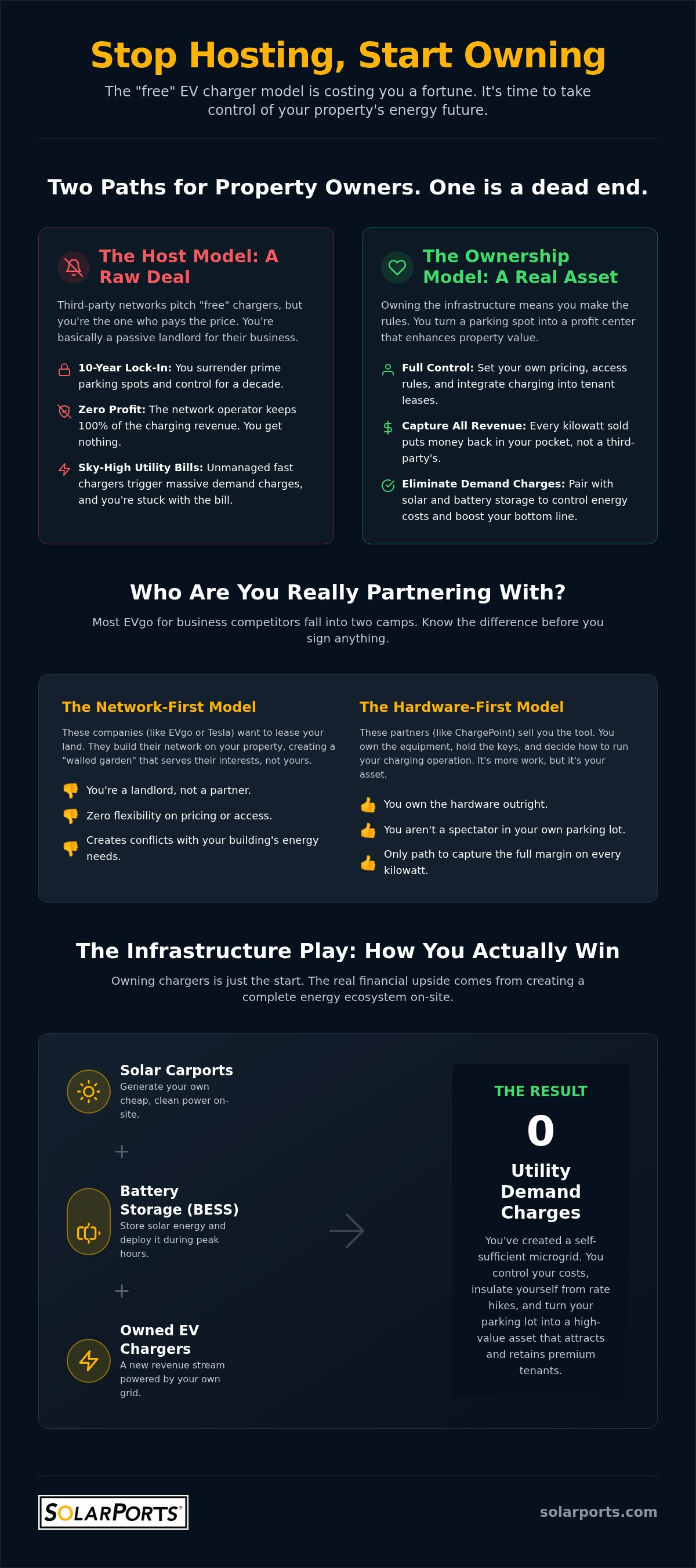
The "free" charger pitch is the oldest trick in the book. You give up a few parking spots for a decade, they install the hardware, and they keep the revenue. It sounds like a win until you look at the opportunity cost. You're essentially acting as a passive landlord for a high-traffic utility. By the time you realize you've signed away your most valuable real estate, you're locked into a long-term contract that offers zero financial upside for your property.
The current state of electric vehicle charging infrastructure makes it easy to sign a bad contract. When evaluating EVgo for business competitors, you'll notice a massive divide between companies that want to lease your land and those that want to help you own the asset. Public networks prioritize throughput. They want cars in and out as fast as possible because that's how they get paid. This creates a fundamental conflict with your building's energy profile. You need load management and grid stability; they need volume and high-speed turnover.
The Hidden Cost of High-Speed Public Infrastructure
Unmanaged DC fast chargers are a nightmare for your utility bill. One car plugs in during a peak window, and your demand charges for the entire month can skyrocket. You're footing the bill for the grid strain while the network operator collects the charging fees. It's a raw deal. Beyond the electricity, "network fees" often eat away at the perceived benefits of hosting. If you aren't looking at EVgo for business competitors through the lens of ownership, you're leaving significant revenue on the table. Transitioning to an ownership model through our services allows you to capture that margin instead of subsidizing a third-party's growth.
Evaluating the Top EVgo for Business Competitors
Selecting the right partner among EVgo for business competitors requires looking past the glossy brochures. Most providers fall into two distinct camps: those who want to lease your dirt and those who want to sell you a tool. ChargePoint is the primary alternative for owners who want to hold the keys. They offer a hardware-first model where you own the equipment and set the pricing. It requires more upfront capital, but it ensures you aren't just a spectator in your own parking lot.
Tesla represents the opposite end of the spectrum. While a Supercharger station brings undeniable brand value and attracts high-end tenants, it offers almost zero flexibility for the landlord. You're essentially hosting a closed ecosystem. If your goal is integrated energy management, Tesla's "walled garden" approach often creates more hurdles than it solves. For sites with specific power constraints, local microgrid solutions like ElectricFish are emerging. These systems use integrated battery storage to buffer the grid, which helps prevent those massive demand charge spikes that ruin your ROI.
Hardware-First vs. Network-First Alternatives
The choice between managed services and owned equipment depends entirely on your 2026 fiscal goals. A managed network feels easy, but an owned system is the only way to capture the full margin of every kilowatt sold. You should vet every competitor based on their ability to integrate with a Commercial property energy cost saving analysis. If the hardware can't communicate with your existing rooftop solar or BESS, you're building a siloed system that will eventually cost you more in maintenance and lost efficiency. If you're ready to see how these models actually pencil out for your specific site, schedule a brief strategy call with our team.
The Infrastructure Play: Why California Owners Are Pivoting to Ownership
Owning the gear isn't just about collecting a few extra cents per kilowatt. It's a strategic play to capture the entire value chain of your parking lot. Most EVgo for business competitors want to keep you on the sidelines as a passive host. By taking ownership, you gain the leverage to bundle charging directly into tenant leases or monthly parking fees. This creates a stickier environment for high-value commercial tenants who want predictable costs. You're no longer just providing a parking spot; you're managing a critical utility that you actually control.
You need this control because our utility landscape is a mess. It's essential to use strategies to lower commercial electricity bills in California that account for the heavy load these chargers pull. Northern California businesses face specific PG&E grid constraints and SCE rate hikes that national providers often ignore. A local partner understands these substation limits. They won't leave you with a system that the grid can't actually support.
Integrating BESS and Solar to Kill Demand Charges
The numbers only pencil out if you're generating your own power. A commercial solar carport with EV charging in California is the most logical way to do this. But solar alone won't stop a massive demand charge if everyone plugs in at once. A Battery Energy Storage System (BESS) acts as a physical buffer. It discharges during those high-demand windows, preventing EV sessions from triggering utility penalties that can double your bill in an afternoon. Check out our projects to see how these integrated systems look in the real world.
Take Control of Your Property's Energy Future
The "free" charger model is effectively dead for savvy California landlords in 2026. Continuing to act as a passive host for public networks means leaving money on the table while losing control over your property's energy load. When you evaluate EVgo for business competitors, focus on the ownership model that integrates directly with your building's fiscal goals. It's about building an ecosystem, not just adding a plug. As California-based turnkey experts, we specialize in BESS and demand charge mitigation specifically for commercial real estate. We help you own the infrastructure so you can capture the profit. Stop subsidizing third-party networks and start building your own asset. Get a Strategic Energy Cost Saving Analysis for Your Property today. Your bottom line will thank you.
Frequently Asked Questions
Is it better to own the EV chargers or host a network like EVgo?
Owning the equipment is almost always the smarter financial move if you have the capital. Hosting a network is essentially renting out your parking spots for pennies while someone else keeps the real profit. Ownership gives you the power to set your own rates and bundle services for tenants. It turns a utility into a controlled asset that actually adds to your property's valuation.
How do EV chargers affect my commercial property's demand charges?
Chargers create massive, unpredictable spikes in electricity demand. If three cars plug in at 2:00 PM, your utility sees a huge surge and hits you with a peak demand charge that lasts all month. This is why we push for BESS integration. A battery absorbs that initial hit so your building's metered load stays flat, saving you from thousands in unnecessary utility penalties.
Can I use solar carports to power my business EV charging stations?
Solar carports are the most efficient way to produce the energy your chargers consume. You're basically turning your asphalt into a mini power plant. When you combine these carports with on-site storage, you can charge vehicles using the sun's energy even after it goes down. It's a closed-loop system that keeps your operational costs predictable regardless of what the utility does.
What are the best EVgo competitors for small-scale commercial real estate in California?
For small-scale California properties, the best EVgo for business competitors are those that offer an owner-operated model. Brands like ChargePoint provide the hardware but let you keep the margin. You should also look at local microgrid firms that specialize in our market. They understand California's specific grid bottlenecks and rebate structures better than the massive national networks that just want to lease your land.
Frequently asked questions
Is it better to own the EV chargers or host a network like EVgo?
Owning the equipment is almost always the smarter financial move if you have the capital. Hosting a network is essentially renting out your parking spots for pennies while someone else keeps the real profit. Ownership gives you the power to set your own rates and bundle services for tenants. It turns a utility into a controlled asset that actually adds to your property's valuation.
How do EV chargers affect my commercial property's demand charges?
Chargers create massive, unpredictable spikes in electricity demand. If three cars plug in at 2:00 PM, your utility sees a huge surge and hits you with a peak demand charge that lasts all month. This is why we push for BESS integration. A battery absorbs that initial hit so your building's metered load stays flat, saving you from thousands in unnecessary utility penalties.
Can I use solar carports to power my business EV charging stations?
Solar carports are the most efficient way to produce the energy your chargers consume. You're basically turning your asphalt into a mini power plant. When you combine these carports with on-site storage, you can charge vehicles using the sun's energy even after it goes down. It's a closed-loop system that keeps your operational costs predictable regardless of what the utility does.
What are the best EVgo competitors for small-scale commercial real estate in California?
For small-scale California properties, the best EVgo for business competitors are those that offer an owner-operated model. Brands like ChargePoint provide the hardware but let you keep the margin. You should also look at local microgrid firms that specialize in our market. They understand California's specific grid bottlenecks and rebate structures better than the massive national networks that just want to lease your land.