
Commercial Battery Storage for Peak Shaving in California: A No-Nonsense 2026 Strategy

Most California business owners are writing a blank check to their utility provider every month. It’s not just the energy you use; it’s the penalty you pay for hitting a high-usage spike for fifteen minutes. Implementing commercial battery storage for peak shaving California operations is the only real way to stop these charges from eating your margins. We know the pressure is high to act, but the fear of over-investing in a massive battery bank keeps most executives stuck in the status quo.
This isn't about chasing dead SGIP rebates. It's about a data-driven strategy to right-size your hardware and protect your bottom line from summer demand charges that now exceed $28 per kilowatt. This guide explains how to navigate NEM 3.0 and build a turnkey system that makes your monthly energy spend predictable again. You’ll learn how to turn a complex hardware purchase into a surgical financial strike.
Key Takeaways
- Most businesses pay more in demand charges than for the actual power they consume. We’ll show you how to target the expensive 4 PM to 9 PM window to keep your utility bills under control.
- Don't fall into the "bigger is better" trap with hardware. Effective commercial battery storage for peak shaving California relies on right-sizing the system to your building’s actual load profile.
- A professional energy cost saving analysis is the only way to avoid wasting money on unneeded capacity. It’s the mandatory first step for any project that actually wants to see a real ROI.
- Think about turnkey solutions that combine storage with solar carport systems. You get the dual benefit of providing shade for vehicles while charging your batteries with clean, free energy.
Table of Contents
- The Financial Mechanics of Peak Shaving in California
- Implementing BESS: Right-Sizing Your Storage Strategy
- Deployment and ROI: Navigating the California Landscape
The Financial Mechanics of Peak Shaving in California
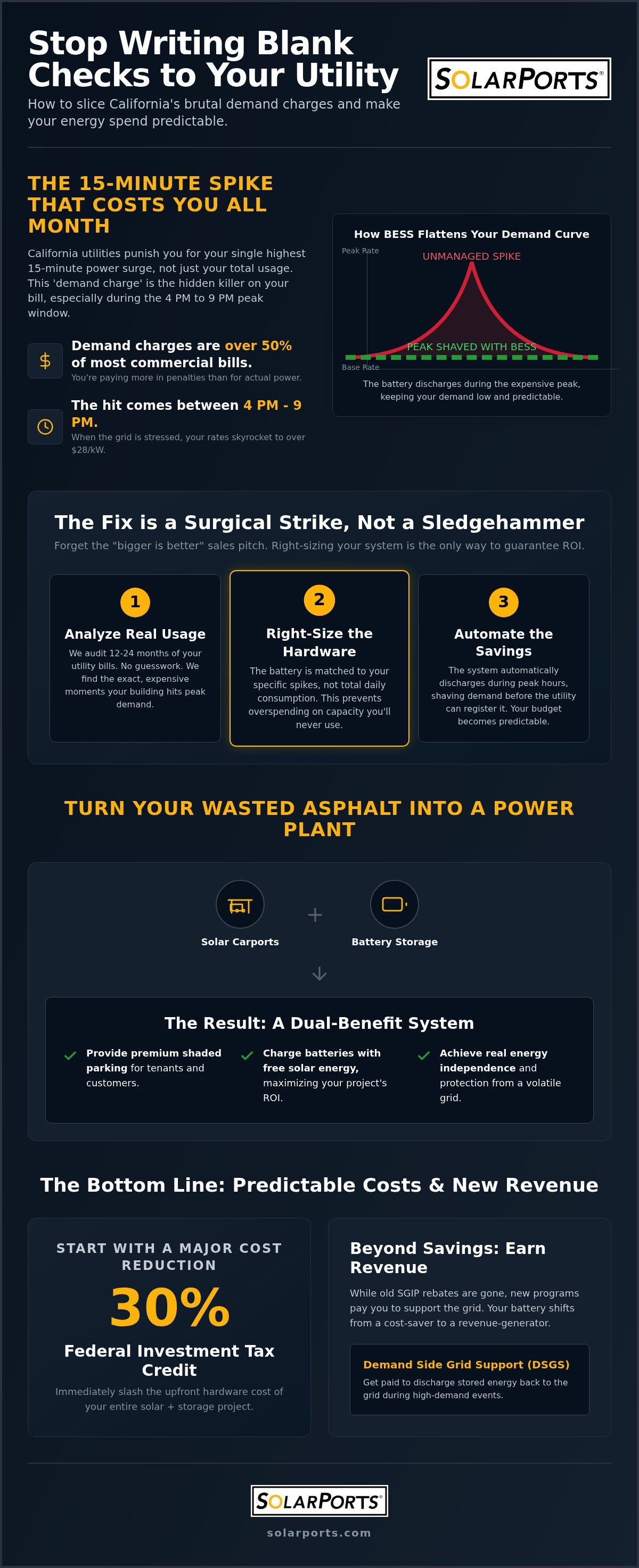
California utilities aren't just selling you electricity; they're selling you capacity. Demand charges often make up over 50% of a commercial bill, which is why a battery energy storage system is no longer a luxury. It's a defensive tool. Using commercial battery storage for peak shaving California properties is a surgical fix for an operational leak. Typically, this means discharging stored power from 4 PM to 9 PM, which is when the grid is most stressed and prices are highest.
Demand Charges vs. Consumption: Where Your Money Actually Goes
Think of consumption as the total distance you drive and demand as the top speed you hit. If you turn on every piece of heavy machinery at 4:30 PM, you hit a 15-minute spike. That one spike sets your demand charge for the entire month. In Northern California, summer demand charges can exceed $28 per kilowatt. A "Base Bill" reflects that peak, while a "BESS-Optimized Bill" uses stored energy to flatten the curve. By 2026, grid volatility and rising rates make this strategy essential for anyone trying to maintain a predictable budget.
Capacity management is the real game here. We see it in the data from every commercial property energy cost saving analysis we perform. Utilities like PG&E and SCE have structured their rates to punish unmanaged usage. If you don't have a system that automatically shaves these peaks, you're essentially handing over your profits to the utility. Commercial battery storage for peak shaving California operations ensures you only pay for the power you need, not the spikes you can't avoid.
Implementing BESS: Right-Sizing Your Storage Strategy
Most vendors want to sell you the biggest battery bank that can fit on your equipment pad. Don't let them. The biggest mistake in this market is over-building hardware that will never pay for itself. Effective commercial battery storage for peak shaving California isn't about daily consumption; it's about matching battery capacity to your specific spikes rather than your total daily usage. Buying more lithium than your ROI justifies is just another form of waste.
The Critical Role of Commercial Energy Cost Saving Analysis
You cannot guess your load profile. We perform a commercial energy cost saving analysis by auditing 12 to 24 months of utility data to find the exact points where your costs are highest. This data-driven approach prevents the "solar cowboy" tactic of selling as many panels and batteries as possible. We focus on the surgical removal of demand charges, not just adding hardware for the sake of it.
Site-specific load history is everything. This is especially true in Northern California where weather and grid demands shift wildly between the Bay Area and the Central Valley. We look at the granular history of your building to ensure the system is sized to protect your profit margins. A warehouse in Stockton has different needs than a retail center in San Francisco, and a generic system size will fail both of them. If you want to see how these numbers apply to your specific property, you can book a strategy session to review your utility history. It's about precision, not persuasion.
Deployment and ROI: Navigating the California Landscape
Deployment in this state is a bureaucratic hurdle race. A turnkey approach isn't a luxury; it's a necessity for managing the friction between initial analysis and final grid interconnection. We see more commercial real estate owners choosing small-scale, manageable energy projects over massive, risky infrastructure. These smaller systems are faster to permit and offer a much cleaner path to ROI. Using commercial battery storage for peak shaving California projects ensures you're attacking the most expensive parts of your bill without the risk of an over-engineered disaster.
Beyond Batteries: Integrating Solar Carports and Rooftop Arrays
Parking lots are usually the most underutilized assets on a commercial site. Installing solar carport systems turns that flat asphalt into a power plant. This setup provides a dual-benefit: you give your tenants vehicle shade while generating the "free" energy needed to charge your BESS. This synergy between rooftop solar and storage is the only real path to energy independence. It’s a core component of the broader strategies to lower commercial electricity bills California owners are using to stay profitable.
The financial math for 2026 is straightforward. You start with the 30% Federal Investment Tax Credit (ITC) to slash the upfront hardware cost. While general SGIP rebate funds have largely dried up for the mass market, new revenue streams like the Demand Side Grid Support (DSGS) program pay you to discharge your batteries during grid stress. This shifts the battery from a simple cost-saving tool to a proactive revenue asset. It’s a hard-nosed calculation that makes commercial battery storage for peak shaving California a mandatory move for your property’s bottom line.
Securing Your Operational Margins for 2026
The math on California utility rates isn't getting any friendlier. You can keep paying for those 15-minute spikes, or you can use data to stop the bleed. We've seen that success with commercial battery storage for peak shaving California depends entirely on the initial analysis, not just the hardware. By using our data-backed right-sizing methodology and integrating it with existing assets, you turn a complex liability into a predictable financial asset. Our California-specific expertise ensures you don't over-invest in equipment you'll never use. We handle the turnkey project management so you can focus on your actual business operations. It’s time to move from defense to offense on your energy spend.
Get Your Commercial Energy Cost Saving Analysis
Frequently Asked Questions
How much can peak shaving actually reduce my California commercial utility bill?
Peak shaving targets the demand charge portion of your bill, which frequently accounts for more than 50% of the total cost for California commercial properties. Implementing commercial battery storage for peak shaving California sites allows you to flatten usage spikes and reduce these specific charges by 30% or more. The exact savings depend on your facility's load profile determined through a granular audit.
What is the typical ROI for a commercial BESS installation in 2026?
Most commercial BESS projects in 2026 see a full return on investment within 7 to 10 years. This timeframe is significantly shorter than solar-only installations, which now take 10 to 15 years to pay back under NEM 3.0 rules. By utilizing commercial battery storage for peak shaving California operations, businesses avoid the low export rates of the current grid and maximize the value of every kilowatt generated.
Does peak shaving with battery storage require a solar installation?
No, you don't technically need solar panels to benefit from peak shaving, but the financial case is much weaker without them. A standalone battery can charge from the grid during low-cost hours and discharge during peak windows. However, combining storage with a rooftop or carport system allows you to charge with free energy, which drastically improves the project ROI and provides true energy independence.
How long does a commercial battery storage system last before needing replacement?
Modern commercial battery systems are typically engineered to last between 10 and 15 years depending on their daily cycle depth. Most manufacturers provide performance warranties that guarantee a specific percentage of capacity remains after a set number of years. Regular monitoring and proper right-sizing ensure the system isn't over-stressed, which helps preserve the hardware's integrity throughout its operational lifespan.
Frequently asked questions
How much can peak shaving actually reduce my California commercial utility bill?
Peak shaving targets the demand charge portion of your bill, which frequently accounts for more than 50% of the total cost for California commercial properties. Implementing commercial battery storage for peak shaving California sites allows you to flatten usage spikes and reduce these specific charges by 30% or more. The exact savings depend on your facility's load profile determined through a granular audit.
What is the typical ROI for a commercial BESS installation in 2026?
Most commercial BESS projects in 2026 see a full return on investment within 7 to 10 years. This timeframe is significantly shorter than solar-only installations, which now take 10 to 15 years to pay back under NEM 3.0 rules. By utilizing commercial battery storage for peak shaving California operations, businesses avoid the low export rates of the current grid and maximize the value of every kilowatt generated.
Does peak shaving with battery storage require a solar installation?
No, you don't technically need solar panels to benefit from peak shaving, but the financial case is much weaker without them. A standalone battery can charge from the grid during low-cost hours and discharge during peak windows. However, combining storage with a rooftop or carport system allows you to charge with free energy, which drastically improves the project ROI and provides true energy independence.
How long does a commercial battery storage system last before needing replacement?
Modern commercial battery systems are typically engineered to last between 10 and 15 years depending on their daily cycle depth. Most manufacturers provide performance warranties that guarantee a specific percentage of capacity remains after a set number of years. Regular monitoring and proper right-sizing ensure the system isn't over-stressed, which helps preserve the hardware's integrity throughout its operational lifespan.