
Bay Area Commercial BESS: A Strategic Guide to Energy Independence in 2026

Demand charges can now account for over 50% of your total electric bill. It's the financial reality for Northern California owners who watch margins vanish between 4 p.m. and 9 p.m. every day. Rates aren't going down. You've likely felt the sting of those unpredictable peak spikes that make monthly financial planning feel like guesswork. It's time to stop treating electricity as a fixed overhead and start treating it as a manageable asset.
This guide explains how a Bay Area commercial BESS helps you reclaim control over your operational expenses. We'll show you how the 30% federal tax credit and 100% bonus depreciation maximize your 2026 ROI. You'll also learn the specific steps to secure grid resiliency; we're covering everything from Title 24 mandates to the data you need to actually right-size your system.
Key Takeaways
- Target a 20% to 40% reduction in monthly demand charges. You will learn how to use stored power to bypass the most expensive utility rates in California.
- Leverage the 30% federal ITC and 100% bonus depreciation to front-load your returns. These incentives make standalone storage a viable strategy even if your roof isn't fit for solar.
- Navigate the 2026 Title 24 mandates for new construction. Integrated storage is now a legal requirement for most nonresidential projects over 10,000 square feet.
- Avoid the financial waste of an oversized system. A successful Bay Area commercial BESS relies on a precise energy cost saving analysis to match your specific load profile.
Table of Contents
- Why Bay Area Businesses are Pivoting to Commercial BESS in 2026
- Calculating the Strategic ROI: SGIP, ITC, and Demand Mitigation
- Navigating the Installation: From Analysis to Turnkey Deployment
Why Bay Area Businesses are Pivoting to Commercial BESS in 2026
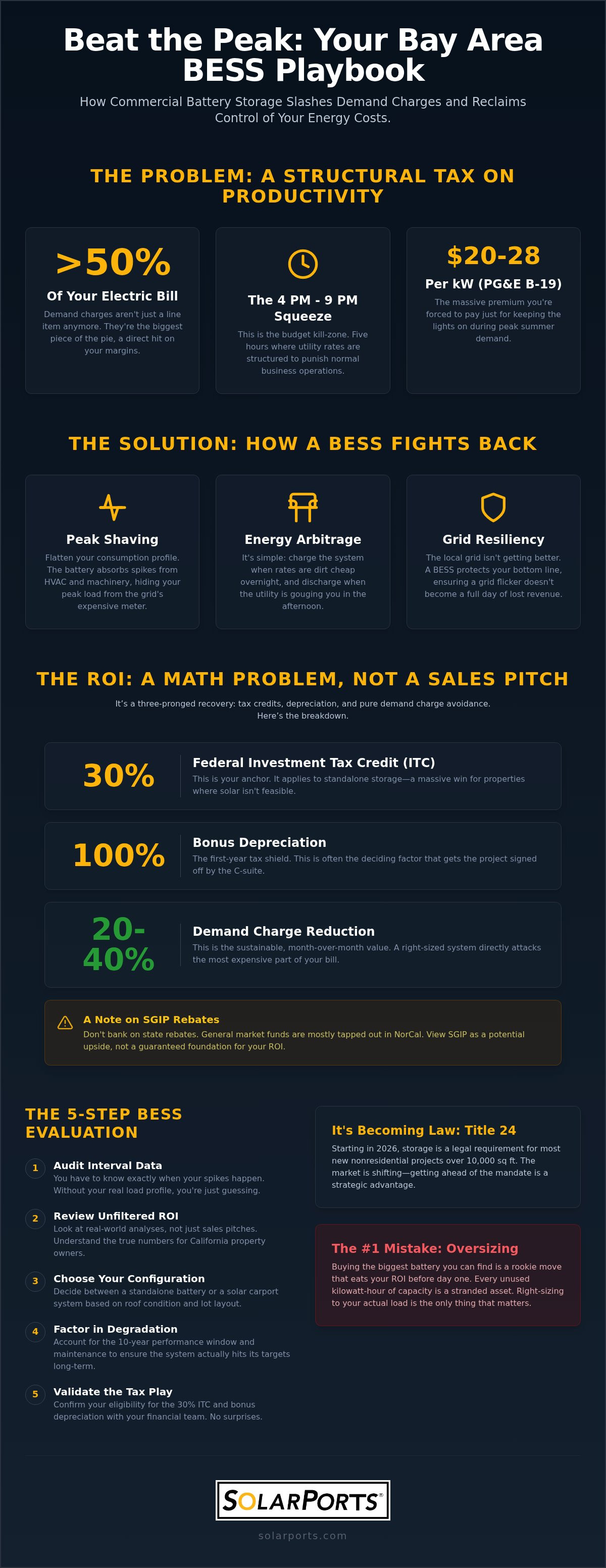
PG&E rates have reached a breaking point. For commercial properties across San Jose and Oakland, demand charges now frequently account for over 50% of the total electric bill. It’s a structural tax on productivity. Investing in a Battery Energy Storage System (BESS) isn't just a sustainability play; it's a defensive financial strategy. By deploying a Bay Area commercial BESS, you stop being a victim of the 4 p.m. to 9 p.m. peak window. During these hours, summer demand charges for B-19 plans can sit between $20 and $28 per kW. That is a massive premium for simply staying open.
The logic is simple: peak shaving and energy arbitrage. You use the battery to flatten your consumption profile. When your HVAC or heavy equipment spikes, the battery absorbs the impact instead of the grid. You charge the system when rates are at their floor and discharge when the utility is at its most expensive. It transforms electricity from a volatile, uncontrollable overhead into a predictable asset that you manage through commercial energy cost saving analysis. This isn't just about saving a few dollars; it's about decoupling your business from the utility’s pricing whims.
Grid Resiliency in the Face of Northern California Instability
The local grid isn't getting more reliable. Between aging infrastructure and planned outages, operational continuity is constantly at risk. In 2026, standalone storage is no longer a luxury; it’s becoming a standard requirement for high-value commercial leases. Tenants want to know their servers and climate controls won't die because of a local transformer failure. Plus, with Title 24 mandates now requiring storage for most new builds over 10,000 square feet, the market is shifting. A property equipped with a Bay Area commercial BESS offers that level of certainty. It protects your bottom line by ensuring that a grid flicker doesn't result in a full day of lost revenue.
Calculating the Strategic ROI: SGIP, ITC, and Demand Mitigation
ROI for a Bay Area commercial BESS is a math problem, not a sales pitch. You're looking at a three-pronged recovery: tax credits, depreciation, and demand charge avoidance. The 30% federal ITC is the anchor. In 2026, this credit applies to standalone storage, which is a massive win for properties where solar isn't feasible. When you layer in 100% bonus depreciation, the first-year tax shield often becomes the deciding factor for executive approval.
Don't bank on state rebates as your primary driver. The Self-Generation Incentive Program (SGIP) general market budgets are mostly tapped out in Northern California. It's better to view SGIP as a potential upside rather than a guaranteed foundation. Your sustainable value comes from mitigating demand charges, which can account for over 50% of your bill. A right-sized system typically reduces these charges by 20% to 40% by flattening your load profile during expensive peak windows.
Five Steps to Evaluating a Commercial BESS Investment
- Audit interval data: You need to see exactly when your spikes happen. If you don't know your load profile, you're guessing.
- Review the data: Consult our Commercial Solar ROI Analysis to see the unfiltered reality of these investments.
- Choose your configuration: Decide between a standalone battery or a solar carport system based on your roof condition and parking lot layout.
- Factor in degradation: Account for the 10-year performance window and routine maintenance to ensure the system actually hits its peak shaving targets.
- Validate the tax play: Confirm your eligibility for the 30% ITC and bonus depreciation with your financial team.
If you're ready to see how a Bay Area commercial BESS fits your specific property, you can schedule a tailored energy cost saving analysis to get the hard numbers.
Navigating the Installation: From Analysis to Turnkey Deployment
Buying the biggest battery you can find is a rookie mistake. It’s an expensive way to store air. An oversized Bay Area commercial BESS eats your ROI before the system even turns on. You need a system that matches your load, not your ego. We focus on the "Right-Sizing" imperative because every kilowatt-hour of unused capacity is a stranded asset. This is where the Federal Investment Tax Credit helps, but only if the underlying economics of the hardware make sense. If the system is too big, you're paying for capacity that never discharges.
Then there’s the paperwork. Northern California isn't exactly famous for streamlined bureaucracy. You're dealing with interconnection agreements and the updated 2026 fire safety standards that took effect on January 1. Most projects stall here because owners try to juggle three different vendors who don't talk to each other. A turnkey deployment isn't just a convenience; it's a schedule protector. It keeps your project from getting buried under a pile of municipal red tape and ensures your Bay Area commercial BESS actually goes online as planned.
The SolarPorts Development Approach to Commercial Energy Analysis
Our methodology at SolarPorts Development is rooted in hard data. We start with a Commercial Energy Cost Saving Analysis to map your exact usage patterns. We don't guess. By reviewing our past projects, you can see how we’ve integrated BESS with rooftop solar or carports for similar properties across San Jose and Oakland. We look for the "thinking fix" first. Sometimes that means staggering your equipment startup times to lower the initial load before we even spec the battery. It’s about structural efficiency, not just hardware.
Securing Your Operational Margins Through 2026
The era of passive utility dependence is over. You've seen how demand charges can cannibalize up to 50% of your budget, but you also have the tools to stop it. Deploying a Bay Area commercial BESS isn't just about hardware; it's about shifting your property into a high-efficiency asset. Between the 30% federal ITC and 100% bonus depreciation, the financial window for small-scale commercial real estate is wide open. We specialize in turnkey, California-exclusive deployments that prioritize data over guesswork. You don't need a massive industrial system; you need a right-sized solution that protects your bottom line during peak hours. It's time to transition from paying for utility instability to owning your energy future.
Request a Commercial Energy Cost Saving Analysis to see the hard numbers for your property. Let's build a more resilient foundation for your business today.
Frequently Asked Questions
What is the typical lifespan of a commercial BESS in the Bay Area?
Most systems are engineered for a 10 to 15 year operational life. It’s really about that 10 year performance window where the battery maintains enough capacity to hit your peak shaving targets. After a decade, you’ll see some degradation in efficiency. Proper thermal management and routine maintenance are what keep the system from hitting a performance wall early.
Can I install a battery system without adding solar panels to my commercial roof?
Yes, you can. Standalone storage is a legitimate strategy for properties with poor roof integrity or significant shading issues. In 2026, standalone Bay Area commercial BESS projects qualify for the 30% federal ITC. You simply charge the system from the grid during off peak hours when power is cheap and discharge it when those $28 per kW demand charges kick in.
How does the SGIP incentive work for businesses in Northern California in 2026?
It’s no longer the primary driver it once was. As of mid 2026, general market SGIP budgets for Northern California commercial applicants are effectively closed. You shouldn't build your financial model around it. Instead, focus on the 30% federal tax credit and 100% bonus depreciation. Those are the concrete incentives that actually move the needle on your ROI today.
What is the difference between peak shaving and energy arbitrage for commercial properties?
Peak shaving targets the highest spikes in your usage to lower demand charges; it’s about flattening the curve. Energy arbitrage is different. It’s a buy low, sell high strategy with power. You charge your Bay Area commercial BESS at midnight when rates are low and use that stored energy at 5 p.m. when PG&E rates are at their absolute highest.
Frequently asked questions
What is the typical lifespan of a commercial BESS in the Bay Area?
Most systems are engineered for a 10 to 15 year operational life. It’s really about that 10 year performance window where the battery maintains enough capacity to hit your peak shaving targets. After a decade, you’ll see some degradation in efficiency. Proper thermal management and routine maintenance are what keep the system from hitting a performance wall early.
Can I install a battery system without adding solar panels to my commercial roof?
Yes, you can. Standalone storage is a legitimate strategy for properties with poor roof integrity or significant shading issues. In 2026, standalone Bay Area commercial BESS projects qualify for the 30% federal ITC. You simply charge the system from the grid during off peak hours when power is cheap and discharge it when those $28 per kW demand charges kick in.
How does the SGIP incentive work for businesses in Northern California in 2026?
It’s no longer the primary driver it once was. As of mid 2026, general market SGIP budgets for Northern California commercial applicants are effectively closed. You shouldn't build your financial model around it. Instead, focus on the 30% federal tax credit and 100% bonus depreciation. Those are the concrete incentives that actually move the needle on your ROI today.
What is the difference between peak shaving and energy arbitrage for commercial properties?
Peak shaving targets the highest spikes in your usage to lower demand charges; it’s about flattening the curve. Energy arbitrage is different. It’s a buy low, sell high strategy with power. You charge your Bay Area commercial BESS at midnight when rates are low and use that stored energy at 5 p.m. when PG&E rates are at their absolute highest.