
Commercial Rooftop Solar in California: A Strategic 2026 Guide to Energy Independence

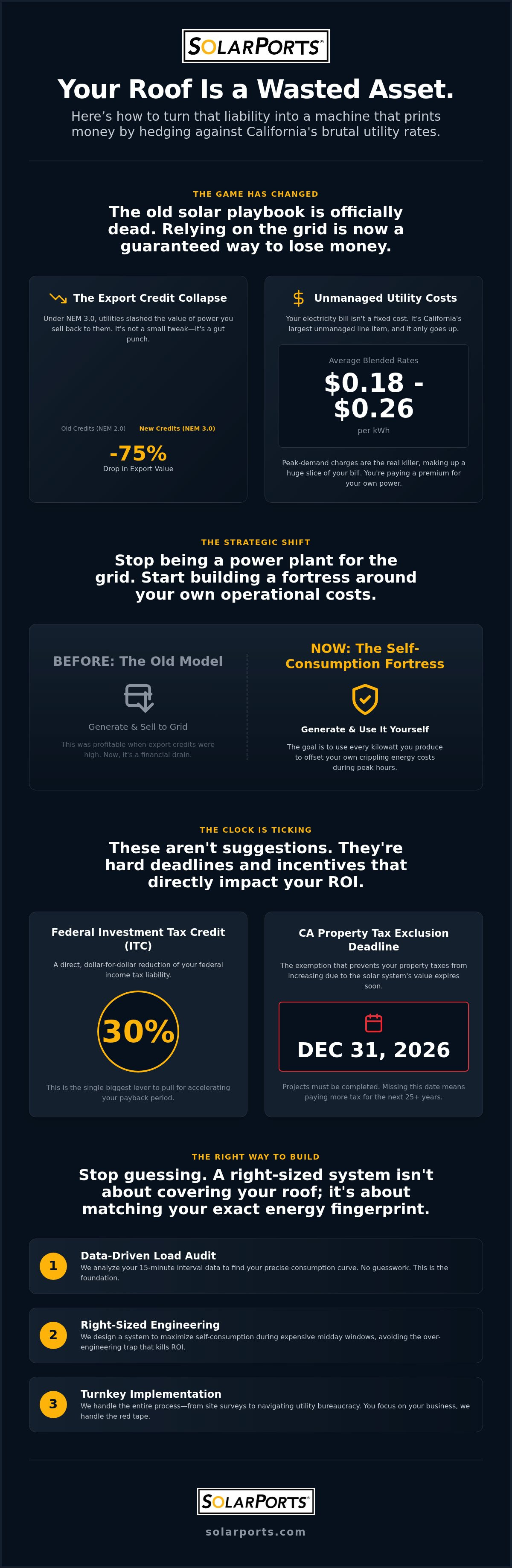
Your commercial roof is currently a liability that leaks capital every time California utilities hike their peak-demand rates. It's an underutilized asset sitting right above your operations. You've likely noticed that the old solar models don't work anymore. With NEM 3.0 slashing export credits by 75%, the focus has shifted from selling energy to the grid to ruthlessly protecting your own bottom line.
We agree that the regulatory landscape feels like a moving target, especially with the state property tax exclusion expiring on December 31, 2026. This guide explains how to navigate commercial rooftop solar California to achieve energy independence. You'll learn to deploy a system that prioritizes self-consumption and fiscal optimization over simple engineering specs. We're covering the exact steps to secure the 30% federal credit and build a turnkey solution that eliminates utility volatility without constant micromanagement.
Key Takeaways
- Stop viewing power as a fixed, uncontrollable cost. You need to treat your roof as a strategic hedge against California's increasing grid volatility.
- Use data-driven load audits to ensure your system is actually right-sized. Most businesses fall into the trap of buying over-engineered hardware that never hits its ROI targets.
- Navigate the 2026 regulatory shifts by leveraging the federal tax credit and meeting property tax exclusion deadlines for your commercial rooftop solar California project.
- Choose a turnkey implementation strategy that offloads the utility bureaucracy. You should be focusing on your core operations while the new asset stabilizes your long-term overhead.
Table of Contents
- The Strategic Case for Commercial Rooftop Solar in Californias 2026 Market
- Engineering a Right-Sized Solar Strategy for Your Property
- Navigating Implementation: From Site Survey to Long-Term ROI
The Strategic Case for Commercial Rooftop Solar in Californias 2026 Market
Electricity is often the largest unmanaged line item in a commercial budget. Most property owners just pay the bill and complain about the hikes. That's a mistake. In California's solar energy landscape, self-generation isn't a hobby; it's a mandatory hedge against utility volatility. Average blended rates are already hitting ranges of $0.18 to $0.26 per kWh. If you aren't producing your own power, you're essentially writing a blank check to the utility every month.
Strategic property owners now view commercial rooftop solar California as a targeted asset management play. It's about taking control of the one variable the utility keeps changing. With NEM 3.0 slashing export credits by 75%, the goal has shifted. You aren't trying to be a power plant for the grid. You're building a fortress around your operational costs before the property tax exclusion ends on December 31, 2026.
Beyond Sustainability: Solar as a Tool for Fiscal Optimization
Forget the marketing fluff about "going green." While carbon reduction is a nice side effect, the real play here is eliminating peak-demand charges. These fees can make up a massive portion of your bill. By deploying commercial rooftop solar California, you're locking in energy costs for the next two decades. It transforms your roof into a high-yield asset. It makes the property more attractive to premium tenants who are also tired of unpredictable overhead. For a detailed breakdown of how these numbers actually hit the ledger, see our commercial solar ROI analysis. This isn't just construction; it's a financial fix for a systemic operational leak.
Engineering a Right-Sized Solar Strategy for Your Property
Engineering a system isn't about covering every square inch of your roof. It's about matching production to your specific consumption curves. A massive system that exports 80% of its power is a financial disaster under current rules. You need a load audit that looks at your 15-minute interval data to find the sweet spot. This is how we avoid the over-engineering trap that many vendors push to pad their own margins.
For properties in Northern California, we have to look at the structural reality. Many older commercial buildings weren't built for the static load of modern arrays. We also factor in local shading issues and California's Building Energy Efficiency Standards to ensure full compliance. If the roof space is tight or the orientation is poor, we often look at solar carports to supplement the commercial rooftop solar California installation. It's a balancing act between available square footage and the highest possible yield.
The Role of Data-Driven Commercial Energy Cost Saving Analysis
You can't guess your way into a 10% IRR. A rigorous commercial energy cost saving analysis is the only way to see the actual impact on your P&L. SolarPorts Development rightsizes the footprint to your actual business hours. This ensures you're self-consuming the maximum amount of power during those expensive midday windows. It's worth looking into turnkey commercial solar CA options to see how this data translates into a live project. If you're ready to see what the numbers look like for your specific site, you can schedule a brief walkthrough of your energy load.
Navigating Implementation: From Site Survey to Long-Term ROI
Implementation is usually where the wheels fall off. Between utility interconnection queues and local permit offices, the bureaucracy can swallow a project whole. A turnkey model ensures your operations don't skip a beat while we handle the red tape. This is especially vital for commercial rooftop solar California projects where the regulatory barrier is high. You want a partner who manages the commercial solar installation timeline with precision, not excuses.
Speed is a financial necessity now. To maximize your internal rate of return, you need to leverage the commercial solar tax credit California before the 2026 deadlines shift. It’s about accelerating that payback period so the asset starts contributing to the bottom line sooner. Our goal is to move from site survey to commissioning without the typical construction delays that plague unmanaged vendors.
Integrating BESS and Carports for Maximum Resilience
Solar panels alone are only half the solution in 2026. Without a Battery Energy Storage System (BESS), you're still exposed to the utility's evening peak-demand spikes. The latest research on demand charge savings confirms that storage is the primary lever for cutting those costs. We often pair rooftop arrays with carports to hit the necessary capacity. You can see these integrated systems in action by reviewing our recent projects. It's a comprehensive approach that ensures you aren't just making power, but using it when the grid is most expensive.
Securing Your Fiscal Future Above the Roofline
The era of passive utility spending is over. Missing the 2026 window means losing the property tax exclusion and paying more for the same infrastructure. We've established that commercial rooftop solar California is a strategic asset management play, not just a hardware install. You need a system calibrated to your specific load profile so you aren't exporting cheap power while paying for peak-demand spikes.
SolarPorts Development specializes in Northern California commercial real estate with a turnkey process that manages everything from audit to activation. We use data-driven rightsizing to protect your ROI. It's time to stop treating energy as an unmanaged operational leak and start treating your roof as a financial engine.
Ready to see the actual numbers for your site? Request a Strategic Energy Cost Saving Analysis to begin your transition.
Frequently Asked Questions
Is my commercial roof in Northern California suitable for solar?
Suitability usually comes down to structural load and orientation. Most flat-roof commercial buildings in Northern California are ideal, but we have to watch for mechanical obstructions like HVAC units that cast shadows. If your roof is old, it's smarter to swap it during the solar install. This prevents you from paying to pull the panels off later. We verify this during the audit.
How long is the typical payback period for a commercial solar system in 2026?
You're likely looking at a payback period between five and seven years. This timeline is driven by the 30% federal tax credit and the 20% bonus depreciation available in 2026. Since California's utility rates are climbing, the energy you don't buy from the grid pays for the system faster. We'll give you a data-driven report that shows the exact break-even month.
Will solar installation disrupt my daily business operations?
Disruption is almost zero with a turnkey strategy. Most construction for commercial rooftop solar California happens on the roof or in the electrical room. We handle the crane lifts and staging during off-peak hours so your tenants don't lose parking or access. You won't have to shut down your business or deal with construction crews wandering through your office space.
What is the difference between small-scale commercial solar and utility-scale projects?
Small-scale solar is "behind-the-meter," meaning the power stays on-site to run your business. Utility-scale projects are massive power plants that sell electricity back to the grid. We focus on the small-scale side. Our goal is helping property owners kill their own utility bills rather than trying to compete with the big power companies as a wholesale energy provider.
Frequently asked questions
Is my commercial roof in Northern California suitable for solar?
Suitability usually comes down to structural load and orientation. Most flat-roof commercial buildings in Northern California are ideal, but we have to watch for mechanical obstructions like HVAC units that cast shadows. If your roof is old, it's smarter to swap it during the solar install. This prevents you from paying to pull the panels off later. We verify this during the audit.
How long is the typical payback period for a commercial solar system in 2026?
You're likely looking at a payback period between five and seven years. This timeline is driven by the 30% federal tax credit and the 20% bonus depreciation available in 2026. Since California's utility rates are climbing, the energy you don't buy from the grid pays for the system faster. We'll give you a data-driven report that shows the exact break-even month.
Will solar installation disrupt my daily business operations?
Disruption is almost zero with a turnkey strategy. Most construction for commercial rooftop solar California happens on the roof or in the electrical room. We handle the crane lifts and staging during off-peak hours so your tenants don't lose parking or access. You won't have to shut down your business or deal with construction crews wandering through your office space.
What is the difference between small-scale commercial solar and utility-scale projects?
Small-scale solar is "behind-the-meter," meaning the power stays on-site to run your business. Utility-scale projects are massive power plants that sell electricity back to the grid. We focus on the small-scale side. Our goal is helping property owners kill their own utility bills rather than trying to compete with the big power companies as a wholesale energy provider.