
Commercial Battery Storage for California Warehouses: The 2026 Strategic Reality

Paying over $28 per kilowatt in summer demand charges is no longer a worst case scenario for Northern California warehouse operators; it's the current baseline. It feels like you're being punished just for keeping the lights on. Many owners are now looking at commercial battery storage for warehouses California as the only logical way to stop the bleeding. You’ve likely realized that the old safety nets like SGIP are gone, leaving you to face some of the highest utility rates in the country with zero backup. It’s a brutal financial reality that makes "business as usual" look like a liability.
This article shows you how to turn your energy bill into a controlled asset by using BESS to dodge those peak charges. We aren't here to talk about vague sustainability goals. We're focused on the 2026 strategic reality of Title 24 compliance and bottom-line protection. You will see how a proper energy cost saving analysis from SolarPorts Development prevents over-spending on hardware while ensuring your facility stays operational when the grid stumbles. We are moving away from a world of optional incentives and into an era of strategic necessity.
Key Takeaways
- Demand charges aren't just a line item; they often account for over half of a California warehouse's total electric bill. You'll learn how to identify and neutralize the 4 PM to 9 PM price spikes that drain your margins.
- The "bigger is better" mentality is a dangerous myth that leads to wasted capital and systems that never pay for themselves. We explain why right-sizing your system through a rigorous energy cost saving analysis is the only way to protect your ROI.
- New Title 24 mandates mean solar and batteries are no longer optional for most new warehouse builds. We show you how to satisfy these requirements without over-complicating your facility's infrastructure.
- Integrating commercial battery storage for warehouses California with solar carport systems allows you to generate and store power without sacrificing a single square foot of indoor floor space.
- Managing multiple vendors for solar, BESS, and electrical work is a recipe for expensive delays and technical friction. You'll see why a turnkey approach is the only way to ensure your hardware and software work together from day one.
Table of Contents
- Why California Warehouses are Getting Hammered by Demand Charges
- Right-Sizing BESS: Title 24 Compliance and ROI for Warehouses
- The SolarPorts Development Approach: Turning Energy Costs into Operational Assets
Why California Warehouses are Getting Hammered by Demand Charges
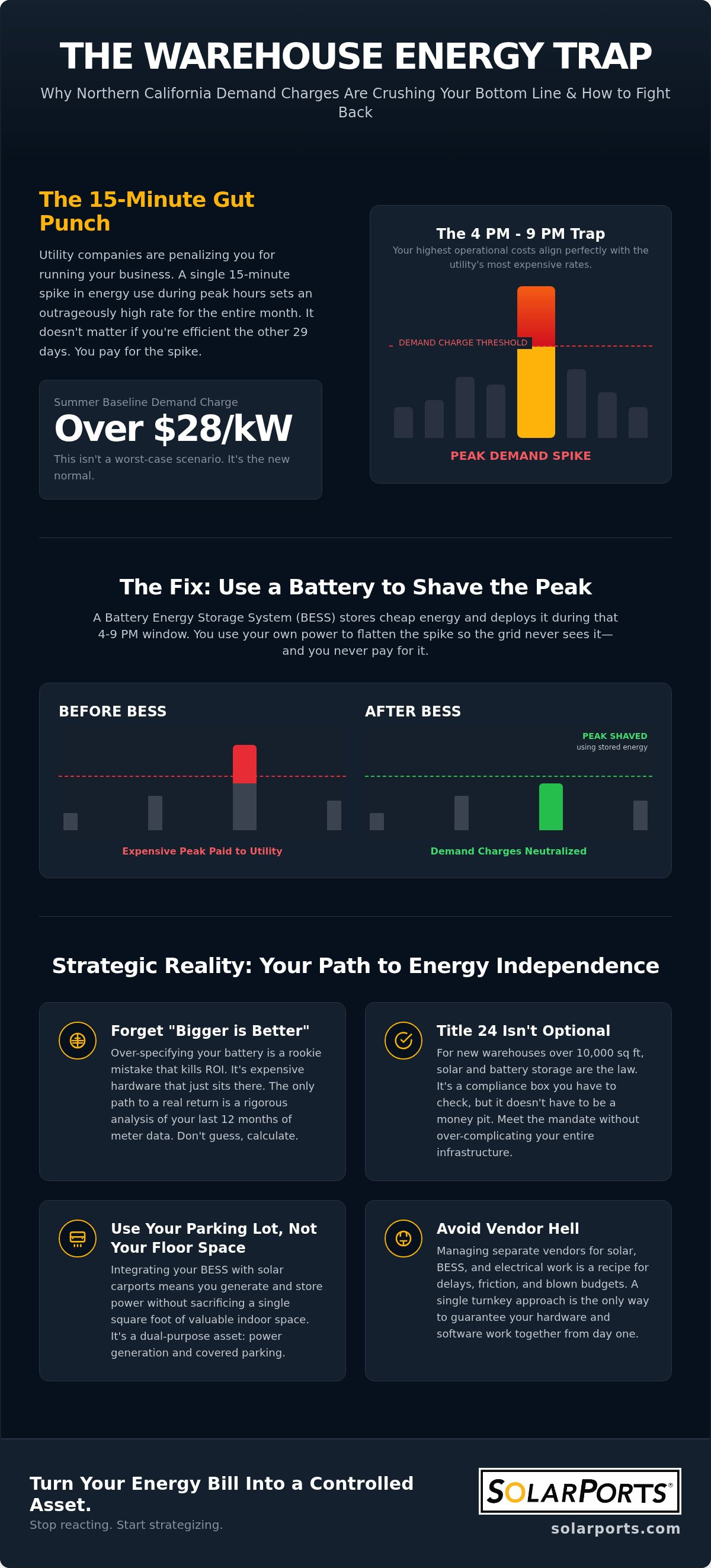
Demand charges aren't just a small line item; they're often over half of what you're paying on a Northern California electric bill. It's a massive hit to the budget that feels like a penalty for actually running your business. If your warehouse pulls a heavy load for just fifteen minutes during a peak window, you're stuck with that inflated rate for the whole month. It doesn't matter if you're efficient the other 29 days. You're paying for that one spike.
The 4 PM to 9 PM trap is where PG&E really gets you. Most late-shift operations are buying power exactly when the utility wants it least, so they charge you a premium for it. This is where a Battery Energy Storage System (BESS) actually earns its keep. You store energy when it's cheap and then use it to "shave" the top off your demand. Look, the whole point of peak shaving is just staying under that utility cap. You use the battery to eat the spike so the grid never even sees it, which keeps the most expensive kilowatt-hours off your books entirely.
Grid volatility isn't a theory anymore. We've seen it every summer when the grid starts to buckle under the load. Investing in commercial battery storage for warehouses California is basically insurance against a utility provider that can't guarantee stability. When the grid fluctuates, your operations shouldn't have to stop just to save on costs.
The 2026 Utility Reality in Northern California
The shift to the Net Billing Tariff (NBT) changed the math for everyone. Standalone solar doesn't cut it anymore because the utility won't pay you a fair price for the power you send back. You have to keep what you generate. Pairing solar with a battery ensures you're using your own power instead of giving it away for pennies while still paying full price at night. To optimize this, high-efficiency solutions from Nippon Energy can help you capture more power to store and use when rates are at their highest.
Summer Heatwaves and Cooling Costs
Heatwaves are the new normal. When the temperature spikes, your cooling systems work harder and your demand charges skyrocket instantly. Managing these surges through a comprehensive energy cost saving analysis is how you stop reacting to the bill and start controlling the asset. It's about protecting your bottom line when the weather is at its worst.
Right-Sizing BESS: Title 24 Compliance and ROI for Warehouses
Compliance is just a box you have to check, but don't let it become a money pit for your commercial battery storage for warehouses California project. Since we're in 2026, the Title 24 code is the law for any new warehouse over 10,000 square feet. You don't get to skip the battery anymore. But here's the thing: most people are over-specifying because they're scared of under-sizing. Buying too much battery is just as bad for your ROI as buying none at all. It's expensive hardware that just sits there doing nothing.
You've got to actually look at the math before you cut a check. Honestly, you're flying blind unless you run a commercial energy cost saving analysis to see what your facility actually pulls from the grid and what your discharge needs really look like. It's about being precise. You also have to deal with the fire marshal, and having UL9540A certification is basically your only ticket to getting that local fire department permit approved without a massive headache.
Navigating these safety codes is easier when you work with experienced local contractors. For instance, Firemex Solutions Inc. specializes in fire sprinkler systems for industrial facilities, helping owners manage the broader fire safety requirements that often overlap with energy storage permitting.
Steps to Calculate Your Warehouse Storage Needs
You need a strategy that's based on your actual meter data, not a salesperson's best guess.
- Look at 12 months of interval data to find the highest 15-minute spikes that are currently driving your demand charges.
- Figure out the "critical load" required to keep refrigeration or automated sorting running during a shut-off.
- Check out our commercial solar ROI analysis to see how these capital costs translate into long-term fiscal projections.
If you're tired of guessing which system size will actually move the needle, book a technical review of your interval data so we can look at the unfiltered math for your property together.
The SolarPorts Development Approach: Turning Energy Costs into Operational Assets
Managing multiple vendors for solar, BESS, and electrical work is a recipe for failure. One contractor blames the inverter, the other points at the wiring, and you are left paying the utility bill while they argue on your loading dock. SolarPorts Development eliminates this friction by providing a single point of accountability from the first data pull to the final permit. This is the foundation of our turnkey commercial solar CA model. We don't just drop hardware on your site; we build an integrated system where the software and switchgear actually talk to each other.
Integrating BESS with solar carport systems is often the most logical move for warehouses with structural roof constraints or limited indoor square footage. You are already paying for the parking lot. You might as well turn that asphalt into a power plant that shades your employees' vehicles. Our modular designs also ensure you aren't locked into your 2026 capacity forever. If you add a fleet of electric delivery vans or expand your late-shift operations, your commercial battery storage for warehouses California can scale right along with your load requirements.
Maximizing Incentives and the 2026 Tax Landscape
The financial landscape for storage has shifted significantly this year. While the 30% Federal Investment Tax Credit (ITC) remains a primary driver for commercial projects, the local rebate scene is tighter. As of July 2026, most SGIP budgets are closed to new general market applicants. This means your ROI strategy must rely on aggressive peak shaving and federal tax benefits rather than state-level checks that may no longer be available. We help you navigate these filings to ensure every available dollar is captured.
Next Steps: From Analysis to Activation
You cannot skip the physical site walk-through. We have to evaluate your existing switchgear capacity to see if it can handle the discharge rates of a modern BESS without a costly main service upgrade. Once the technical specs are locked, we finalize the commercial solar installation timeline to keep your facility running. The goal is a seamless transition where the only thing that changes is the size of your monthly utility check.
Securing Your Facility’s Financial Future in 2026
The 2026 energy landscape isn't getting any easier for warehouse operators. You're facing higher rates and stricter Title 24 mandates every year. But commercial battery storage for warehouses California shouldn't be viewed as a burden. It's the most effective tool you have to dismantle those 4 PM to 9 PM demand charges that gut your operational budget. By right-sizing your system and avoiding the multi-vendor blame game, you turn a volatile utility expense into a predictable, managed asset.
We specialize in mid-sized commercial real estate because we know the granular nuances of the California market. Our team provides the California-specific regulatory expertise and turnkey BESS and solar integration you need to stay compliant without wasting capital. It's about precision over persuasion. You need a system that works from day one without the technical friction that stalls most industrial projects.
It is time to stop guessing about your ROI. Request Your Data-Driven Energy Cost Saving Analysis to see the unfiltered math for your property. Let’s move your facility toward energy independence and long-term fiscal stability.
Frequently Asked Questions
Is battery storage mandatory for California warehouses in 2026?
Yes, it is mandatory for most new nonresidential construction projects over 10,000 square feet. The 2025 update to California’s Title 24 Energy Code, which went into effect on January 1, 2026, requires both solar PV and battery storage for new warehouses. This isn't just about sustainability. It's a regulatory hurdle you have to clear to get your certificate of occupancy. If you're retrofitting an existing building, the mandate doesn't apply yet, but the financial pressure from utilities often makes it feel just as mandatory.
How much can a BESS system actually reduce a warehouse electricity bill?
A well-sized system typically targets the demand charge portion of your bill, which can represent over half of your total monthly cost. By using commercial battery storage for warehouses California to cap your peak draw during expensive windows, you're effectively deleting the most expensive kilowatt-hours from your statement. The actual savings vary based on your load profile. Facilities with heavy late-shift operations or massive cooling needs see the fastest ROI because they have the most aggressive peaks to shave.
What is the typical lifespan of a commercial battery storage system?
You should expect a lifespan between 10 and 15 years for most industrial-grade battery systems. The actual longevity depends on your discharge depth and how many cycles the system runs per day to manage your peaks. Most manufacturers provide warranties that guarantee a certain percentage of capacity retention over a decade. It's an asset that requires monitoring—similar to how maintaining clean panels ensures maximum energy capture—and for specialized support in other markets, you can visit Texas Engineered Solar LLC to see how professional care extends system life. Modern thermal management has made these systems much more durable than the technology available just a few years ago.
Can I install battery storage without having solar panels on my warehouse?
Yes, standalone battery storage is a viable strategy for facilities that cannot support rooftop solar. You can charge the batteries during off-peak hours when rates are lowest and discharge them when the utility hits you with peak-demand pricing. This is a pure financial arbitrage play. While pairing with solar is common, a standalone BESS still qualifies for federal tax credits in 2026, making it a powerful tool for buildings with structural roof limitations or shaded parking lots.
Frequently asked questions
Is battery storage mandatory for California warehouses in 2026?
Yes, it is mandatory for most new nonresidential construction projects over 10,000 square feet. The 2025 update to California’s Title 24 Energy Code, which went into effect on January 1, 2026, requires both solar PV and battery storage for new warehouses. This isn't just about sustainability. It's a regulatory hurdle you have to clear to get your certificate of occupancy. If you're retrofitting an existing building, the mandate doesn't apply yet, but the financial pressure from utilities often makes it feel just as mandatory.
How much can a BESS system actually reduce a warehouse electricity bill?
A well-sized system typically targets the demand charge portion of your bill, which can represent over half of your total monthly cost. By using commercial battery storage for warehouses California to cap your peak draw during expensive windows, you're effectively deleting the most expensive kilowatt-hours from your statement. The actual savings vary based on your load profile. Facilities with heavy late-shift operations or massive cooling needs see the fastest ROI because they have the most aggressive peaks to shave.
What is the typical lifespan of a commercial battery storage system?
You should expect a lifespan between 10 and 15 years for most industrial-grade battery systems. The actual longevity depends on your discharge depth and how many cycles the system runs per day to manage your peaks. Most manufacturers provide warranties that guarantee a certain percentage of capacity retention over a decade. It's an asset that requires monitoring, but modern thermal management has made these systems much more durable than the technology available just a few years ago.
Can I install battery storage without having solar panels on my warehouse?
Yes, standalone battery storage is a viable strategy for facilities that cannot support rooftop solar. You can charge the batteries during off-peak hours when rates are lowest and discharge them when the utility hits you with peak-demand pricing. This is a pure financial arbitrage play. While pairing with solar is common, a standalone BESS still qualifies for federal tax credits in 2026, making it a powerful tool for buildings with structural roof limitations or shaded parking lots.