
Commercial Energy Audit Checklist California: A Strategic 2026 Guide

California commercial ratepayers paid $21.2 billion more for electricity than the rest of the country last year. That isn't just a "cost of doing business" inconvenience; it's a structural failure in how most properties manage their load. If you're staring at a PG&E or SCE bill where demand charges represent nearly half of the total, you already know that generic advice won't solve the problem. Using a rigorous commercial energy audit checklist California executives can rely on is the only way to stop overpaying for power you aren't even using.
We understand the skepticism toward "green" initiatives that offer more PR than ROI. You need a strategy that handles AB 802 compliance by the June 1st deadline while identifying the specific efficiency leaks and demand charge traps unique to your building. This guide provides a clear roadmap for 2026. We'll show you how to move past the compliance hurdle to find high-impact projects that lower operational overhead and protect your bottom line from the next inevitable rate hike.
Key Takeaways
- Establish a 24-month weather-normalized baseline to keep your AB 802 reporting accurate ahead of the June 1st deadline.
- Use this commercial energy audit checklist California to find the HVAC set-point errors and envelope leaks that are driving your peak demand.
- Rank your potential upgrades by simple payback periods so you're focusing on fiscal ROI rather than just generic green advice.
- Turn your audit findings into action by right-sizing a Battery Energy Storage System (BESS) to shave the demand charges that eat your margin.
Table of Contents
- The California Baseline: Benchmarking and Data Preparation
- The Physical Audit Checklist: Systems, Envelope, and Demand Leaks
- From Audit to ROI: Executing the Strategic Fix
The California Baseline: Benchmarking and Data Preparation
You can't fix what you haven't measured. Most property owners treat utility bills like a tax they just have to pay, but that's a mistake that costs thousands. A real What is an energy audit? starts with a forensic look at 12 to 24 months of raw data. We aren't just looking at the total cost. We're looking for the weather-normalized baseline. This tells us how your building reacts when a heat wave hits the Central Valley or a cold snap settles in the Bay Area. Without this data, your commercial energy audit checklist California is just a piece of paper.
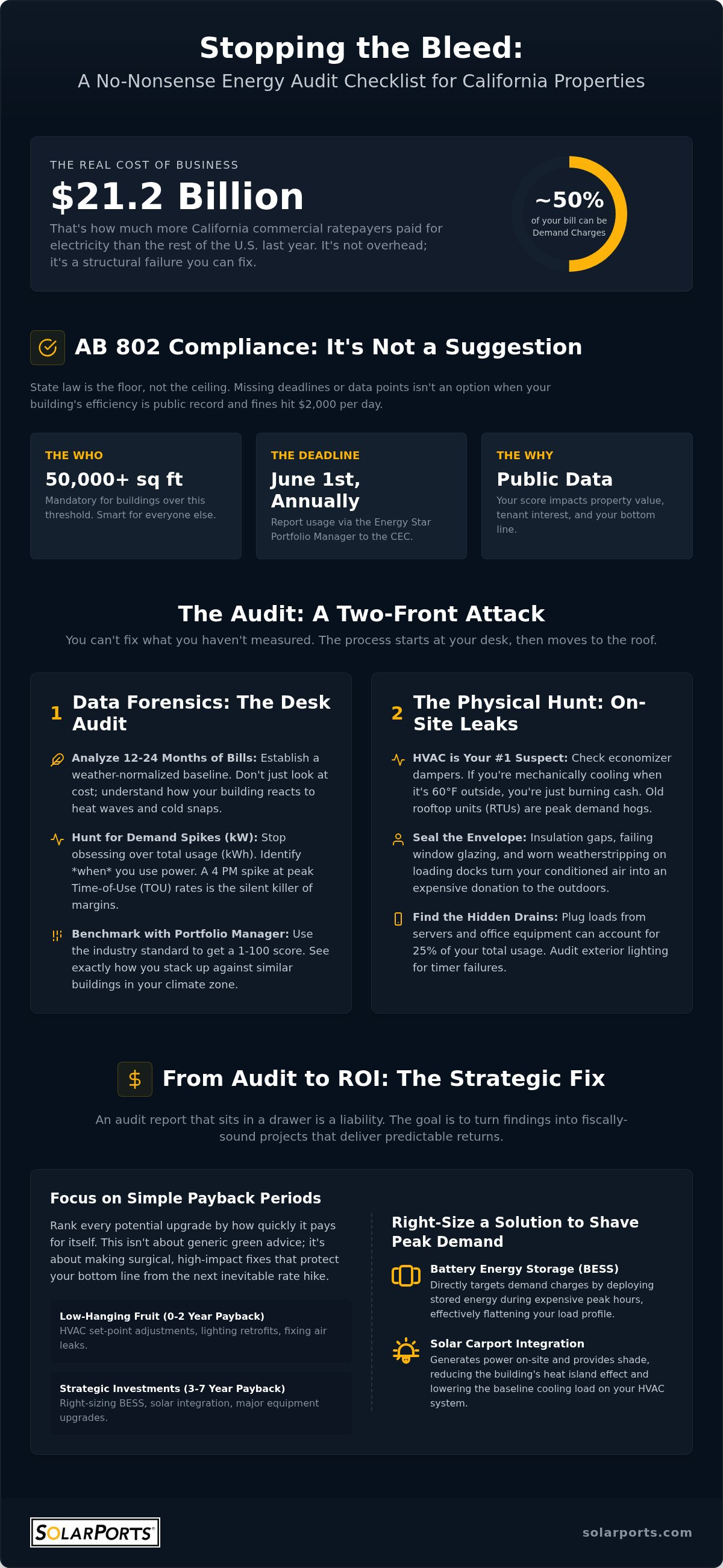
If your building is over 50,000 square feet, AB 802 isn't a suggestion. It's a mandate. You have until June 1st every year to report your usage via Energy Star Portfolio Manager. The California Energy Commission (CEC) publishes this data, which means your efficiency, or lack thereof, is public record. It impacts property value and tenant interest. If you're below that threshold, you should still use Portfolio Manager. It’s the industry standard for a reason; it gives you a 1-100 score that tells you exactly where you stand against similar buildings in our specific climate zones.
Utility Bill Forensics
Look at your PG&E or SCE bill. Stop focusing only on the kilowatt-hours (kWh). Focus on the demand charges (kW). In California, where average commercial rates sit around 25.75¢/kWh, demand charges are the silent killer of margins. We analyze Time-of-Use (TOU) patterns to see if your building spikes at 4:00 PM when rates are highest. This granular look is the first step in a commercial property energy cost saving analysis. It reveals whether your costs are driven by total consumption or just bad timing.
California Regulatory Compliance
State law is the floor, not the ceiling. San Francisco requires benchmarking for buildings as small as 10,000 square feet and audits every five years. Berkeley and Los Angeles have their own strict ordinances that affect everyone from industrial warehouses to premier Hollywood event spaces like Serra On Vine. Don't get caught with a $2,000 per day fine for missing a data category. Automate your data sharing with the CEC through Portfolio Manager. It's a one-time setup that prevents a recurring administrative nightmare and keeps you compliant without the manual data entry.
The Physical Audit Checklist: Systems, Envelope, and Demand Leaks
Once you've nailed down your baseline data through California's Benchmarking Program, it's time to get on the roof. A commercial energy audit checklist California property managers actually use isn't just about counting lightbulbs. It's about finding where your money is physically bleeding out of the structure. We start with a high-level walk-through to catch the obvious stuff like compressed air leaks or old T12 lighting, but the real savings are deeper than that.
Don't ignore the building envelope. Insulation gaps and failing window glazing turn your building into a sieve. Then there's the plug load problem. Between server rooms and office equipment that stays on 24/7, these hidden drains can account for 25% of your total usage. It adds up fast. If you're tired of guessing which system is killing your budget, you can book a strategic walkthrough to see where your specific demand traps are hidden.
HVAC and Mechanical Systems
Your HVAC system is likely the single biggest driver of your peak demand. In Northern California, we have massive diurnal temperature swings. If your economizers aren't functioning, you're paying to mechanically cool a building when the outside air is 60 degrees. It's a waste of money. Check the age of your rooftop units (RTUs). If you're running equipment with SEER ratings from 15 years ago, you're essentially burning cash to stay compliant with 2026 efficiency standards. For businesses that need to maintain strict temperature control during system upgrades or special events without adding to the building's permanent load, you can learn more about KC Frost Wagon and their mobile cooling solutions.
The 'Demand Charge' Hunt
This is where most audits fail. You need to identify large equipment that kicks on simultaneously. If your chillers and heavy machinery start at the same time, you're hitting an artificial peak that SCE or PG&E will penalize you for all month long. This is the perfect time to look at your parking lot. A solar carport integration doesn't just generate power; it provides shade that reduces the heat island effect around your building, lowering the cooling load before it even hits your HVAC.
Quick Physical Checklist:- Inspect HVAC economizer dampers for full range of motion.
- Check weatherstripping on all loading dock doors and secondary exits.
- Verify that server room cooling isn't fighting the main building set-points.
- Audit exterior lighting for photocell or timer failures.
From Audit to ROI: Executing the Strategic Fix
An audit report that sits in a drawer is a liability, not an asset. You've used the commercial energy audit checklist California to find the leaks; now you have to rank the remedies. We prioritize Energy Conservation Measures (ECMs) based on a cold, hard look at the simple payback period. If a mechanical upgrade doesn't pay for itself within a tight financial window, it's a distraction. Focus your capital on the projects that yield the highest immediate reduction in operational overhead.
The most effective way to neutralize the demand charges we identified earlier is a Battery Energy Storage System (BESS). This isn't about backup power. It's about data-driven load shifting. By using your audit data to right-size the capacity, you can shave those expensive 4:00 PM peaks without over-investing in hardware you don't need. You should also evaluate your site's structural reality. If your roof is nearing its end of life, a solar carport might be the smarter strategic move to avoid reroofing complications while still securing your energy independence.
Right-Sizing Your Solution
A "one-size-fits-all" solar array is a common trap that usually fails the ROI test. You aren't trying to build a power plant; you're trying to optimize a specific financial asset. Precision matters here. We match battery and solar capacity to the exact demand "spikes" found in your audit, ensuring you aren't paying for excess capacity that never sees a return.
California Incentives and Financing
Navigating the 2026 federal tax credit rules and state-level SGIP rebates requires a specialized eye. These incentives can cover a significant portion of your storage costs if you apply before the funding blocks disappear. The goal is a seamless transition from the initial data gathering to a turnkey installation. You want the savings without the project management headache or operational downtime.
Secure Your Operational Bottom Line
Your utility bill shouldn't be an unpredictable liability. By moving from simple AB 802 compliance to a deep-dive physical inspection, you've already done more than most of your competitors to stabilize your overhead. The real shift happens when you stop viewing energy as a fixed cost and start treating it as a manageable operational variable. Whether it's fixing a short-cycling HVAC unit or deploying a BESS to crush those 4:00 PM demand spikes, every step in this commercial energy audit checklist California guide is designed to protect your margins.
Protecting those margins also involves optimizing broader operational costs. For instance, many leading property owners—such as those on the East Coast who partner with RPS Building Services—find that pairing energy efficiency with professional janitorial solutions is the key to maintaining a high-value, low-cost asset.
Generic solutions won't work in Northern California's complex rate environment. You need a strategy backed by data-driven ROI modeling and local expertise that understands how to navigate SCE and PG&E's specific traps. Don't wait for another double-digit rate hike to force your hand. Get a No-Nonsense Commercial Energy Cost Saving Analysis today to see exactly how much you can reclaim from your utility company. It's time to turn your property into a high-efficiency asset that finally works for you.
Frequently Asked Questions
How much does a commercial energy audit cost in California?
Audit costs fluctuate based on the building's total square footage and the complexity of its mechanical systems. A simple walk-through is less intensive than an investment-grade analysis that requires deep engineering hours. It's best to view the audit as a strategic financial tool; the objective is to uncover savings that far outweigh the cost of the initial data gathering.
What is the difference between an ASHRAE Level 1 and Level 2 audit?
A Level 1 audit is a preliminary walk-through designed to spot obvious waste like lighting inefficiencies or basic envelope leaks. A Level 2 audit is much more comprehensive, involving a full system inventory and a granular breakdown of your utility data. For a commercial energy audit checklist California property owners use to justify major capital projects, a Level 2 audit provides the necessary data for accurate ROI modeling.
How long does a typical energy audit take for a commercial property?
The site visit itself usually wraps up in a single day, but the technical analysis and report delivery often take two to four weeks. This timeline depends on your team's ability to provide 24 months of utility data and clear access to all mechanical spaces. A thorough commercial energy audit checklist California requires time to cross-reference your actual usage against the 2026 rate structures used by PG&E or SCE.
Can an energy audit help my business avoid California's peak demand charges?
Yes, an audit identifies the specific equipment and operational habits that create your highest load spikes. Once you know exactly when your building hits its peak, you can implement load-shifting strategies to stay below expensive utility thresholds. This data is the foundation for right-sizing a Battery Energy Storage System (BESS) to shave demand charges during the high-cost 4:00 PM to 9:00 PM window.
Frequently asked questions
How much does a commercial energy audit cost in California?
Audit costs fluctuate based on the building's total square footage and the complexity of its mechanical systems. A simple walk-through is less intensive than an investment-grade analysis that requires deep engineering hours. It's best to view the audit as a strategic financial tool; the objective is to uncover savings that far outweigh the cost of the initial data gathering.
What is the difference between an ASHRAE Level 1 and Level 2 audit?
A Level 1 audit is a preliminary walk-through designed to spot obvious waste like lighting inefficiencies or basic envelope leaks. A Level 2 audit is much more comprehensive, involving a full system inventory and a granular breakdown of your utility data. For a commercial energy audit checklist California property owners use to justify major capital projects, a Level 2 audit provides the necessary data for accurate ROI modeling.
How long does a typical energy audit take for a commercial property?
The site visit itself usually wraps up in a single day, but the technical analysis and report delivery often take two to four weeks. This timeline depends on your team's ability to provide 24 months of utility data and clear access to all mechanical spaces. A thorough commercial energy audit checklist California requires time to cross-reference your actual usage against the 2026 rate structures used by PG&E or SCE.
Can an energy audit help my business avoid California's peak demand charges?
Yes, an audit identifies the specific equipment and operational habits that create your highest load spikes. Once you know exactly when your building hits its peak, you can implement load-shifting strategies to stay below expensive utility thresholds. This data is the foundation for right-sizing a Battery Energy Storage System (BESS) to shave demand charges during the high-cost 4:00 PM to 9:00 PM window.