
Non-Penetrating Flat Roof Solar Mounting: Protecting Your Commercial Asset

Why would you spend six figures on a solar asset just to gamble your building's structural integrity on a series of roof penetrations? It's a valid concern for any California property owner who understands that a single leak can compromise an entire operation. You likely recognize that non-penetrating flat roof solar mounting is the cleanest path to energy independence, yet you worry about whether a ballasted system can actually withstand the new ASCE 7-22 wind load standards. You aren't alone in wanting the tax benefits without the structural headaches.
We're going to show you how to secure a 30% federal tax credit and lower your operating costs without ever piercing your roof membrane. You can keep your 20-year warranty fully intact while turning your roof into a revenue-generating asset. This guide breaks down the engineering behind ballasted mounts, the financial impact of California's property tax exclusion, and why the "no-drill" approach is the most strategic move for your 2026 fiscal planning.
Key Takeaways
- Protect your warranty. Using weight instead of bolts keeps your TPO or EPDM membrane intact, which is the only way to ensure your roof manufacturer doesn't walk away from a future claim.
- Navigate California's seismic and wind load shifts. Discover how non-penetrating flat roof solar mounting meets the ASCE 7-22 standards that officially took effect in early 2026.
- Cut labor expenses by 30-50%. These systems are built for speed; they allow your installation team to bypass the slow, messy process of flashing every single penetration.
- Maximize your 2026 tax position. We break down the 30% federal ITC and 100% bonus depreciation rules that make this the most fiscally sound year for a commercial solar rollout.
Table of Contents
- Why Non-Penetrating Ballast Systems Rule Commercial Flat Roofs
- Engineering for California: Wind, Weight, and Seismic Realities
- The Financial Case: Speed, Tax Credits, and ROI
Why Non-Penetrating Ballast Systems Rule Commercial Flat Roofs
Drilling into a commercial roof is a liability. Every hole you punch through a membrane is a potential leak, and every leak is a future line item on your maintenance budget. For modern TPO and EPDM surfaces, non-penetrating flat roof solar mounting has become the standard for a reason. It uses gravity, not bolts, to secure the array. This keeps the waterproof integrity of your building exactly where it needs to be: unbroken. Choosing non-penetrating flat roof solar mounting means you aren't just buying hardware; you're buying a risk-mitigation strategy for your primary real estate asset.
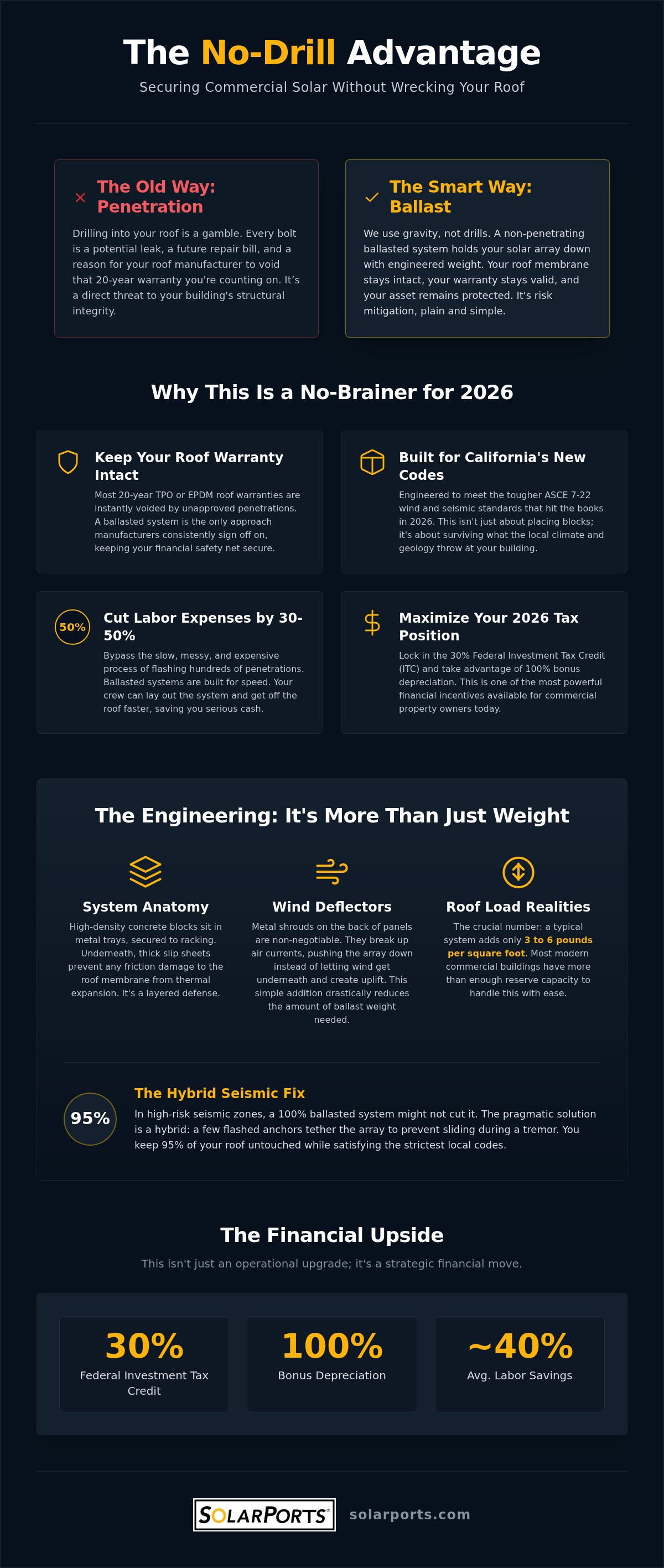
Most Photovoltaic mounting systems designed for flat surfaces rely on ballast. This isn't just about piling weight on the roof. It's about strategic distribution. High-density concrete blocks sit within specialized metal trays, holding the panels down against wind uplift. To prevent these trays from rubbing against the membrane, we use thick protective mats or slip sheets. This prevents friction damage caused by thermal expansion, which can shred a roof membrane over a decade if left unprotected.
The Anatomy of a Ballasted Solar Array
A typical setup is fairly straightforward but requires engineering precision. You have the racking rails, the concrete ballast, and the panels themselves. The tilt angle of the panels is a constant balancing act. A steeper tilt captures more energy in some California latitudes but acts like a sail, requiring more weight to stay put. Lower tilts are more aerodynamic and easier on the building's structural limits. We look at these variables during our energy cost saving analysis to find the sweet spot for your specific site.
Protecting Your Existing Roof Warranty
Your 20-year roof warranty is a massive financial safety net. The moment a solar crew starts drilling without manufacturer approval, that warranty usually disappears. Most manufacturers require a no-penetration approach to keep their coverage active. We coordinate directly with roofing contractors to make sure the install remains "in-system." This means the solar doesn't just sit on the roof; it exists in a way that the original roofing company officially signs off on, preserving your long-term protection.
For those who need similar professional oversight for residential roofing or exterior upgrades, powersolsolutions.com provides specialized services to ensure every project meets rigorous quality standards.
Engineering for California: Wind, Weight, and Seismic Realities
California isn't just about sun; it's about wind and earthquakes. The adoption of the ASCE 7-22 standard in the 2026 building code means that structural engineering requirements for solar have become significantly more rigorous. When deploying non-penetrating flat roof solar mounting, you can't just dump concrete blocks on a roof and hope for the best. You need a "thinking fix" where ballast is strategically distributed based on the specific wind zones of your roof's surface. Central areas often require less weight, while corners and edges need higher density to resist uplift forces.
Wind deflectors, often called shrouds, are a critical part of this engineering puzzle. These metal plates are installed on the back of the panels to break the air current and push the array down toward the roof rather than letting the wind get underneath it. By using these deflectors, we can often reduce the total amount of ballast needed. This is a massive win for older buildings with tighter structural margins. It allows you to maximize your Federal Investment Tax Credit without overstressing the building's bones.
Before you commit to a project, a commercial energy cost saving analysis must include a professional structural integrity check. We look at the existing dead load and compare it against the added weight of the solar asset. If you're unsure about how your specific building will handle the extra load, you can schedule a technical site assessment to get a clear answer before moving forward.
Seismic Attachments: The Hybrid Approach
Sometimes, a 100% ballasted system won't pass California's strict seismic codes, especially in high-activity zones. In these cases, we use a hybrid approach. We might install a few strategic, flashed anchors that act as tethers to prevent the array from sliding during a tremor. You still keep 95% of your roof hole-free, but you get the lateral stability required by local building officials. It's a pragmatic compromise that keeps your building safe and your permit approved.
Calculating Roof Load Capacity
The biggest question we get is: "How much weight are we talking about?" A standard non-penetrating flat roof solar mounting system generally adds between 3 and 6 pounds per square foot of dead load to your roof structure. While most modern commercial buildings are designed with enough "reserve capacity" to handle this, we never guess. We verify the original building plans to ensure the solar investment doesn't become a structural liability over the next twenty years.
The Financial Case: Speed, Tax Credits, and ROI
Labor is the most volatile variable in any commercial solar project. Traditional systems require a crew to locate rafters, drill, and flash every single penetration, which is slow work that inflates your budget. By contrast, non-penetrating flat roof solar mounting installs 30-50% faster because the racking simply rests on the membrane. You're paying for hardware that works with your building, not for extra man-hours spent trying to waterproof a thousand new holes. This efficiency isn't just about saving on the initial bill; it's about getting the system operational before the next utility rate hike hits. Sourcing high-quality hardware from experienced partners like EEHD Erneuerbare Energien Handel und Distribution GmbH ensures that every component in the system meets the rigorous standards required for long-term commercial performance.
The timing for this investment is critical. To capture the full 30% commercial solar tax credit California offers, projects must meet the "Safe Harbor" construction start deadline of July 4, 2026. This credit, combined with 100% federal bonus depreciation, allows you to recoup a massive portion of the system cost in the first year. California also excludes these systems from property tax assessments, so your asset value grows without increasing your tax liability.
Long-term profitability depends on avoiding hidden costs. If a traditional system causes a leak in year eight, you have to pay a solar crew to remove the panels and a roofing crew to fix the membrane. That double-cost event can destroy your commercial solar roi analysis. SolarPorts Development provides a turnkey solution that handles the engineering and the tax math so you don't have to manage multiple vendors.
Operational Efficiency During Installation
Installation shouldn't shut down your business. Penetrating mounts involve loud, invasive drilling that vibrates through the entire structure. Ballasted systems are significantly quieter. Because the process is less invasive, commissioning happens faster. You get the system online and start offsetting those high California peak rates weeks earlier than you would with a traditional build. It's a streamlined deployment that respects your operational schedule.
During these active construction phases, many developers integrate solar-powered surveillance from Jobcam to monitor project milestones and secure equipment without needing temporary grid connections.
In a similar vein, maintaining a building's overall electrical health is paramount; Redlec Energy Solutions provides the comprehensive electrical and air conditioning services required to ensure that both residential and commercial properties remain efficient alongside their solar investments.
For property owners in Australia seeking a similar commitment to quality, you can find_out_more about the professional installation services offered by GridFree Solar.
Next Steps for Your Property
The first move is always a data-driven energy assessment. We need to verify your roof's reserve capacity and run the numbers on your specific utility load. You can see how we've handled similar builds by reviewing our recent projects. Once the structural and financial feasibility is confirmed, we can move to lock in your 2026 tax position and start reducing your overhead.
Secure Your Asset’s Future Without the Risk
The logic is straightforward. Protecting your building's membrane isn't a "nice to have" feature; it's a requirement for maintaining your 20-year warranty. By choosing non-penetrating flat roof solar mounting, you're opting for a system that respects structural limits while meeting California's updated seismic standards. We've established how these ballasted arrays cut labor costs and lock in 2026 tax credits without compromising your roof's integrity. It's the most pragmatic way to turn an idle roof into a revenue-generating asset.
Don't let the complexity of Northern California's real estate market or shifting building codes stall your progress. We specialize in turnkey BESS and solar integration, focusing on data-backed ROI planning that strips away the guesswork. We've spent years refining this process so you don't have to worry about the engineering nuances or the permit office. You get a streamlined path to lower overhead and a more resilient building.
If you're ready to see the actual data for your site, get your no-nonsense Commercial Energy Cost Saving Analysis today. We're ready to help you build something that lasts.
Frequently Asked Questions
Will a non-penetrating solar system blow off my roof in a storm?
No, they won't blow off if the engineering accounts for the current California Building Code standards. We use aerodynamic wind deflectors to create downward pressure, which actually helps hold the array in place during high winds. The weight distribution is calculated specifically for your building's wind zone to ensure the ballast offsets any uplift forces without needing a single bolt.
Do non-penetrating solar mounts work on all flat roof types?
They work on most modern commercial membranes including TPO, EPDM, and PVC. The critical factor is using high-quality slip sheets or protective mats to isolate the metal racking from your roof surface. This prevents friction damage when the system expands and contracts in the sun. If your roof is already failing or structurally compromised, we'll identify those issues during the initial site assessment.
How much extra weight does a ballasted solar system add to my commercial building?
A typical non-penetrating flat roof solar mounting system adds between 3 and 6 pounds per square foot of dead load to your structure. Most California commercial buildings are designed with enough reserve capacity to handle this additional weight easily. We always verify the original structural plans to make sure the building's "bones" can support the long-term load of the solar asset.
Can I still get a roof warranty if I install a ballasted solar array?
Yes, and it's often the only way to keep a 20-year manufacturer's warranty fully intact. Because we aren't drilling holes, we aren't creating the leak points that typically void these agreements. We coordinate directly with your roofing contractor to ensure the installation is "in-system," meaning the manufacturer officially recognizes the solar array as a safe, non-penetrating addition to their membrane.
Frequently asked questions
Will a non-penetrating solar system blow off my roof in a storm?
No, they won't blow off if the engineering accounts for the current California Building Code standards. We use aerodynamic wind deflectors to create downward pressure, which actually helps hold the array in place during high winds. The weight distribution is calculated specifically for your building's wind zone to ensure the ballast offsets any uplift forces without needing a single bolt.
Do non-penetrating solar mounts work on all flat roof types?
They work on most modern commercial membranes including TPO, EPDM, and PVC. The critical factor is using high-quality slip sheets or protective mats to isolate the metal racking from your roof surface. This prevents friction damage when the system expands and contracts in the sun. If your roof is already failing or structurally compromised, we'll identify those issues during the initial site assessment.
How much extra weight does a ballasted solar system add to my commercial building?
A typical non-penetrating flat roof solar mounting system adds between 3 and 6 pounds per square foot of dead load to your structure. Most California commercial buildings are designed with enough reserve capacity to handle this additional weight easily. We always verify the original structural plans to make sure the building's "bones" can support the long-term load of the solar asset.
Can I still get a roof warranty if I install a ballasted solar array?
Yes, and it's often the only way to keep a 20-year manufacturer's warranty fully intact. Because we aren't drilling holes, we aren't creating the leak points that typically void these agreements. We coordinate directly with your roofing contractor to ensure the installation is "in-system," meaning the manufacturer officially recognizes the solar array as a safe, non-penetrating addition to their membrane.