
SGIP 2026: Commercial Energy Storage in San Francisco

Demand charges can constitute 40% of your commercial property's operating budget, essentially a tax on your business for staying powered during peak hours. It's a weight that only gets heavier as PG&E peak rates climb toward 50 cents per kWh. You've likely heard that funding for SGIP for commercial energy storage San Francisco is tightening, and the fear of missing out on the final incentive steps is a valid concern for any CFO. We know the application process feels unnecessarily opaque, often leaving decision-makers guessing about their actual ROI.
This article provides a direct, no-nonsense breakdown of how to leverage remaining 2026 funding, including $850 per kWh equity rates, to offset battery costs and slash demand charges. We'll examine the current step status, the financial reality of NEM 3.0, and the specific path to energy resiliency for your building.
Key Takeaways
- Understand that SGIP has shifted into a performance-based incentive that rewards BESS installations for actively reducing grid strain during peak windows.
- Learn how to leverage SGIP for commercial energy storage San Francisco to offset 25-40% of hardware costs while neutralizing PG&E’s aggressive demand charges.
- Identify if your property qualifies for the Equity Resiliency tier, which provides higher incentive rates for critical infrastructure and businesses in high-risk zones.
- Discover why a preliminary energy cost saving analysis is the essential first step to right-sizing your system and securing a reservation before funding steps close.
Table of Contents
- The Reality of SGIP in 2026: Navigating San Francisco’s Incentive Landscape
- Maximizing ROI: Integrating BESS with San Francisco Utility Rates
- The SolarPorts Development Approach: Turnkey BESS Implementation for SF Commercial Real Estate
The Reality of SGIP in 2026: Navigating San Francisco’s Incentive Landscape
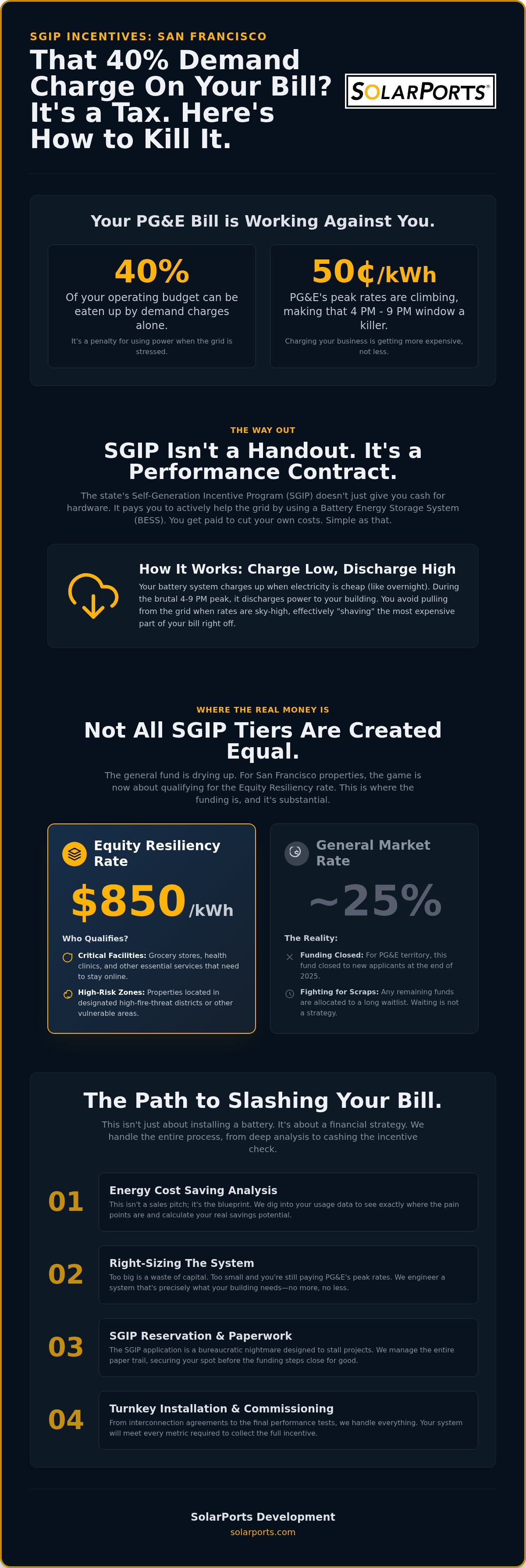
SGIP isn't a gift. It's a performance contract. The program, overseen by the California Public Utilities Commission (CPUC), doesn't just hand out checks for buying hardware. Instead, it rewards BESS systems that actually discharge during peak grid stress. If your battery sits idle, you aren't helping the grid, and you won't see the full rebate. In 2026, the "Step" system is the primary driver of urgency. As capacity fills, the incentive amount drops. For many, the general market funding for PG&E territory closed to new applicants at the end of 2025. This means you're likely looking at waitlists or specific equity categories for your SGIP for commercial energy storage San Francisco project.
Equity Resiliency vs. General Market: Where San Francisco Fits
The 2026 landscape is heavily weighted toward the Non-Residential Equity rate, which sits at $850 per kWh. That's a massive difference compared to general market rates that might only cover 25% of costs. San Francisco buildings often qualify for these higher tiers if they're designated as critical facilities, like grocery stores or health clinics, or if they sit in high-fire-threat districts. We find that a commercial energy cost saving analysis is the only way to verify which tier you actually land in. Mapping your site against the CPUC’s latest resiliency maps is the first step. If you aren't in an equity zone, you're fighting for scraps in the general market waitlist. Waiting is literally costing your business money as these steps close.
Maximizing ROI: Integrating BESS with San Francisco Utility Rates
Peak charges in San Francisco aren't just high; they're predatory. If you're on a PG&E E-19 or E-20 rate, demand charges can constitute up to 40% of your total operating budget. A battery system changes the math. By leveraging SGIP for commercial energy storage San Francisco, you can offset 25% to 40% of your initial hardware costs, effectively turning a defensive backup tool into an active profit center. The strategy is simple: you charge when rates are low and discharge when they spike.
ROI accelerates when you target the 4 PM to 9 PM window. Peak electricity rates in 2026 hit 40 to 50 cents per kWh during these hours, while off-peak rates stay significantly lower. Discharging your BESS then doesn't just save cents; it wipes out the most expensive kilowatt-hours of your day. You should consult the California Public Utilities Commission SGIP guidelines to understand the specific performance requirements that ensure your system remains eligible for these rebates.
The Math of Demand Charge Mitigation in the Bay Area
Your monthly peak usage is the metric PG&E uses to calculate your demand charge. It's a brutal calculation. Most effective strategies to lower commercial electricity bills California rely on "peak shaving," where the battery caps your building's draw from the grid during high-demand spikes. To maintain your SGIP rebate, you must meet a cycling requirement, which means discharging the battery a set number of times annually. It's a logical trade. The grid gets relief, and you dodge the highest charges on your bill. It's worth seeing how these numbers apply to your specific meter by scheduling a technical review of your recent usage data.
The SolarPorts Development Approach: Turnkey BESS Implementation for SF Commercial Real Estate
Most developers just want to sell you as many lithium-ion cells as possible. We don't. A battery is a financial instrument, and if it isn't sized correctly, it's a liability. It starts with a commercial energy cost saving analysis. This isn't a formality; it's the blueprint for the entire project. If you over-build, you're wasting capital on capacity you'll never use. If you under-build, you're still paying those 50-cent peak charges to PG&E. SolarPorts Development focuses on the small-scale commercial sector because these properties need precision, not just scale.
Securing SGIP for commercial energy storage San Francisco is a paperwork nightmare that stalls most projects before they even break ground. We take that off your plate. From the initial reservation to the final incentive claim form, we manage the bureaucracy. You can consult the Official SGIP Program Details to see just how many regulatory hoops exist, but our turnkey process is designed to bypass those headaches. We ensure your system meets every performance metric required to actually collect the rebate.
From Analysis to Interconnection: Our San Francisco Process
Review our past projects to see how we've optimized storage footprints for buildings with tight urban constraints. The reality is that the timeline from reservation to final rebate payout usually spans 12 to 18 months. It's a long game. Our role as your developer is to manage the engineering, permitting, and utility interconnection so the project stays on track. We don't just install hardware; we protect your ROI by ensuring the system performs exactly as the initial analysis promised.
Securing Your San Francisco Energy Strategy
PG&E isn't going to lower your demand charges out of the goodness of their heart. Those peak rates are a structural reality of doing business in the Bay Area. We've shown that navigating SGIP for commercial energy storage San Francisco is a race against the "Step" system, where waiting costs you capital. You need a system that's right-sized through rigorous data, not a generic sales pitch. SolarPorts Development specializes in small-scale SF commercial BESS projects, providing full SGIP application management and data-backed ROI modeling. We handle the bureaucracy so you can focus on operations. It's time to stop letting peak windows drain your budget. Request your San Francisco Energy Cost Saving Analysis to see the numbers for your specific building. Let's get your project moving before the next incentive step closes.
Frequently Asked Questions
Does SGIP cover the full cost of a commercial battery in San Francisco?
No, SGIP is designed to offset costs rather than eliminate them entirely. While the Equity Resiliency rate of $850 per kWh is substantial, general market rebates typically cover closer to 25% of the total installation. The goal is to lower the barrier for entry so that the resulting demand charge savings can pay off the remaining balance quickly.
How do I know if my San Francisco building is in an Equity Resiliency zone?
You need to verify your location against the latest CPUC resiliency maps or confirm your status as a "Critical Facility." Many San Francisco properties qualify if they provide essential services like food storage or healthcare in specific zones. We use these maps during our initial analysis to confirm if you can access the higher funding tiers for SGIP for commercial energy storage San Francisco.
Can I combine SGIP with the Federal Investment Tax Credit (ITC) in 2026?
Stacking incentives is actually the standard approach for high-ROI projects. You can definitely combine the 30% Federal Investment Tax Credit with your SGIP for commercial energy storage San Francisco rebate. When you factor in the 5-year MACRS depreciation, the net investment becomes much more manageable. It's the most effective way to protect your bottom line from rising utility costs.
What happens to my SGIP rebate if the battery isn't used for backup power?
Your rebate depends on grid performance, not backup frequency. SGIP requires the system to discharge during peak hours to reduce grid strain. While having backup power for critical operations is a major advantage, the program's primary metric is how often you cycle the battery to dodge peak rates. If you don't meet these cycling requirements, your incentive could be at risk.
Frequently asked questions
Does SGIP cover the full cost of a commercial battery in San Francisco?
No, SGIP is designed to offset costs rather than eliminate them entirely. While the Equity Resiliency rate of $850 per kWh is substantial, general market rebates typically cover closer to 25% of the total installation. The goal is to lower the barrier for entry so that the resulting demand charge savings can pay off the remaining balance quickly.
How do I know if my San Francisco building is in an Equity Resiliency zone?
You need to verify your location against the latest CPUC resiliency maps or confirm your status as a "Critical Facility." Many San Francisco properties qualify if they provide essential services like food storage or healthcare in specific zones. We use these maps during our initial analysis to confirm if you can access the higher funding tiers for SGIP for commercial energy storage San Francisco.
Can I combine SGIP with the Federal Investment Tax Credit (ITC) in 2026?
Stacking incentives is actually the standard approach for high-ROI projects. You can definitely combine the 30% Federal Investment Tax Credit with your SGIP for commercial energy storage San Francisco rebate. When you factor in the 5-year MACRS depreciation, the net investment becomes much more manageable. It's the most effective way to protect your bottom line from rising utility costs.
What happens to my SGIP rebate if the battery isn't used for backup power?
Your rebate depends on grid performance, not backup frequency. SGIP requires the system to discharge during peak hours to reduce grid strain. While having backup power for critical operations is a major advantage, the program's primary metric is how often you cycle the battery to dodge peak rates. If you don't meet these cycling requirements, your incentive could be at risk.