
Commercial EV Charging Incentives in California: A Strategic 2026 Resource Guide

The expiration of the federal 30C tax credit on June 30 isn't a setback for your infrastructure goals; it's a filter that separates reactive property owners from strategic ones. You're likely staring at hardware quotes and grid upgrade estimates that feel like a liability. It's exhausting to track which utility rebates are still active and which, like SDG&E's Power Your Drive, are winding down by December 31. We're here to help you secure the capital you need.
This guide provides a definitive map of commercial EV charging incentives California 2026, focusing on how to stack state funds with federal grants to protect your bottom line. We'll break down the upcoming CALeVIP Window 2 requirements, analyze the $79 million NEVI GFO-25-602 solicitation, and explain why pairing these incentives with solar and battery storage is the only logical way to hedge against rising operational costs.
Key Takeaways
- Stop treating these incentives as optional bonuses; they're essential capital injections that expire as early as mid-2026, making immediate action a financial necessity.
- Use utility "make-ready" programs to shift the massive costs of transformers and trenching onto PG&E, SCE, or SDG&E while you focus on the hardware.
- Map out exactly how to stack commercial EV charging incentives California 2026 with local grants to drive your upfront infrastructure costs as close to zero as possible.
- Integrate solar carports and battery energy storage systems (BESS) to protect your property from the demand charges that typically eat away at charging revenue.
Table of Contents
- The 2026 California Incentive Landscape: Federal, State, and Local Layers
- Utility-Specific Rebates: PG&E, SCE, and SDGE Programs
- Maximizing ROI: Stacking EV Incentives with Solar and Storage
The 2026 California Incentive Landscape: Federal, State, and Local Layers
Delaying your EV project is a gamble against utility capacity. Grid-upgrade fees are skyrocketing because the first movers have already claimed the easiest electrical connections. We're seeing commercial EV charging incentives California 2026 shift from generous giveaways to strategic survival tools. With the Advanced Clean Fleets (ACF) regulation hitting hard, you're either building now or paying massive compliance penalties later. Looking back at California's EV Market History shows that the "early adopter" phase is over. We're in the mandate phase now. The big three funding sources, Federal 30C, CALVIP, and utility-led "Make-Ready" programs, each have different timelines that require a coordinated approach.
Federal 30C Tax Credit: The Foundation of Your Project
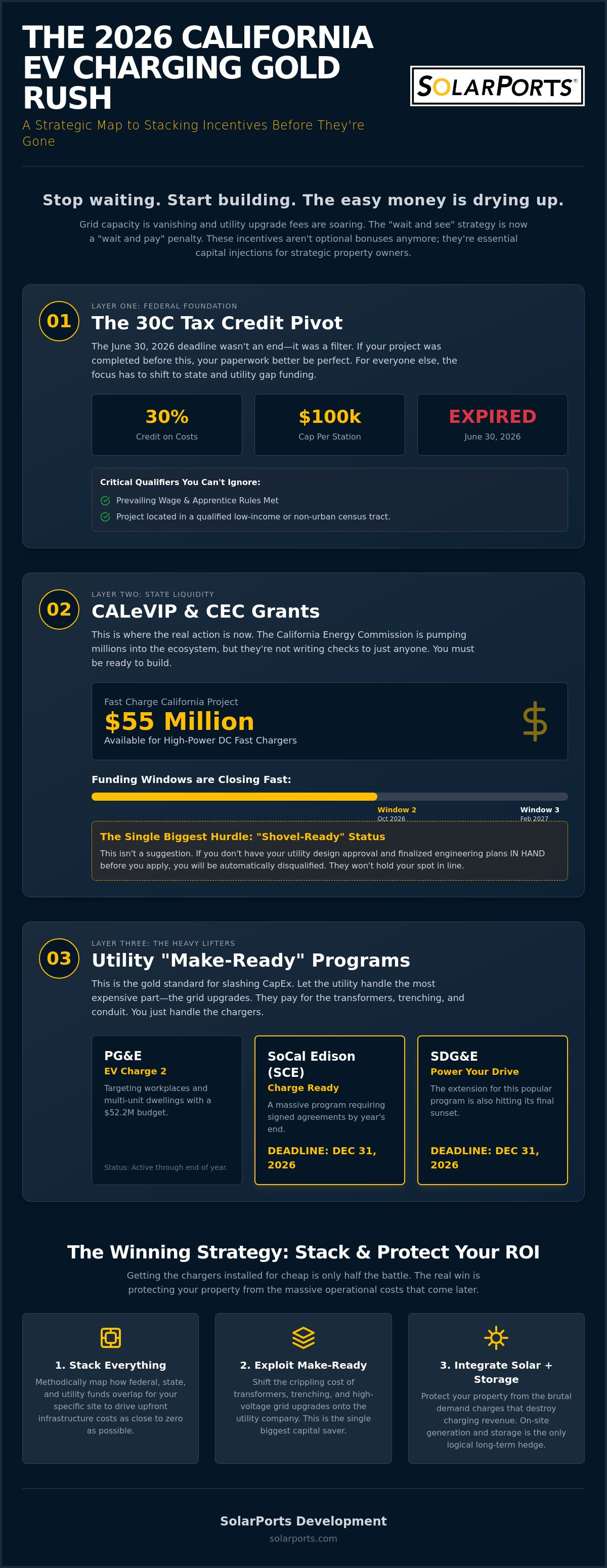
The 30C federal tax credit reached a major pivot point on June 30, 2026. If your project wrapped before that date, your documentation needs to be airtight to survive an audit. This credit offered 30% back, capped at $100,000 per station, but only if you played by the rules regarding prevailing wages and registered apprentices. For those who missed the window, the focus shifts to state-level gap funding. You still need to check your census tract; if you aren't in a rural or low-income area, this federal path was likely closed to you anyway. It's a binary qualification that property owners often overlook until the tax filing stage.
California-Specific Grants: CEC and CALVIP Updates
The California Energy Commission is currently the primary source of liquidity. CALeVIP’s Fast Charge California Project has $55 million on the table, but the criteria have narrowed significantly. They want "ready-to-build" sites in disadvantaged communities. Window 2 opens in October 2026, and Window 3 follows in February 2027. Securing commercial EV charging incentives California 2026 requires a level of bureaucratic precision most developers underestimate. If you haven't already completed a commercial property energy cost saving analysis and secured utility design approval, you won't be fast enough to catch these funds. These aren't just rebates. They are the only way to offset the hardware costs of high-power 150kW+ chargers that the state now demands.
Utility-Specific Rebates: PG&E, SCE, and SDGE Programs
Utility programs are the heavy lifters in this ecosystem. The "Make-Ready" model is the gold standard for reducing capital expenditure because it shifts the most expensive burdens away from the property owner. Essentially, the utility covers the high-voltage infrastructure, the transformers, the trenching, and the conduit. You're responsible for the chargers and the final connection. It's a massive capital shift. If you check current Federal and State EV Incentives, you'll see that these utility partnerships are the bedrock of California's electrification strategy.
In 2026, the landscape is competitive and time-sensitive. PG&E’s EV Charge 2 program, authorized with a $52.2 million budget, is actively targeting workplaces and multi-unit dwellings through the end of the year. Contrast that with Southern California Edison’s Charge Ready program, which requires signed participation agreements by December 31, 2026. If you're in San Diego, the Power Your Drive extension is also hitting its sunset on that same date. You can view our past projects to see how we’ve navigated these specific utility timelines to lock in funding before the windows slammed shut.
Navigating the Application Bureaucracy
Don't fall into the "first-come, first-served" trap with an incomplete application. Utilities in California are notorious for automatic disqualifications if your engineering plans aren't 100% finalized. They won't hold your place in line while you figure out your site map. You need a "shovel-ready" status from day one. Many property owners lose out on commercial EV charging incentives California 2026 simply because they didn't have their utility design approval in hand before hitting 'submit'.
The Role of Demand Response
Your chargers shouldn't just sit there as passive assets. Enrolling in demand response programs can unlock "bonus" rebates for your hardware while protecting you from the "demand charge" shock on your monthly bill. By integrating your charging with a commercial energy cost saving analysis, you ensure your chargers aren't pulling max power during peak utility rates. It’s about building a smart system, not just a plug. If you're unsure how your current electrical capacity fits into these programs, you might want to schedule a brief strategy session to review your site's potential.
Maximizing ROI: Stacking EV Incentives with Solar and Storage
Stacking isn't just a financial strategy; it's the only way to prevent your utility bill from cannibalizing your infrastructure investment. If you install high-power chargers without a plan to manage the load, you're essentially inviting the utility to charge you premium rates for every kilowatt. The unfiltered reality is that without local generation, your EV chargers will eat your solar savings within the first quarter of operation. By consulting the California EV Charging Laws and Incentives database, it's clear that the state is increasingly favoring projects that integrate renewable energy to reduce grid strain.
Installing EV charging without Battery Energy Storage Systems (BESS) is a significant financial mistake in 2026. Batteries allow you to "buffer" the power delivery, drawing from the grid when rates are low and discharging to vehicles when demand charges would otherwise spike. This isn't about being green. It's about protecting your margin. When you combine the ongoing federal Investment Tax Credit (ITC) for solar and storage with the remaining commercial EV charging incentives California 2026, you create a capital stack that dramatically lowers the barrier to entry.
The Solar Carport Advantage
Building solar carport systems for commercial properties allows you to qualify for stackable tax credits that hardware alone can't touch. You're effectively combining two major capital projects into one. This synergy reduces "soft costs" because you only trench the parking lot once and only hire the engineering team for a single unified design. Many high-tier state grants now actually require a "clean energy" component to unlock maximum funding levels, making the carport an essential part of the application.
Calculating the Final Payback Period
Net Project Cost is defined as the total expenditure for hardware, labor, and soft costs minus the sum of all federal tax credits, state block grants, and utility "make-ready" rebates. BESS is the critical variable here; it mitigates the demand charge spikes caused by multiple EVs charging simultaneously, which can otherwise double your monthly operational costs. Without storage, your payback period stretches into a decade; with it, you're looking at a much tighter, more defensible financial horizon.
Secure Your Infrastructure Capital Before the 2026 Deadlines
2026 isn't just another year for infrastructure; it's a hard deadline for several high-value programs. We've seen utility windows for SDG&E and SCE close without much warning, leaving property owners to foot the bill for grid upgrades that could've been subsidized. Securing commercial EV charging incentives California 2026 requires more than just a list of grants. It requires a strategy that integrates solar carports and BESS to handle the load without destroying your operational budget.
Our team brings California-specific regulatory expertise and data-driven ROI modeling directly to your project. We don't just sell hardware; we provide turnkey BESS and solar carport integration designed for the 2026 tax codes. You don't have to guess where your project stands or if you're missing out on stackable credits. We focus on the financial and operational integrity of the site from day one.
Take the first step toward a defensible energy strategy. Get a no-nonsense Commercial Energy Cost Saving Analysis to lock in your project's financial feasibility. The funding is there for those who move now.
Frequently Asked Questions
Can I stack the Federal 30C tax credit with California utility rebates in 2026?
Yes, you can generally combine federal tax credits with utility "make-ready" incentives, but you have to be careful with state-level grant rules. While the 30C credit is designed to layer on top of other funding, programs like CALeVIP often have specific restrictions against using other state-funded grants for the same hardware. It's a matter of building a capital stack that doesn't trigger a "double dipping" audit. We always recommend verifying the specific utility's participation agreement to ensure they don't claim a right to the federal credits you're planning to harvest.
What are the labor requirements for the 2026 commercial EV charging tax credit?
To secure the full 30% credit, you must comply with strict prevailing wage and registered apprenticeship requirements. If your project fails to meet these federal labor standards, your credit is automatically reduced to 6% of the total cost. This is a massive financial penalty for a simple oversight in contractor selection. You need to ensure your installation team provides certified payroll records and documentation showing that a specific percentage of the work was performed by registered apprentices. It's a non-negotiable part of the 2026 tax landscape.
How do I know if my California commercial property is in an eligible census tract for 30C?
You have to use the latest Department of Energy mapping tools to confirm your property falls within a low-income or non-urban census tract. The 30C credit isn't a blanket incentive available to every business in the state. If your property is located in a high-income urban center, you're likely ineligible for this specific federal credit. We look at the specific tract ID during our initial analysis to determine if commercial EV charging incentives California 2026 from the federal level are actually on the table for your site.
Is there a limit to how many EV charging stations I can get incentives for?
Limits are typically set on a per-site basis rather than a total portfolio cap. For example, CALeVIP Window 2 provides up to $100,000 per charging port, but they have a maximum funding limit per project location. Utility programs like PG&E’s EV Charge 2 also focus on a specific number of ports per site to manage grid impact. You can often pursue incentives for multiple properties across your portfolio, provided each application is treated as a separate project with its own engineering and utility approval. Each program has different "port caps" that you'll need to navigate.
Frequently asked questions
Federal 30C Tax Credit: The Foundation of Your Project
The 30C federal tax credit reached a major pivot point on June 30, 2026. If your project wrapped before that date, your documentation needs to be airtight to survive an audit. This credit offered 30% back, capped at $100,000 per station, but only if you played by the rules regarding prevailing wages and registered apprentices. For those who missed the window, the focus shifts to state-level gap funding. You still need to check your census tract; if you aren't in a rural or low-income area, this federal path was likely closed to you anyway. It's a binary qualification that property owners often overlook until the tax filing stage.
California-Specific Grants: CEC and CALVIP Updates
The California Energy Commission is currently the primary source of liquidity. CALeVIP’s Fast Charge California Project has $55 million on the table, but the criteria have narrowed significantly. They want "ready-to-build" sites in disadvantaged communities. Window 2 opens in October 2026, and Window 3 follows in February 2027. Securing commercial EV charging incentives California 2026 requires a level of bureaucratic precision most developers underestimate. If you haven't already completed a commercial property energy cost saving analysis and secured utility design approval, you won't be fast enough to catch these funds. These aren't just rebates. They are the only way to offset the hardware costs of high-power 150kW+ chargers that the state now demands. Utility programs are the heavy lifters in this ecosystem. The "Make-Ready" model is the gold standard for reducing capital expenditure because it shifts the most expensive burdens away from the property owner. Essentially, the utility covers the high-voltage infrastructure, the transformers, the trenching, and the conduit. You're responsible for the chargers and the final connection. It's a massive capital shift. If you check current Federal and State EV Incentives, you'll see that these utility partnerships are the bedrock of California's electrification strategy. In 2026, the landscape is competitive and time-sensitive. PG&E’s EV Charge 2 program, authorized with a $52.2 million budget, is actively targeting workplaces and multi-unit dwellings through the end of the year. Contrast that with Southern California Edison’s Charge Ready program, which requires signed participation agreements by December 31, 2026. If you're in San Diego, the Power Your Drive extension is also hitting its sunset on that same date. You can view our past projects to see how we’ve navigated these specific utility timelines to lock in funding before the windows slammed shut.
Navigating the Application Bureaucracy
Don't fall into the "first-come, first-served" trap with an incomplete application. Utilities in California are notorious for automatic disqualifications if your engineering plans aren't 100% finalized. They won't hold your place in line while you figure out your site map. You need a "shovel-ready" status from day one. Many property owners lose out on commercial EV charging incentives California 2026 simply because they didn't have their utility design approval in hand before hitting 'submit'.
The Role of Demand Response
Your chargers shouldn't just sit there as passive assets. Enrolling in demand response programs can unlock "bonus" rebates for your hardware while protecting you from the "demand charge" shock on your monthly bill. By integrating your charging with a commercial energy cost saving analysis, you ensure your chargers aren't pulling max power during peak utility rates. It’s about building a smart system, not just a plug. If you're unsure how your current electrical capacity fits into these programs, you might want to schedule a brief strategy session to review your site's potential. Stacking isn't just a financial strategy; it's the only way to prevent your utility bill from cannibalizing your infrastructure investment. If you install high-power chargers without a plan to manage the load, you're essentially inviting the utility to charge you premium rates for every kilowatt. The unfiltered reality is that without local generation, your EV chargers will eat your solar savings within the first quarter of operation. By consulting the California EV Charging Laws and Incentives database, it's clear that the state is increasingly favoring projects that integrate renewable energy to reduce grid strain. Installing EV charging without Battery Energy Storage Systems (BESS) is a significant financial mistake in 2026. Batteries allow you to "buffer" the power delivery, drawing from the grid when rates are low and discharging to vehicles when demand charges would otherwise spike. This isn't about being green. It's about protecting your margin. When you combine the ongoing federal Investment Tax Credit (ITC) for solar and storage with the remaining commercial EV charging incentives California 2026, you create a capital stack that dramatically lowers the barrier to entry.
The Solar Carport Advantage
Building solar carport systems for commercial properties allows you to qualify for stackable tax credits that hardware alone can't touch. You're effectively combining two major capital projects into one. This synergy reduces "soft costs" because you only trench the parking lot once and only hire the engineering team for a single unified design. Many high-tier state grants now actually require a "clean energy" component to unlock maximum funding levels, making the carport an essential part of the application.
Calculating the Final Payback Period
Net Project Cost is defined as the total expenditure for hardware, labor, and soft costs minus the sum of all federal tax credits, state block grants, and utility "make-ready" rebates. BESS is the critical variable here; it mitigates the demand charge spikes caused by multiple EVs charging simultaneously, which can otherwise double your monthly operational costs. Without storage, your payback period stretches into a decade; with it, you're looking at a much tighter, more defensible financial horizon. 2026 isn't just another year for infrastructure; it's a hard deadline for several high-value programs. We've seen utility windows for SDG&E and SCE close without much warning, leaving property owners to foot the bill for grid upgrades that could've been subsidized. Securing commercial EV charging incentives California 2026 requires more than just a list of grants. It requires a strategy that integrates solar carports and BESS to handle the load without destroying your operational budget. Our team brings California-specific regulatory expertise and data-driven ROI modeling directly to your project. We don't just sell hardware; we provide turnkey BESS and solar carport integration designed for the 2026 tax codes. You don't have to guess where your project stands or if you're missing out on stackable credits. We focus on the financial and operational integrity of the site from day one. Take the first step toward a defensible energy strategy. Get a no-nonsense Commercial Energy Cost Saving Analysis to lock in your project's financial feasibility. The funding is there for those who move now.
Can I stack the Federal 30C tax credit with California utility rebates in 2026?
Yes, you can generally combine federal tax credits with utility "make-ready" incentives, but you have to be careful with state-level grant rules. While the 30C credit is designed to layer on top of other funding, programs like CALeVIP often have specific restrictions against using other state-funded grants for the same hardware. It's a matter of building a capital stack that doesn't trigger a "double dipping" audit. We always recommend verifying the specific utility's participation agreement to ensure they don't claim a right to the federal credits you're planning to harvest.
What are the labor requirements for the 2026 commercial EV charging tax credit?
To secure the full 30% credit, you must comply with strict prevailing wage and registered apprenticeship requirements. If your project fails to meet these federal labor standards, your credit is automatically reduced to 6% of the total cost. This is a massive financial penalty for a simple oversight in contractor selection. You need to ensure your installation team provides certified payroll records and documentation showing that a specific percentage of the work was performed by registered apprentices. It's a non-negotiable part of the 2026 tax landscape.
How do I know if my California commercial property is in an eligible census tract for 30C?
You have to use the latest Department of Energy mapping tools to confirm your property falls within a low-income or non-urban census tract. The 30C credit isn't a blanket incentive available to every business in the state. If your property is located in a high-income urban center, you're likely ineligible for this specific federal credit. We look at the specific tract ID during our initial analysis to determine if commercial EV charging incentives California 2026 from the federal level are actually on the table for your site.
Is there a limit to how many EV charging stations I can get incentives for?
Limits are typically set on a per-site basis rather than a total portfolio cap. For example, CALeVIP Window 2 provides up to $100,000 per charging port, but they have a maximum funding limit per project location. Utility programs like PG&E’s EV Charge 2 also focus on a specific number of ports per site to manage grid impact. You can often pursue incentives for multiple properties across your portfolio, provided each application is treated as a separate project with its own engineering and utility approval. Each program has different "port caps" that you'll need to navigate.