
California SGIP & Commercial Battery Storage: A 2026 Strategy for Demand Charge Reduction

Your monthly utility bill isn't a fixed cost. It's a discretionary tax you're paying every time your building's peak demand spikes during the wrong hour. It's exhausting to watch California rates climb 50% since 2020 while the "lottery" of state rebates feels rigged against you. You've likely heard the SGIP gold rush is over for most businesses, and in 2026, that's the cold reality. Deploying commercial battery storage for demand charge reduction California is no longer about chasing a disappearing rebate. It's about structural OpEx control.
We know the frustration of complex tiers and the fear of buying an over-engineered system. You'll learn how to navigate the remaining SGIP categories to fund your hardware and how to eliminate the demand charges eating your profits. We're laying out a clear path to maximize ROI through tax stacking and data-driven sizing so you can stop being a victim of the utility's schedule.
Key Takeaways
- Demand charges are based on peak draw intensity, not total energy volume, and typically represent about half of a California commercial power bill.
- Utilizing commercial battery storage for demand charge reduction California allows you to structurally lower monthly OpEx by capping those expensive utility spikes.
- Maximizing ROI requires a granular 15-minute interval data audit to ensure your battery is right-sized rather than over-engineered and unnecessarily expensive.
- Successful implementation in 2026 means pivoting from broad state rebates toward navigating utility bureaucracy and securing specific resiliency funding paths.
Table of Contents
- The California Demand Charge Trap & Why SGIP is the Solution
- ROI Engineering: Right-Sizing BESS for Demand Charges
- Navigating Implementation: From Audit to Interconnection
The California Demand Charge Trap & Why SGIP is the Solution
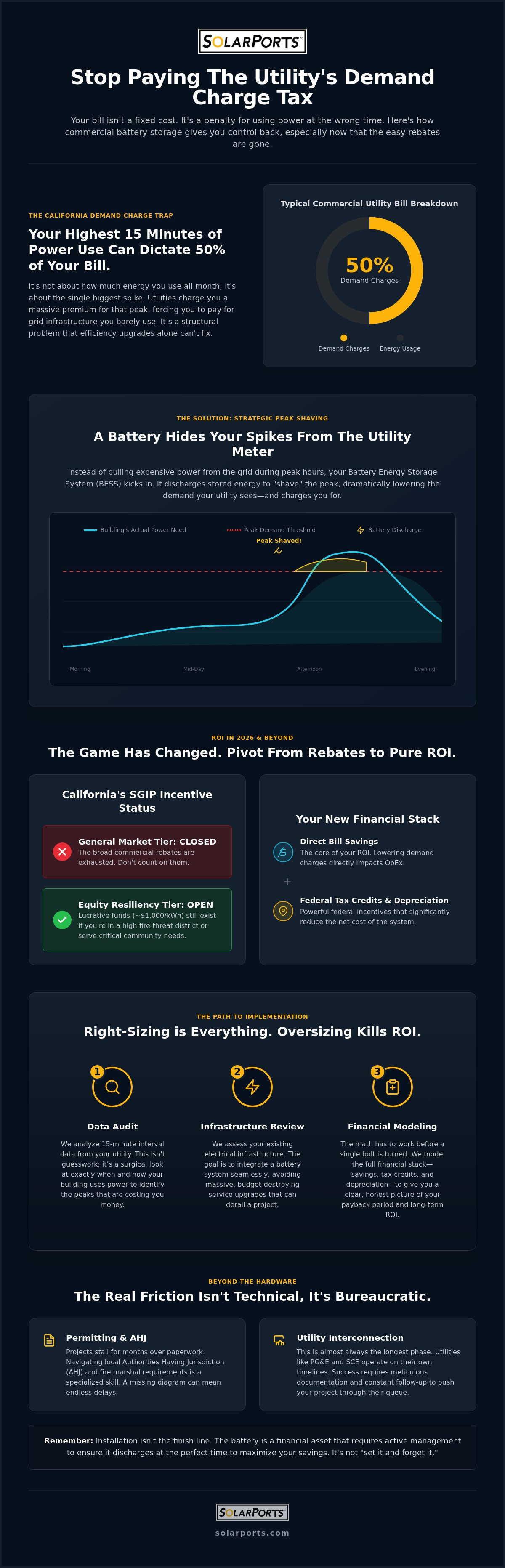
Demand charges aren't about total consumption. They're about your building's most aggressive 15-minute window of draw. In California, these spikes often account for 50% of your total monthly bill, creating a structural overhead that standard efficiency measures simply can't touch. It's a trap. You pay for the grid capacity the utility thinks you might need, not just what you actually use over the month. This is where commercial battery storage for demand charge reduction California becomes a financial necessity rather than an environmental gesture. By deploying a battery energy storage system (BESS), you discharge stored power during those peak windows, effectively hiding your draw from the utility meter.
How SGIP Incentives Offset BESS Capital Costs
The Self-Generation Incentive Program (SGIP) was designed to reward this exact behavior. It operates as a step-down system, where the available rebate drops as the program hits specific capacity milestones. As we move through 2026, the landscape has tightened. The General Market tier, which once served the broad commercial sector, closed to new applications at the end of 2025. Now, the focus is on the Equity Resiliency category.
This tier remains highly lucrative. It often provides incentives around $1,000 per kWh for businesses in high fire-threat districts or those serving critical infrastructure. Navigating this bureaucracy requires a precise commercial property energy cost saving analysis to determine if you qualify for these specific 2026 funds. If you don't fit the equity criteria, the large-scale general funds are exhausted. This means your ROI must come from direct bill savings and peak shaving. It's a fundamental shift from subsidy-chasing to pure operational engineering, and reviewing our past commercial energy projects shows how this looks in the current market.
ROI Engineering: Right-Sizing BESS for Demand Charges
Efficiency dies when you over-engineer. Many vendors will try to sell you the largest capacity available, but an oversized battery is just idle capital sitting on your roof or in your electrical room. The goal is surgical. We use commercial battery storage for demand charge reduction California to perform "peak shaving." This means discharging just enough energy to keep your grid draw below a calculated threshold. If you undersize, you miss the peak and pay the full penalty. If you oversize, your payback period stretches into a decade. Precision is the only way to protect the bottom line.
The 5-Step Process to Selecting Your Commercial Battery System
Finding the sweet spot requires more than a glance at last month's bill. It starts with a deep dive into the numbers.
- Step 1: Conduct a commercial energy cost saving analysis. We map your load spikes using 15-minute interval data directly from the utility. This reveals exactly when and why your costs are exploding.
- Step 2: Evaluate your existing electrical infrastructure. We look for ways to integrate a BESS without triggering a massive service upgrade, which can derail project timelines and budgets.
- Step 3: Model the financial stack. This includes checking the latest status of California's Self-Generation Incentive Program (SGIP) alongside federal tax credits and depreciation to see how they impact the net system cost.
The math has to work before the first bolt is turned. If you aren't sure where your peak draw is coming from, consider requesting a data profile review to see the real numbers.
Navigating Implementation: From Audit to Interconnection
Buying the hardware is the easy part. The real friction starts when you move from the spreadsheet to the electrical room. A "turnkey" solution is a hollow promise if your installer doesn't have a direct line to the local Authorities Having Jurisdiction (AHJ). We've seen projects stall for months because a permit application lacked a single specific diagram required by a local fire marshal. Interconnection with the utility is almost always the longest phase. It's tedious. You're dealing with entities like PG&E or SCE that operate on their own timelines, and they won't rush just because your demand charges are spiking. Success requires meticulous documentation and constant follow-up to push the project through the queue.
Installation isn't the finish line. Commercial battery storage for demand charge reduction California requires active asset management to maintain its value. If the system discharges too early in the day, you'll have an empty battery when your actual peak hits at 5:00 PM. You're essentially managing a financial asset that happens to be made of lithium. It needs to be monitored and adjusted as your building's load profile shifts over time.
Why Local California Expertise Beats National Generalists
National firms often struggle with the granular reality of our state's regulatory landscape. California's fire codes for BESS installations, especially regarding thermal runaway protection in indoor setups, are the strictest in the country. If you aren't familiar with commercial solar project management in CA, you'll likely hit a wall with local permitting. Staying current with California's Self-Generation Incentive Program (SGIP) requirements is also mandatory for long-term compliance. Local experts know the specific quirks of Northern and Southern California utility territories, which is the difference between a system that's online in six months and one that's a year behind schedule.
Securing Your 2026 Operational Budget
Peak demand spikes shouldn't dictate your operational margins. The 2026 landscape is clear: the era of easy rebates has passed, but the opportunity for structural cost control is better than ever. Success relies on right-sizing your hardware using 15-minute interval data rather than vendor averages. You need a partner who's actually navigated the specific fire codes and utility delays unique to this state. Implementing commercial battery storage for demand charge reduction California is a strategic financial pivot that requires precision over persuasion. We offer California-exclusive expertise and turnkey management to ensure your BESS performs exactly when the grid is most expensive. Don't leave your ROI to chance or generic installers. Take the next step toward reclaiming your profits and Request Your Commercial Energy Cost Saving Analysis today. Your data is ready to work for you.
Frequently Asked Questions
What is the current 2026 status of SGIP funding for California businesses?
SGIP funding for general commercial projects officially ended on December 31, 2025. The program's focus in 2026 is almost exclusively on residential equity and narrow resiliency categories. Most businesses are now placed on a waitlist that only moves when existing projects are canceled. You'll need to rely on direct bill savings rather than assuming a state check is coming.
How much can a battery storage system actually reduce my monthly demand charges?
A right-sized system can cap your peak draw and eliminate the majority of your demand charges. These fees frequently account for 50% of a California commercial power bill, so the savings are immediate. By using commercial battery storage for demand charge reduction California, you structurally lower your monthly OpEx. It's about shifting your load away from the utility's most expensive windows.
Can I stack SGIP with the Federal Investment Tax Credit (ITC)?
Stacking is still the standard approach for commercial projects, even with 2026's tighter regulations. While the residential tax credit expired at the end of 2025, businesses can still utilize the federal Investment Tax Credit (ITC) alongside available SGIP funds. When you combine these with accelerated depreciation, the net cost of the system drops significantly. It requires a sophisticated financial analysis to get right.
How long does the typical commercial BESS installation take from audit to activation?
Expect the process to take six to twelve months from your first data audit to final activation. The actual construction is relatively fast. The delay always happens during the utility interconnection phase and local permitting. PG&E and SCE have strict documentation requirements that can stall a project for months. We manage that bureaucracy daily to keep the timeline from slipping into a second year.
Frequently asked questions
What is the current 2026 status of SGIP funding for California businesses?
SGIP funding for general commercial projects officially ended on December 31, 2025. The program's focus in 2026 is almost exclusively on residential equity and narrow resiliency categories. Most businesses are now placed on a waitlist that only moves when existing projects are canceled. You'll need to rely on direct bill savings rather than assuming a state check is coming.
How much can a battery storage system actually reduce my monthly demand charges?
A right-sized system can cap your peak draw and eliminate the majority of your demand charges. These fees frequently account for 50% of a California commercial power bill, so the savings are immediate. By using commercial battery storage for demand charge reduction California, you structurally lower your monthly OpEx. It's about shifting your load away from the utility's most expensive windows.
Can I stack SGIP with the Federal Investment Tax Credit (ITC)?
Stacking is still the standard approach for commercial projects, even with 2026's tighter regulations. While the residential tax credit expired at the end of 2025, businesses can still utilize the federal Investment Tax Credit (ITC) alongside available SGIP funds. When you combine these with accelerated depreciation, the net cost of the system drops significantly. It requires a sophisticated financial analysis to get right.
How long does the typical commercial BESS installation take from audit to activation?
Expect the process to take six to twelve months from your first data audit to final activation. The actual construction is relatively fast. The delay always happens during the utility interconnection phase and local permitting. PG&E and SCE have strict documentation requirements that can stall a project for months. We manage that bureaucracy daily to keep the timeline from slipping into a second year.