
ROI of Commercial Battery Storage in California: The Unfiltered 2026 Reality for Property Owners

In 2026, the California power grid isn't just a utility; it's a financial predator designed to punish your business for operating during the day. You've likely seen those $50 per kW summer demand charges in San Diego or the $28 spikes in Northern California and realized that simple solar isn't enough to fix the ROI of commercial battery storage California property owners now require. NEM 3.0 basically gutted the value of sending power back to the grid, leaving businesses with systems that produce plenty of energy but still result in five-figure monthly bills. It's a frustrating cycle of paying for infrastructure that doesn't actually lower your overhead.
We're cutting through the polished sales brochures to give you the unfiltered reality of how these systems actually perform this year. You deserve a pragmatic look at the numbers without the usual marketing fluff or "too-clean" sales pitches that national vendors love to push. This guide breaks down the math of bypassing SGIP waitlists, maximizing the 30% federal tax credit, and using a Battery Energy Storage System to cap your peak demand once and for all. We'll show you exactly how to turn energy from a monthly liability into a strategic asset that pays for itself on a predictable, data-driven timeline.
Key Takeaways
- California utilities essentially charge a premium for the "privilege" of daytime operation. Managing demand charges is now a tactical necessity rather than a sustainability option.
- The true ROI of commercial battery storage California is found in the delta between uncontrolled utility spikes and your own stabilized battery discharge.
- Federal incentives like the 30% ITC and 100% bonus depreciation are the reliable pillars for capital recovery in 2026, regardless of SGIP waitlists.
- A BESS installation functions as a strategic real estate asset that lowers OpEx to directly increase Net Operating Income and improve Cap Rates.
- Realizing these financial gains requires a turnkey approach to handle the "headache" of permitting and interconnection without distracting your core staff.
Table of Contents
- Beyond the Electric Bill: How Demand Charge Management Drives California BESS ROI
- The 2026 Incentive Stack: Navigating SGIP, ITC, and MACRS for Maximum Recovery
- From Expense to Asset: Why Battery Storage is a Strategic Real Estate Play
Beyond the Electric Bill: How Demand Charge Management Drives California BESS ROI
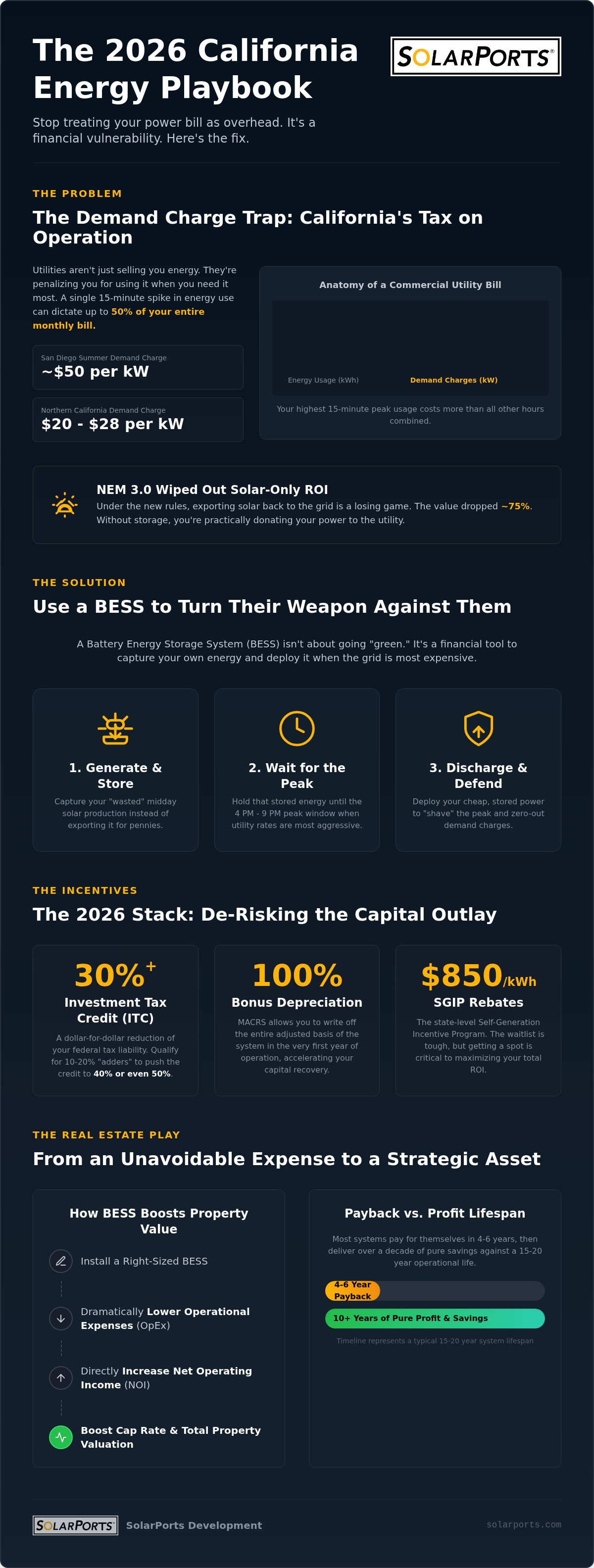
California utilities aren't just charging for energy; they are charging for the 'privilege' of using it when you need it most. It's a blunt tax on your operations. The real ROI of commercial battery storage California property owners experience is the delta between uncontrolled utility spikes and stabilized battery discharge. If you look at your bill, you'll see that it isn't just about how many kilowatt-hours you used over thirty days. It's about that one 15-minute window where your demand peaked. This is the "Demand Charge Trap." A single spike, perhaps when your HVAC and machinery kick in simultaneously at 4:15 PM, can dictate up to 50% of your entire monthly commercial bill. Energy arbitrage, the practice of buying low and using high, isn't a luxury anymore. It's the baseline for any profitable business in this state.
The NEM 3.0 Reality Check for Commercial Owners
Solar alone doesn't cut it anymore. Under NEM 3.0, the value of exporting power back to the grid has dropped by about 75%, sometimes as low as $0.05 per kWh. If you don't have a place to put that power, you're essentially donating it to the utility. A Battery Energy Storage System (BESS) captures that "wasted" midday solar production. Instead of selling it for pennies, you store it and discharge it during the 4 PM to 9 PM peak pricing window when utility rates are at their most aggressive. It's about keeping the value you've already generated.
Northern California Grid Volatility
Operating under PG&E in 2026 is a constant exercise in risk management. Demand charges in Northern California now hover between $20 and $28 per kW, making overhead nearly impossible to predict without a buffer. This grid instability forces businesses to pay for infrastructure they can't always rely on. While there are various strategies to lower commercial electricity bills California property owners can try, none are as effective as physically decoupling your peak demand from the grid. For most CFOs, the first step is a commercial property energy cost saving analysis to see exactly where those 15-minute spikes are hiding in their data.
The 2026 Incentive Stack: Navigating SGIP, ITC, and MACRS for Maximum Recovery
The 2026 incentive stack is a tiered financial structure integrating the 30% federal investment tax credit, 100% MACRS bonus depreciation, and state-level SGIP rebates that effectively de-risks the initial capital outlay for energy infrastructure. It is not a single check you get in the mail. It is a calculated recovery of capital that happens over the first 12 to 24 months of operation—a process similar to how Trump Tariff Relief assists companies in reclaiming funds through tariff refunds. The anchor of this stack is the 30% Investment Tax Credit (ITC). If your project meets domestic content requirements or sits in a designated "energy community," you can stack 10% "adders" to push that credit to 40% or even 50%. This is a dollar-for-dollar reduction in your federal tax liability, not just a deduction.
The Self-Generation Incentive Program (SGIP) is a different beast in 2026. Most of the General Market budget is currently on a waitlist, but the Non-Residential Equity rate still offers up to $850 per kWh for those who qualify. You have to be aggressive with the application timing. We see many owners get discouraged by the waitlist, but the reality is that projects drop out of the queue constantly. Securing a spot in that line is critical to maximizing the ROI of commercial battery storage California property owners can expect. When you combine this with 100% MACRS bonus depreciation, you can often write off the entire adjusted basis of the system in the first year.
Right-Sizing: The Secret to Protecting Your IRR
Over-building a battery system is the fastest way to kill your ROI. You aren't trying to build a fortress; you're trying to build a scalpel that cuts the most expensive 15-minute peaks off your bill. Without a commercial energy cost saving analysis, you're just guessing at capacity. We find the "sweet spot" where the cost of adding another kWh of storage no longer yields a proportional drop in demand charges. This precision ensures the ROI of commercial battery storage California projects stays in the double digits from day one.
Financing and the 'Payback' Timeline
Most commercial systems reach a full payback within 4 to 6 years. Given that Lithium Iron Phosphate (LFP) chemistry now offers a 15 to 20-year operational life, you're looking at a decade or more of pure, unencumbered savings. The hurdle is never the technology; it's the administrative friction. SolarPorts handles the turnkey implementation, from the permitting headaches to the complex utility interconnection paperwork that usually stalls these projects for months. If you want to see how these layers apply to your specific meter data, you can walk through a preliminary recovery model with our team.
From Expense to Asset: Why Battery Storage is a Strategic Real Estate Play
Stop looking at battery storage as just a utility fix. It's a real estate play. When you lower your OpEx, your Net Operating Income (NOI) climbs. For a commercial investor, that's the only metric that truly matters. A building with stabilized energy costs is simply worth more on the open market because it's less exposed to the whims of the grid. If you can shave $20,000 off your annual demand charges, you've effectively increased the property's valuation by $400,000 at a 5% Cap Rate. That is the real power behind the ROI of commercial battery storage California investors are starting to realize. It's about building equity through efficiency.
Then there's the cost of doing nothing. What happens when the grid goes down for four hours? For a cold storage facility or a data center, that's not an inconvenience; it's a catastrophic loss of revenue. Resiliency has a dollar value that doesn't show up on a monthly bill until it's too late. SolarPorts acts as the architect for this transition, moving your property from being a victim of the grid to becoming a truly energy-independent entity. We don't just sell hardware; we engineer a defense for your bottom line.
Integrating Solar Carports for Double ROI
The synergy between storage and solar carport systems is where the math gets interesting. You're using underutilized parking space to generate the very power your BESS stores for those expensive 4 PM peaks. It's a closed-loop system that protects your bottom line from every angle while providing a visible amenity for tenants. For a deeper dive into how these combined systems perform, check out our commercial solar ROI analysis.
The Operational Reality: Maintenance and Longevity
Modern batteries don't need a full-time engineer. The monitoring software does the heavy lifting, automatically discharging when rates spike without you ever touching a dial. Modern BESS software acts as an invisible CFO for your energy meter, constantly auditing your load to ensure you never pay a penny more than necessary. It's a set-it-and-forget-it asset that works harder for your property value than almost any other capital improvement you could make this year.
Securing Your Building’s Financial Future Against an Aggressive Grid
The math is clear. Between the 30% federal tax credit and the immediate boost to your property's Net Operating Income, waiting for a better deal usually just means losing another year to five-figure demand spikes. The ROI of commercial battery storage California owners are seeing in 2026 is built on a simple reality: you either control your energy peaks or the utility company controls your bank account. It isn't just about sustainability. It is about a tactical defense of your bottom line and your property's long-term valuation.
SolarPorts specializes in the small-scale commercial projects that national vendors often ignore. We focus on Northern California's specific grid challenges and use data-driven analysis to ensure you aren't over-building for your actual needs. Our team handles the permitting, the interconnection, and the bureaucratic headaches so you can stay focused on your core operations. You don't have to be a victim of the next rate hike.
Request a Professional Energy Cost Saving Analysis today to see the numbers for your specific meter data. It's time to turn your energy overhead into a predictable, strategic asset.
Frequently Asked Questions
What is the typical ROI for commercial battery storage in California in 2026?
Most commercial property owners see a full payback on their investment within four to six years. This timeline is heavily influenced by the 30% federal tax credit and the ability to claim 100% bonus depreciation in the first year. Because the hardware is rated for a 15 to 20-year lifespan, the ROI of commercial battery storage California projects remains high well after the initial capital is recovered.
How do demand charges affect the payback period of a BESS installation?
Demand charges are the primary driver of your payback timeline because they often represent 50% of a commercial bill. A battery doesn't just save you on total energy use; it targets the specific 15-minute spikes that the utility uses to calculate your highest monthly rate. Shaving those peaks can drop your monthly expenses by thousands of dollars, which directly accelerates your break-even point.
Can I still get SGIP incentives for my California business this year?
Yes, but it's a waitlist game in 2026. While the General Market budgets are often fully reserved, the Equity and Equity Resiliency tiers still offer significant rebates for businesses in specific zones or industries. Getting into the queue now is vital because the program is scheduled to sunset, and spots open up as other projects in the line fail to reach construction.
Does battery storage actually increase my commercial property value?
Battery storage increases property value by permanently lowering your operating expenses and raising your Net Operating Income (NOI). In the commercial real estate world, a building that costs less to run is worth more to an investor. If you save $25,000 a year in utility costs, you've added significant value to the asset when calculated against current market cap rates.
How long does a commercial battery storage system last before it needs replacement?
Modern Lithium Iron Phosphate (LFP) systems are designed to last between 15 and 20 years. The software manages the "cycles" of the battery to prevent the cells from wearing out too quickly. You don't have to worry about a total replacement in the short term; it's a long-term infrastructure asset that requires very little hands-on maintenance from your staff.
What happens to my BESS ROI if utility rates change in the future?
Your ROI actually improves as utility rates go up. When PG&E or SDG&E raises prices, the "avoided cost" of the energy you've stored in your battery becomes more valuable. You're essentially hedging against inflation by locking in your energy costs today, ensuring that every future rate hike only makes your battery system more profitable.
Frequently asked questions
What is the typical ROI for commercial battery storage in California in 2026?
Most commercial property owners see a full payback on their investment within four to six years. This timeline is heavily influenced by the 30% federal tax credit and the ability to claim 100% bonus depreciation in the first year. Because the hardware is rated for a 15 to 20-year lifespan, the ROI of commercial battery storage California projects remains high well after the initial capital is recovered.
How do demand charges affect the payback period of a BESS installation?
Demand charges are the primary driver of your payback timeline because they often represent 50% of a commercial bill. A battery doesn't just save you on total energy use; it targets the specific 15-minute spikes that the utility uses to calculate your highest monthly rate. Shaving those peaks can drop your monthly expenses by thousands of dollars, which directly accelerates your break-even point.
Can I still get SGIP incentives for my California business this year?
Yes, but it's a waitlist game in 2026. While the General Market budgets are often fully reserved, the Equity and Equity Resiliency tiers still offer significant rebates for businesses in specific zones or industries. Getting into the queue now is vital because the program is scheduled to sunset, and spots open up as other projects in the line fail to reach construction.
Does battery storage actually increase my commercial property value?
Battery storage increases property value by permanently lowering your operating expenses and raising your Net Operating Income (NOI). In the commercial real estate world, a building that costs less to run is worth more to an investor. If you save $25,000 a year in utility costs, you've added significant value to the asset when calculated against current market cap rates.
How long does a commercial battery storage system last before it needs replacement?
Modern Lithium Iron Phosphate (LFP) systems are designed to last between 15 and 20 years. The software manages the "cycles" of the battery to prevent the cells from wearing out too quickly. You don't have to worry about a total replacement in the short term; it's a long-term infrastructure asset that requires very little hands-on maintenance from your staff.
What happens to my BESS ROI if utility rates change in the future?
Your ROI actually improves as utility rates go up. When PG&E or SDG&E raises prices, the "avoided cost" of the energy you've stored in your battery becomes more valuable. You're essentially hedging against inflation by locking in your energy costs today, ensuring that every future rate hike only makes your battery system more profitable.