
How to Reduce Commercial Demand Charges in California: A 2026 Strategic Playbook

A single fifteen-minute spike in energy usage shouldn't have the power to inflate your entire monthly operating budget by forty percent. Yet, for many businesses in the Golden State, that's the reality of modern utility billing. With SDG&E summer on-peak demand charges hitting $50.71 per kW as of July 2026, this "peak moment tax" has become a legitimate threat to your bottom line. You're likely searching for how to reduce commercial demand charges California utilities like PG&E and SCE continue to escalate, especially when it feels like you're being penalized for simply running essential equipment.
It's frustrating to watch your OpEx fluctuate while utility structures shift toward complex subscription models and evening peak windows. We've built this guide to give you a clear, data-backed roadmap for reclaiming control over your energy spend. You'll discover how a strategic combination of Battery Energy Storage Systems (BESS) and solar carports can physically decouple your facility from the grid's most expensive moments. We're moving past the marketing fluff to verify exactly how these assets pay for themselves through 2026 and beyond.
Key Takeaways
- Identify the 15-minute window that acts as a monthly "speeding ticket" for your facility, dictating your overhead regardless of total energy use.
- Master operational load sequencing to stagger heavy machinery and HVAC startups, creating a zero-cost "thinking fix" for your peak demand.
- Access a data-backed playbook on how to reduce commercial demand charges California utilities like PG&E and SDG&E have pushed to record highs.
- Evaluate how BESS and solar carports function as a physical hedge, decoupling your operations from the grid during the expensive 4:00 PM to 9:00 PM window.
Table of Contents
- The California Demand Charge Trap: Why Your Bill is 50% Peak Fees
- Operational Load Sequencing: The "Thinking Fix" for Demand Reduction
- Infrastructure as a Hedge: Peak Shaving with Solar and BESS
The California Demand Charge Trap: Why Your Bill is 50% Peak Fees
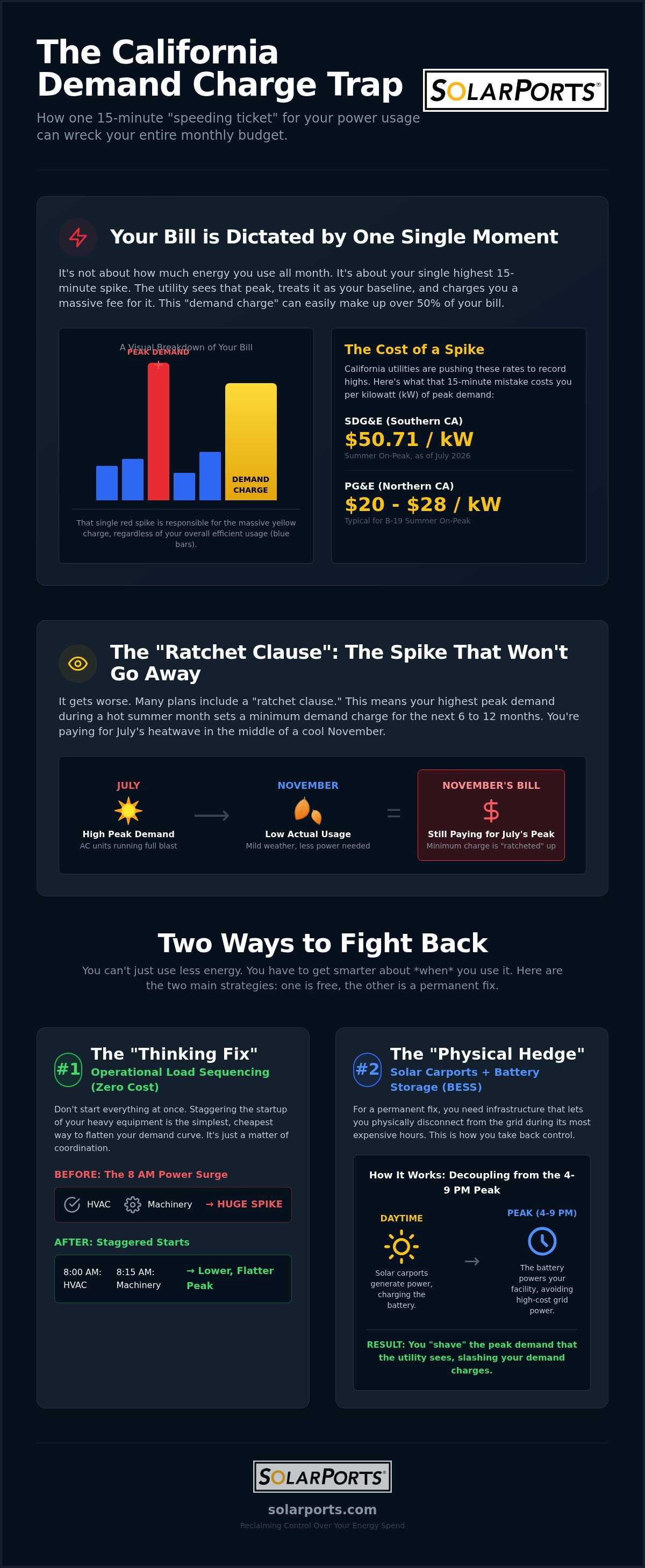
California commercial utility bills have become a math problem that most facility managers are losing. It's not because you're leaving the lights on. In 2026, the actual energy you consume is often only half the story. The rest is dictated by demand charges. Think of it as a speeding ticket for your building. If you turn on your heavy machinery or HVAC systems all at once, you create a massive 15-minute spike. Even if you throttle back immediately after, the utility bill treats that single moment as your new baseline for the next thirty days.
This is the core of what demand charges are and why they're so destructive to your OpEx. Traditional efficiency measures like switching to LED lighting are great for reducing total kilowatt-hours, but they do almost nothing to lower that peak demand line item. If you want to know how to reduce commercial demand charges California utilities impose, you have to look at the physical timing of your load, not just your lightbulbs. One ill-timed equipment startup can trigger a charge that dwarfs your actual usage costs.
Understanding the Demand Ratchet Clause
The ratchet is where the financial pain really sets in. Many California rate structures include a clause where your highest demand spike in the summer months sets a floor for your bill for the next six to twelve months. You could have a quiet, efficient November, but you're still paying for that one heatwave in July when the AC units redlined. While regional specialists like Third Coast Spray Foam offer high-performance insulation to combat this in other climates, the principle is universal: a better-insulated envelope prevents your cooling system from spiking into "ratchet" territory. The utility company justifies this by claiming they must reserve grid capacity specifically for your worst-case scenario. It's an expensive reservation you never asked for.
The 2026 California Utility Landscape
The landscape has shifted aggressively under the new Net Billing Tariff. For Northern California businesses, PG&E's large commercial customers, particularly those on B-19 plans, are now facing substantial summer on-peak demand charges, often ranging between $20 and $28 per kW. These figures represent a significant portion of operating costs. While utilities like SDG&E in Southern California are reporting even higher figures, with some large commercial customers seeing rates hit $50.71 per kW as of July 2026, the underlying challenge of demand charges is a statewide issue impacting profitability across California. Business as usual isn't just inefficient anymore; it's a competitive disadvantage. If your neighbor has already figured out how to reduce commercial demand charges California utilities are hiking, their operating costs are lower, giving them a direct edge in the local market.
Operational Load Sequencing: The "Thinking Fix" for Demand Reduction
Most businesses start their day with a massive, unforced error. At 8:00 AM, the lights go on, the HVAC units kick into high gear, and production machinery hums to life simultaneously. This creates a power surge that sets your demand charge for the entire month within the first hour of operation. If you're trying to figure out how to reduce commercial demand charges California utilities penalize you for, the answer isn't necessarily using less power. It's about changing the sequence.
Equipment staggering is a "thinking fix." It costs nothing but coordination. By delaying the startup of your largest motors or chillers by just 15 or 20 minutes, you prevent those loads from stacking on top of each other. A commercial property energy cost saving analysis is the best way to see which circuits are actually the culprits. It's about unmasking the hidden spikes that happen when you aren't looking.
HVAC Staging and Smart Controls
Cooling a building all at once is a financial disaster. Instead of letting all rooftop units fire at 100% capacity simultaneously, you can stage them to come online in waves. This flattens the demand curve significantly. Understanding California's utility rate structures shows that the grid doesn't care about your total daily work; it only cares about those 15-minute peaks. Automated Demand Response (ADR) systems can help the building "think" for itself, making these adjustments without manual intervention.
Analyzing Your 15-Minute Interval Data
Your "Green Button" data is the most valuable asset you aren't using. This 15-minute interval data reveals the exact moment your profits disappear into the utility's pockets. Any commercial solar ROI analysis worth its salt has to start here. If you can't see the spikes, you can't kill them.
Behavioral changes have a ceiling, though. You can only ask your team to stagger starts so many times before operational reality gets in the way. Eventually, you need a physical hedge to handle the load automatically. If you're ready to see the data behind your own facility, you can book a strategy session to review your interval data and find where the waste is hiding.
Infrastructure as a Hedge: Peak Shaving with Solar and BESS
Behavioral fixes have a limit. While staggering equipment is a smart first step, your load sequencing plan will eventually crack when a heatwave hits or a production deadline requires all hands on deck. Incorporating passive energy-saving measures, such as the high-efficiency cellular shades from Axent Shutters Blinds & Shades LLC, can significantly reduce the thermal load on your building and lower the initial cooling spike. This is where you stop trying to out-think the grid and start building a physical buffer. A Battery Energy Storage System (BESS) acts as a grid shock absorber. It sits between your facility and the utility, discharging power the moment a surge is detected. This ensures the grid never sees your 15-minute spike, effectively keeping your demand line flat. It's the most reliable method for anyone looking at how to reduce commercial demand charges California utilities continue to hike.
A BESS can typically reduce the demand portion of a utility bill by 20% to 40%. By discharging stored energy during peak windows, you decouple your operations from the utility's price volatility. You aren't just saving energy; you're buying insurance against the record-high rates seen in 2026. This hardware fix turns a variable, unpredictable expense into a controlled, manageable line item, creating room for San Diego businesses to invest in visibility through Yeahgor Commercial Wraps & Decals.
The Synergy of Solar Carports and Storage
Solar carports provide a unique advantage by generating power during the day and offering shade for your property, but solar alone isn't a demand-charge killer. If a cloud passes during your peak usage window, your demand spike hits the grid instantly. Integrating BESS ensures your turnkey commercial solar in CA actually hits the demand line item. The battery bridges the "cloud gap," guaranteeing that your peak shaving strategy remains intact regardless of the weather.
Turning Energy Strategy into a Competitive Advantage
Reclaiming your OpEx from utility "speeding tickets" allows you to reinvest in the property itself. This isn't a sunk cost; it's a long-term financial hedge. Reducing your overhead makes your real estate more competitive and improves tenant retention. Your energy infrastructure becomes a predictable asset rather than a monthly liability. If you're ready to stop guessing what your next bill will look like, it's time to get a clear picture of your data. Schedule your free strategic consultation to unmask your demand spikes.
Reclaim Your OpEx From California's Peak Demand Trap
The 2026 utility landscape doesn't reward general efficiency; it rewards precision. You've seen how a single equipment startup can dictate your overhead for months and how staggering those loads provides a temporary "thinking fix." To truly solve how to reduce commercial demand charges California utilities keep pushing higher, you eventually need a physical hedge. Decoupling your facility from the grid during the 4:00 PM to 9:00 PM window isn't just about saving pennies; it's about making your property more resilient and competitive in a volatile market.
We specialize specifically in California commercial real estate, providing the data-driven energy cost saving analysis you need to unmask your specific spikes. From there, we deliver turnkey BESS and solar carport solutions that turn your energy strategy into a long-term financial asset. You don't have to stay stuck in the utility's "ratchet" cycle. Schedule your free California commercial energy cost saving analysis and take back control of your operating budget. It's time to stop letting the grid dictate your margins.
Frequently Asked Questions
Can solar panels alone reduce my demand charges in California?
No, solar panels alone are usually insufficient for demand reduction because California's on-peak hours have shifted to the 4:00 PM to 9:00 PM window. By the time the grid becomes most expensive, solar production is already tapering off. While rooftop systems excel at cutting total consumption, they can't reliably "shave" the 15-minute spikes that occur after sunset or during intermittent cloud cover. You need storage to bridge that gap.
How much can a Battery Energy Storage System (BESS) actually save on demand fees?
A Battery Energy Storage System (BESS) can typically reduce the demand portion of your utility bill by 20% to 40%. This is the most effective hardware solution for how to reduce commercial demand charges California businesses face today. By discharging during your facility's highest usage peaks, the BESS ensures you don't exceed your subscription level or trigger record-high summer on-peak rates, which hit $50.71 per kW for SDG&E customers in 2026.
What is the difference between energy consumption and demand charges?
Energy consumption is the total amount of electricity you use, while demand charges are based on your highest point of usage in a single 15-minute window. Think of consumption as the total miles driven and demand as your maximum speed. Even if you drive very few miles, hitting a "high speed" just once triggers a massive charge. In California, these peak fees often represent half of a commercial property's total monthly overhead.
What is a "demand ratchet" and how do I know if my utility uses one?
A demand ratchet is a utility policy where your highest usage spike in a single month sets a minimum billing floor for the following six to twelve months. If you trigger a massive 15-minute surge in July, you'll continue paying for that capacity through the winter, regardless of your actual needs. You'll see this reflected in rate plans from PG&E, SCE, and SDG&E, making it vital to prevent even one-off spikes from occurring.
Frequently asked questions
Can solar panels alone reduce my demand charges in California?
No, solar panels alone are usually insufficient for demand reduction because California's on-peak hours have shifted to the 4:00 PM to 9:00 PM window. By the time the grid becomes most expensive, solar production is already tapering off. While rooftop systems excel at cutting total consumption, they can't reliably "shave" the 15-minute spikes that occur after sunset or during intermittent cloud cover. You need storage to bridge that gap.
How much can a Battery Energy Storage System (BESS) actually save on demand fees?
A Battery Energy Storage System (BESS) can typically reduce the demand portion of your utility bill by 20% to 40%. This is the most effective hardware solution for how to reduce commercial demand charges California businesses face today. By discharging during your facility's highest usage peaks, the BESS ensures you don't exceed your subscription level or trigger record-high summer on-peak rates, which hit $50.71 per kW for SDG&E customers in 2026.
What is the difference between energy consumption and demand charges?
Energy consumption is the total amount of electricity you use, while demand charges are based on your highest point of usage in a single 15-minute window. Think of consumption as the total miles driven and demand as your maximum speed. Even if you drive very few miles, hitting a "high speed" just once triggers a massive charge. In California, these peak fees often represent half of a commercial property's total monthly overhead.
What is a "demand ratchet" and how do I know if my utility uses one?
A demand ratchet is a utility policy where your highest usage spike in a single month sets a minimum billing floor for the following six to twelve months. If you trigger a massive 15-minute surge in July, you'll continue paying for that capacity through the winter, regardless of your actual needs. You'll see this reflected in rate plans from PG&E, SCE, and SDG&E, making it vital to prevent even one-off spikes from occurring.