
Oakland Commercial Solar Carports: A Strategic 2026 Financial Hedge

Your parking lot is likely your most underutilized asset, and right now, it's a liability. Every time PG&E spikes their demand charges, your bottom line takes a hit you didn't budget for. Most Oakland property owners just shrug and pay the invoice. That's a strategic failure. Investing in Oakland commercial solar carports isn't about being "green"; it's about aggressive fiscal optimization. We've seen the data work, specifically with the 150 kW Broadway project that achieved a 2.6-year payback by replacing expensive utility power with on-site generation.
You need to kill those demand charges and drop your LCOE from dollars to cents. This guide shows you how to turn asphalt into a high-yield energy asset while the 30% federal tax credit remains available in 2026. We'll cover NEM 3.0 realities, why BESS integration is no longer optional, and how to clear Oakland's complex zoning hurdles without a headache. It's time to stop renting your power and start owning the infrastructure that produces it.
Key Takeaways
- Stop letting PG&E demand charges dictate your operational budget by slashing your levelized cost of energy from dollars to cents.
- Navigate the Bureau of Planning efficiently by securing a Zoning Worksheet before you turn a single bolt on your project site.
- Use a data-driven energy cost saving analysis to right-size your system and integrate battery storage for maximum peak-shaving impact.
- Deploying Oakland commercial solar carports in 2026 creates a defensive financial hedge that turns underutilized parking lots into high-yield energy assets.
Table of Contents
- The Financial Logic: Why Oakland Commercial Solar Carports Make Sense Now
- Permitting and Zoning: Navigating Oakland’s Local Requirements
- Strategy for Maximum ROI: Right-Sizing and BESS Integration
The Financial Logic: Why Oakland Commercial Solar Carports Make Sense Now
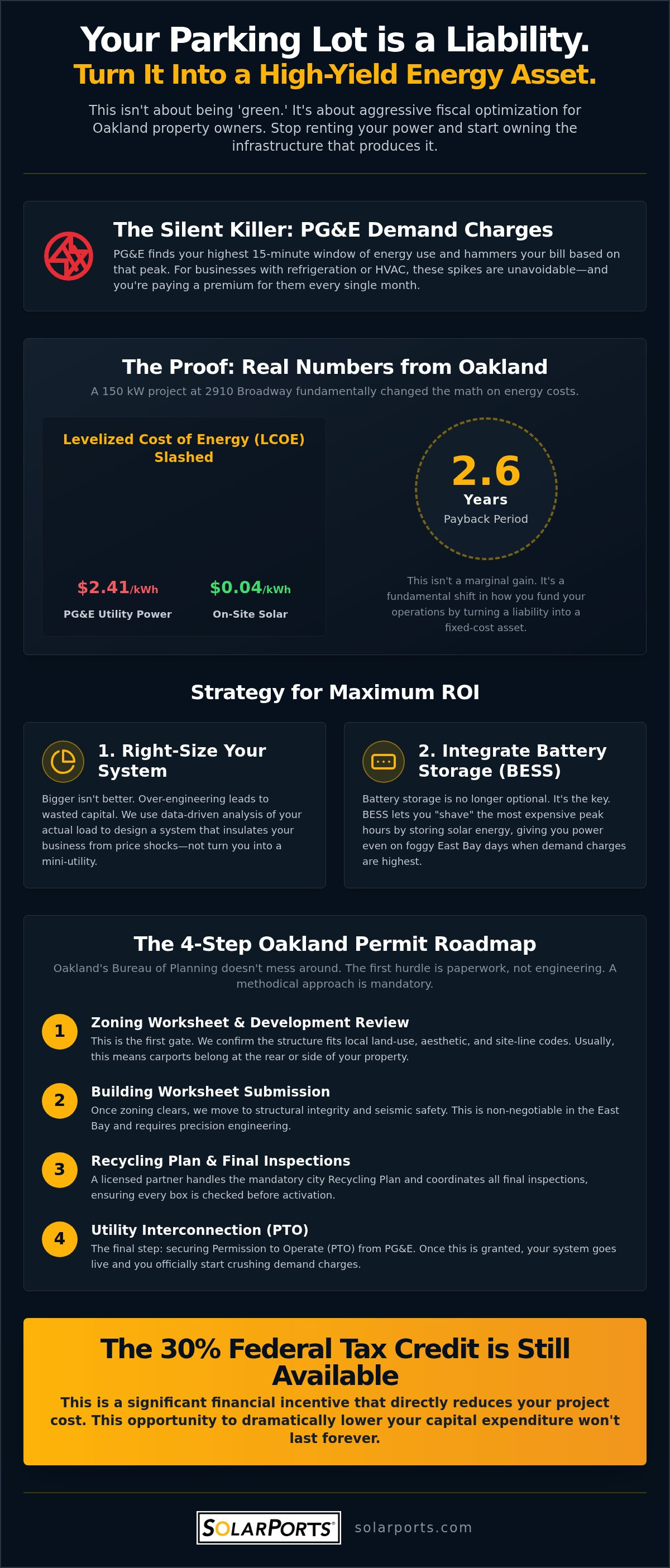
Oakland businesses are trapped. PG&E's rate structure isn't just high; it's designed to penalize you when you're most productive. For most, a parking lot is just a maintenance liability, a slab of asphalt that needs repaving every few years. Transforming that space into solar canopies changes the math. You stop being a passive consumer and start being a producer. Our Oakland project at 2910 Broadway proved this by slashing the LCOE from a staggering $2.41/kWh down to just $0.04/kWh. That isn't a marginal gain. It's a fundamental shift in how you fund your operations.
Oakland commercial solar carports provide a predictable hedge against utility volatility. When PG&E raises rates, your cost of production stays fixed because you own the infrastructure.
Beating PG&E's High-Peak Demand Charges
Demand charges are the silent killer on your utility bill. PG&E looks for your highest 15-minute window of usage and bills you based on that peak, even if the rest of your day is efficient. For grocery stores with refrigeration or retail hubs with high HVAC loads, these peaks are unavoidable. On-site generation from carports hits these peaks exactly when they happen. By generating power where it's used, you're not just lowering your total bill; you're actively shaving off the most expensive part of your rate profile. You can find more strategies to lower commercial electricity bills California to see how this fits into a broader fiscal plan.
Permitting and Zoning: Navigating Oakland’s Local Requirements
Oakland's Bureau of Planning doesn't play around. If you're looking at Oakland commercial solar carports, the first real hurdle isn't the engineering. It's the paperwork. You need a Zoning Worksheet (ZW) before a single bolt is turned on your site. Planners here are focused on aesthetics and site-line codes. This usually means carports belong at the rear or side of your primary facility to satisfy local visibility requirements. While the California Solar Initiative helped set the stage for statewide adoption years ago, local rules in Oakland remain hyper-specific. The process is digital now, but "online" doesn't mean "easy." You still need a classification-appropriate licensed contractor who actually knows how to make a project "pencil" for a city planner.
The 4-Step Oakland Permit Roadmap
Getting your project through the city requires a methodical approach. We follow a strict sequence to avoid costly revisions. It's about precision, not speed. Successfully deploying Oakland commercial solar carports requires more than just panels; it's a zoning exercise that demands local expertise.
- Step 1: Submit the Zoning Worksheet alongside a Basic Application for Development Review. This is where we confirm the structure fits local land-use rules.
- Step 2: Transition to the Building Worksheet once zoning clears. This covers structural integrity and seismic safety, which are critical in the East Bay.
- Step 3: Ensure your turnkey commercial solar CA partner handles the mandatory Recycling Plan and coordinates final inspections with the city.
- Step 4: Secure final utility interconnection and Permission to Operate (PTO) from PG&E to start offsetting those demand charges.
It's a lot to track while running a business. Most owners shouldn't have to learn the nuances of the Oakland Master Fee Schedule just to save on power. If you want to see if your specific lot qualifies for this kind of infrastructure, you can book a technical site review to get the zoning details sorted without the guesswork.
Strategy for Maximum ROI: Right-Sizing and BESS Integration
Bigger isn't always better. Over-engineering a system just leads to wasted capital and longer payback periods. We rely on a data-driven commercial energy cost saving analysis to make sure your infrastructure matches your actual load. Under the current framework of California's solar incentive programs, the logic has shifted. You aren't trying to be a mini-utility. You're trying to insulate your business from external price shocks.
Integrating a Battery Energy Storage System (BESS) is what makes this work. It allows you to "shave" the most expensive peak hours, even on foggy East Bay days. If you're looking at Oakland commercial solar carports as just "panels on a roof," you're missing the point. The battery is what captures the solar energy and deploys it when PG&E rates are highest. It's a tactical deployment of power that ensures your parking lot is actually working for you.
Calculating the Real-World Property Value Gain
The property value gain is the real prize. By lowering your OpEx, you're driving up your Net Operating Income (NOI) every single month. In Oakland's competitive market, a higher NOI directly improves your cap rate and overall valuation. Our analysis of local retail assets showed a potential $41.5M gain over a system's lifespan. It's how smart money justifies the initial cost. You can see the breakdown in our commercial solar ROI analysis. Ultimately, turnkey management is the only way to ensure these financial projections actually manifest while you stay focused on running your company. Oakland commercial solar carports should be a hands-off asset, not a second job.
Owning Your Energy Future in Oakland
Stop letting PG&E's unpredictable demand charges dictate your monthly cash flow. We've already proven that Oakland commercial solar carports can deliver a 2.6-year payback, much like our Broadway project, when the engineering is right-sized for the property's actual load. You aren't just adding panels; you're building a defensive financial asset that increases Net Operating Income and stabilizes your long-term OpEx. It's about taking control before the next inevitable rate hike hits your bottom line.
Our team handles the Bureau of Planning and the BESS integration so you don't have to navigate the bureaucracy alone. We provide data-driven ROI modeling that strips away the marketing fluff to focus on measurable fiscal results. Let's look at your specific utility data and find the waste. Get a Right-Sized Energy Cost Saving Analysis for Your Oakland Property today and start turning that asphalt into an asset.
Frequently Asked Questions
Do I need a special permit for a solar carport in Oakland?
Yes, you'll need a specific set of approvals before construction begins. The process starts with a Zoning Worksheet from the Bureau of Planning to verify setback and visibility codes. Following that, you must secure a Building Worksheet that addresses seismic safety and structural integrity. It's all handled through a digital portal now, but navigating the nuances requires a contractor familiar with Oakland's local fee schedules.
What is the typical payback period for an Oakland commercial solar carport?
Payback periods depend on your energy usage, but we've seen local projects hit a 2.6-year payback. Most Oakland commercial solar carports pencil out quickly because they target PG&E's aggressive demand charges. When you drop your cost per kilowatt-hour from utility rates down to roughly $0.04/kWh, the operational savings, combined with the 30% federal tax credit, accelerate your return on investment significantly.
How does a solar carport affect my property value in California?
It boosts your valuation by directly increasing your Net Operating Income. Since a carport reduces one of your largest operating expenses, it makes the property more attractive to investors looking for stable capitalization rates. In the California market, an asset that produces its own power is worth more because it’s insulated from future utility hikes, effectively turning a maintenance liability into a revenue-generating hedge.
Can I integrate EV charging stations with my commercial solar carport in Oakland?
You can, and it's actually a smart move for long-term asset management. Connecting EV chargers to your carport allows you to use on-site solar power to fuel vehicles, which avoids pulling expensive power from the grid during peak windows. It’s an efficient way to meet tenant demand for charging while keeping your infrastructure upgrades bundled into a single, high-yield energy project.
Frequently asked questions
Do I need a special permit for a solar carport in Oakland?
Yes, you'll need a specific set of approvals before construction begins. The process starts with a Zoning Worksheet from the Bureau of Planning to verify setback and visibility codes. Following that, you must secure a Building Worksheet that addresses seismic safety and structural integrity. It's all handled through a digital portal now, but navigating the nuances requires a contractor familiar with Oakland's local fee schedules.
What is the typical payback period for an Oakland commercial solar carport?
Payback periods depend on your energy usage, but we've seen local projects hit a 2.6-year payback. Most Oakland commercial solar carports pencil out quickly because they target PG&E's aggressive demand charges. When you drop your cost per kilowatt-hour from utility rates down to roughly $0.04/kWh, the operational savings, combined with the 30% federal tax credit, accelerate your return on investment significantly.
How does a solar carport affect my property value in California?
It boosts your valuation by directly increasing your Net Operating Income. Since a carport reduces one of your largest operating expenses, it makes the property more attractive to investors looking for stable capitalization rates. In the California market, an asset that produces its own power is worth more because it’s insulated from future utility hikes, effectively turning a maintenance liability into a revenue-generating hedge.
Can I integrate EV charging stations with my commercial solar carport in Oakland?
You can, and it's actually a smart move for long-term asset management. Connecting EV chargers to your carport allows you to use on-site solar power to fuel vehicles, which avoids pulling expensive power from the grid during peak windows. It’s an efficient way to meet tenant demand for charging while keeping your infrastructure upgrades bundled into a single, high-yield energy project.