
Cost of Commercial Solar Carports: A Strategic 2026 California Breakdown

Installing a solar carport isn't a sustainability play anymore. It's a defensive maneuver against the highest utility rates in the country. If you're currently weighing the cost of commercial solar carport options for 2026, you've likely noticed that the old math doesn't hold up under NEM 3.0 rules. The gap between what you pay for peak power and what the utility credits you for export has turned into a serious financial drain. You need numbers that actually make sense to a board. No marketing fluff. This guide provides a direct, data-backed look at the real-world investment required for California commercial solar carports in 2026. We'll break down why solar-plus-storage is the new baseline, how the July 4th tax credit deadline changes your timeline, and exactly what's driving those property energy bills higher.
Key Takeaways
- Stop looking only at panel prices. The real cost of commercial solar carport projects in California usually hides in soft costs like structural engineering and the headache of local permitting.
- Choosing between a cantilever or a T-frame structure changes more than just the look of your lot. It dictates how much you'll spend on asphalt repairs and trenching around underground utility lines.
- The July 4, 2026, federal deadline is a hard stop for the full 30% tax credit. We'll show you how to use safe harbor provisions so you don't lose a massive chunk of your project funding.
- NEM 3.0 effectively killed the value of exporting power. You'll learn why pairing carports with battery storage is the only way to slash peak-demand charges, even as state rebates like SGIP move to waitlists.
Table of Contents
- Dissecting the All-In Cost of Commercial Solar Carports
- Design Variables That Dictate Your Final Quote
- Offsetting CAPEX with California Incentives and ROI
Dissecting the All-In Cost of Commercial Solar Carports
A simple price-per-watt estimate often fails when applied to a parking lot retrofit. Unlike rooftop systems, a Solar canopy is a structural engineering project as much as an energy one. When calculating the total cost of commercial solar carport installations, you aren't just buying panels. You're funding a site transformation that involves heavy steel, deep foundations, and intensive utility negotiations.
Hardware vs. Soft Costs: Where the Budget Actually Goes
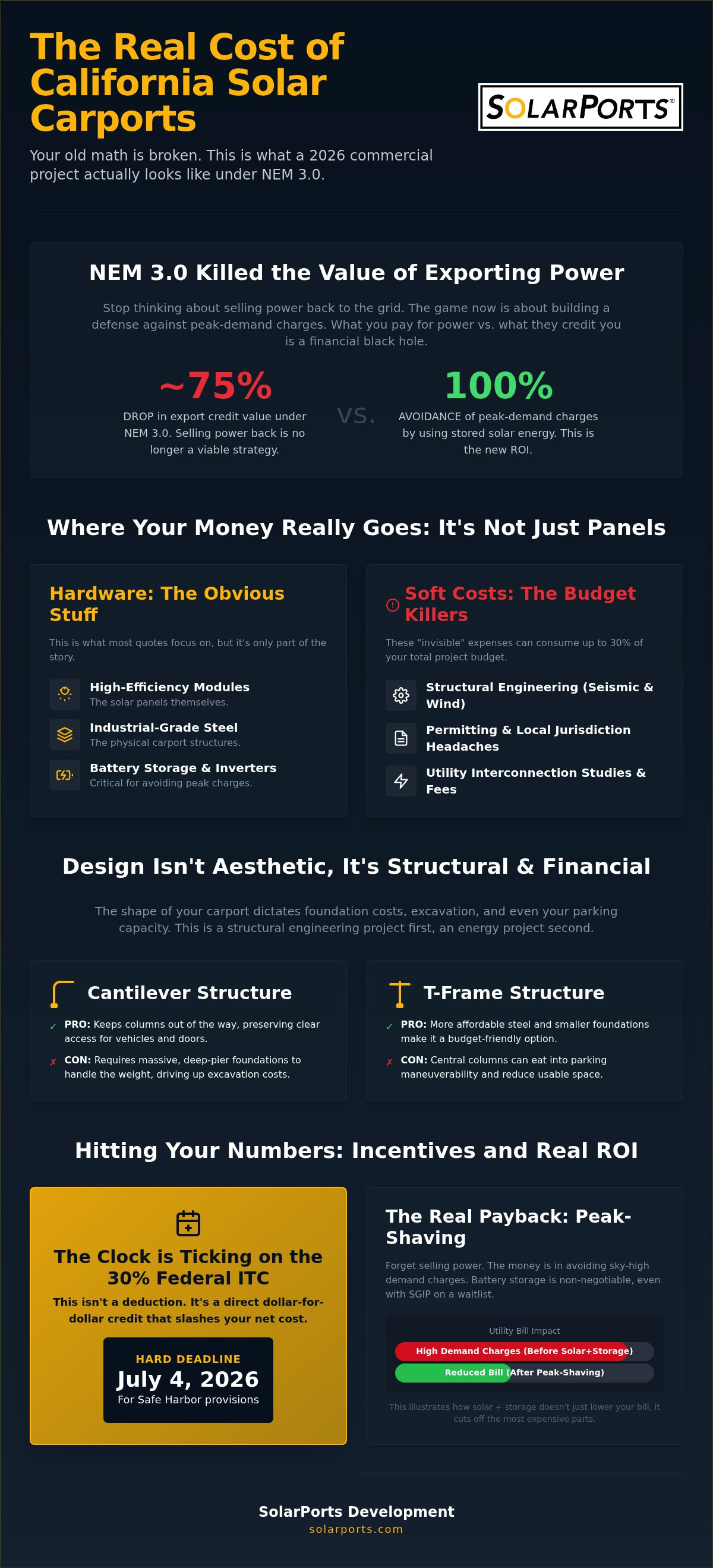
Your hardware spend usually splits between industrial-grade steel structures and high-efficiency modules. However, soft costs often consume up to 30% of the total budget. These are the "invisible" expenses that catch property owners off guard:
- Structural Engineering: Every California site requires specific seismic and wind load calculations for the steel frames.
- Permitting: Local jurisdictions, especially in Northern California, have strict zoning requirements that prolong timelines.
- Interconnection: Utility studies can add months of delays and significant fees before you even break ground.
Labor also drives the final figure. In California, commercial solar projects frequently trigger prevailing wage requirements. This means paying for certified tradespeople to handle the excavation and electrical tie-ins. If your asphalt is aging or underground utility lines are poorly mapped, excavation costs will rise. You aren't just building a power plant. You're re-engineering your property's footprint. Truly understanding the cost of commercial solar carport systems requires looking past the hardware and into the realities of California's construction environment; if you are also considering other property enhancements, you can explore Project-based design and installation fees to see how professional outdoor installation services are structured.
Design Variables That Dictate Your Final Quote
Design isn't an aesthetic choice here. It's a structural necessity. In California, the cost of commercial solar carport projects is heavily dictated by your parking lot's geometry and what's underneath the pavement. Cantilever structures are popular because they keep columns out of the way, but they require massive foundations to handle the weight. T-frame designs are more affordable but eat into your parking maneuverability. If your lot has tight turns or high traffic, the more expensive cantilever might actually save you money by preventing vehicle damage and preserving stall count.
Foundation and Steel: The Hidden Price Drivers
California seismic requirements aren't a suggestion. To meet state code for overhead structures, you're looking at deep-pier foundations that go much further into the ground than a standard building footer. This adds significant cost to the excavation phase. Steel price volatility in 2026 also makes long-term quotes tricky. If you don't lock in your materials early, a swing in steel costs can evaporate your expected ROI before the first panel is installed. While the Self-Generation Incentive Program (SGIP) can help offset costs for the storage side of things, it doesn't cover the raw steel and concrete needed for structural integrity.
Site conditions are the wild card. If your asphalt is crumbling or you hit unmapped utility lines during trenching, your excavation budget will balloon. This is also the time to decide on EV charging. Retrofitting chargers later costs nearly double because you'll have to tear up the same asphalt twice. Integrating them into the initial build is the only logical move for asset management. To see how these variables apply to your specific lot, you can book a strategic site review to get ahead of these hidden costs.
Offsetting CAPEX with California Incentives and ROI
Tax day changes the whole conversation about the cost of commercial solar carport projects. The 30% Federal ITC is a heavy hitter, but you've got to move fast to hit that July 4, 2026, Safe Harbor deadline. It's a direct credit, not just a deduction, which means it hits your bottom line immediately. For most owners, this credit alone slashes the net cost of commercial solar carport installations by nearly a third before you even factor in the tax benefits of depreciation.
ROI in 2026 isn't about the utility cutting you a check for extra power. NEM 3.0 export rates are too low for that to be a viable strategy. The real profit is found in peak-shaving. Even though California's Self-Generation Incentive Program (SGIP) is currently stuck in waitlist purgatory for most commercial sites, the math for battery storage still works by avoiding the highest demand charges. You're effectively building a physical hedge against the utility's next inevitable rate hike.
The Strategic Value of Professional Cost-Saving Analysis
Don't let a vendor sell you more panels than your building can actually handle. Overbuilding is a common trap that inflates your initial spend without adding a cent to your long-term savings. A Commercial Energy Cost Saving Analysis pinpoints the sweet spot where your generation matches your specific load profile. This leads into a clear Commercial Solar ROI Analysis that shows the actual payback period. It's about building a system that serves your balance sheet, not just your parking lot.
Protecting Your Bottom Line Against California Rate Hikes
The real cost of commercial solar carport projects isn't found on a hardware spec sheet. It's determined by how well you navigate California's seismic requirements and utility interconnection hurdles before the 2026 tax deadlines hit. By now, it's clear that a "solar-only" approach won't cut it under NEM 3.0. You need a system that integrates battery storage to aggressively shave peak-demand charges. Success here requires moving past generic estimates and focusing on site-specific data that justifies the investment to your board. Our team specializes in right-sizing these turnkey solutions for small-scale commercial real estate. Stop guessing at your potential ROI. You can Request a Professional Energy Cost Saving Analysis today to lock in your strategy. Let's turn your parking lot into a high-performing financial asset.
Frequently Asked Questions
How much does a commercial solar carport cost per parking space in California?
It's difficult to provide a single number because stall dimensions and structural designs vary. Generally, one parking space requires roughly 3 to 4 kilowatts of solar capacity for adequate coverage. When you factor in the steel and deep foundations required for California sites, the cost per space reflects the complexity of the engineering. Prices fluctuate based on whether you choose a cantilever or T-frame structure.
What are the main factors that increase the cost of solar carport installation?
Seismic engineering is the primary budget driver in California. Every overhead structure must meet strict state codes for wind and earthquake safety, requiring deep-pier foundations. Beyond that, the total cost of commercial solar carport projects often spikes due to soft costs like utility interconnection studies and local permitting. If your lot has crumbling asphalt or unmapped underground lines, excavation expenses will climb quickly.
Are there specific California incentives for commercial solar carports in 2026?
The 30% Federal Investment Tax Credit is the most significant incentive, provided you meet the July 4, 2026, Safe Harbor deadline. California also offers a property tax exclusion, so your assessment won't rise because of the solar array. While state SGIP rebates for battery storage are currently waitlisted for most commercial applicants, the five-year MACRS depreciation schedule remains a powerful tool for recovering capital on the state level.
How long is the typical payback period for a commercial solar carport project?
Most California commercial systems reach a full payback within 5 to 9 years. This timeline is heavily influenced by your utility's peak-demand charges and your use of battery storage. Under NEM 3.0, the old solar-only model has a much slower return. By using stored energy to avoid high evening rates, you can slash the most expensive parts of your bill and shorten the ROI period.
Frequently asked questions
How much does a commercial solar carport cost per parking space in California?
It's difficult to provide a single number because stall dimensions and structural designs vary. Generally, one parking space requires roughly 3 to 4 kilowatts of solar capacity for adequate coverage. When you factor in the steel and deep foundations required for California sites, the cost per space reflects the complexity of the engineering. Prices fluctuate based on whether you choose a cantilever or T-frame structure.
What are the main factors that increase the cost of solar carport installation?
Seismic engineering is the primary budget driver in California. Every overhead structure must meet strict state codes for wind and earthquake safety, requiring deep-pier foundations. Beyond that, the total cost of commercial solar carport projects often spikes due to soft costs like utility interconnection studies and local permitting. If your lot has crumbling asphalt or unmapped underground lines, excavation expenses will climb quickly.
Are there specific California incentives for commercial solar carports in 2026?
The 30% Federal Investment Tax Credit is the most significant incentive, provided you meet the July 4, 2026, Safe Harbor deadline. California also offers a property tax exclusion, so your assessment won't rise because of the solar array. While state SGIP rebates for battery storage are currently waitlisted for most commercial applicants, the five-year MACRS depreciation schedule remains a powerful tool for recovering capital on the state level.
How long is the typical payback period for a commercial solar carport project?
Most California commercial systems reach a full payback within 5 to 9 years. This timeline is heavily influenced by your utility's peak-demand charges and your use of battery storage. Under NEM 3.0, the old solar-only model has a much slower return. By using stored energy to avoid high evening rates, you can slash the most expensive parts of your bill and shorten the ROI period.