
Commercial Solar Carports vs Rooftop Solar: The 2026 Strategic Play for California Property Owners

The obvious choice for renewable energy usually starts on the roof, but for many California property owners, that's becoming a strategic mistake. If you're managing a commercial site in 2026, you're likely caught between skyrocketing PG&E peak-demand charges and a roof structure that simply isn't built for a massive solar array. It's a frustrating spot to be in. You want the energy savings, but you don't want the structural headaches or the tenant complaints about vehicles baking in the sun all day.
We've seen this play out enough to know that the debate of solar carport vs rooftop solar for commercial buildings isn't just about where the panels go; it's about which asset generates the best long-term yield under NEM 3.0. You'll learn how to bypass roof limitations while building the kind of Class A property appeal that keeps high-value tenants happy. We're going to look at the financial math behind carports, the reality of current federal tax credits, and why your parking lot might actually be your most valuable energy resource.
Key Takeaways
- Asphalt is a blank canvas. Learn why carports avoid the structural headaches of cluttered rooftops while keeping tenants cool and happy.
- When looking at a solar carport vs rooftop solar for commercial buildings, the real value is in how you integrate storage to finally neutralize those brutal PG&E peak-demand charges.
- EV charging isn't a luxury anymore. See how to turn your parking lot into a high-yield asset that justifies higher lease rates and Class A status.
- Stop the guesswork on system size. A proper energy cost saving analysis is the only way to make sure you aren't overbuilding and wasting capital.
- The 2026 tax credit landscape is the biggest driver of ROI, but you have to move now to navigate the current service deadlines.
Table of Contents
- Why Solar Carports Often Outperform Rooftop Arrays for CA Commercial Real Estate
- Maximizing Asset Value: Integrating BESS and EV Charging Infrastructure
- Navigating the 2026 California ROI Landscape: From Analysis to Installation
Why Solar Carports Often Outperform Rooftop Arrays for CA Commercial Real Estate
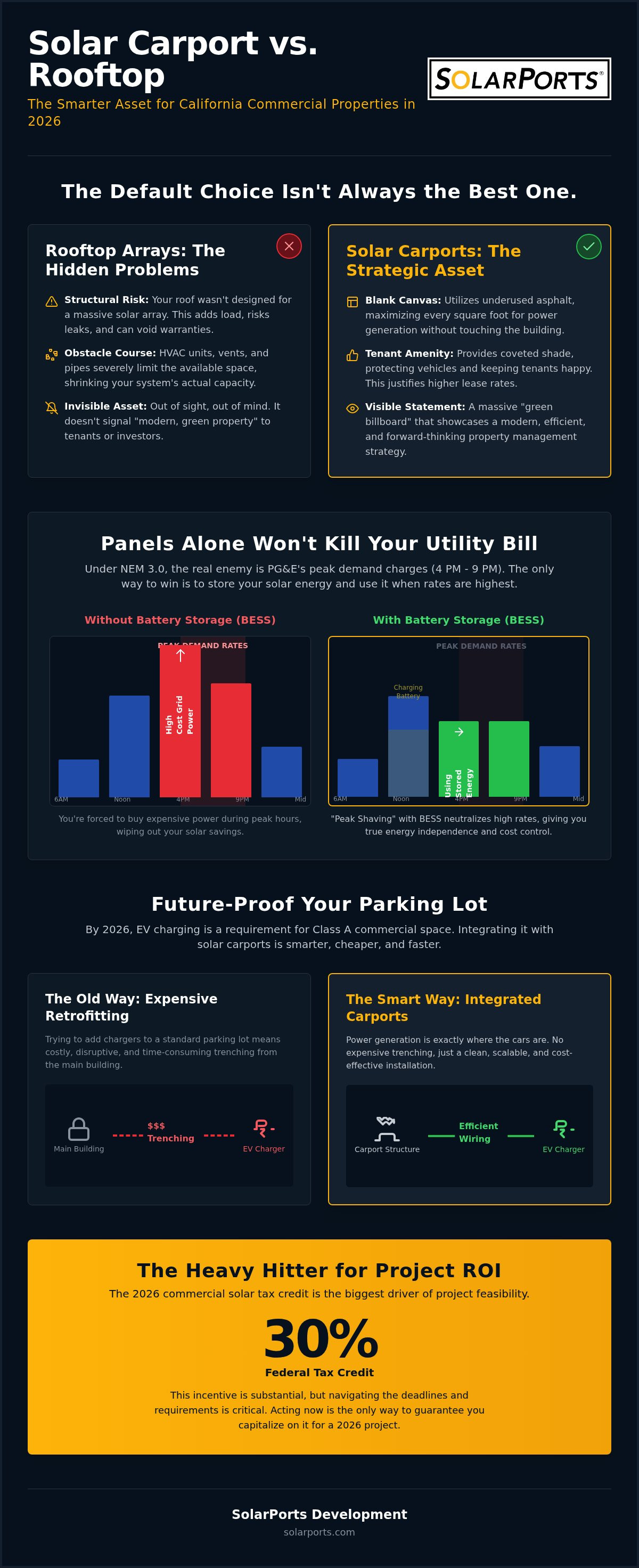
Rooftop solar is often treated as the default because it's less expensive upfront. That's shortsighted. When you weigh the pros and cons of a solar carport vs rooftop solar for commercial buildings, you have to look at the total lifecycle value. Your parking lot is essentially a blank canvas of underutilized asphalt. Compare that to a roof that's likely already crowded with HVAC units, vents, and aging membranes that you'll eventually have to replace. In California, shade is a premium. Protecting vehicles from the sun isn't just a nice to have anymore. It's a way to justify higher lease rates and keep tenant satisfaction high.
The "Invisible Asset" Problem
Rooftop solar is basically invisible from the street. It does the job, but it doesn't tell a story to your investors or prospective tenants. A solar canopy, on the other hand, acts as a massive green billboard. Understanding What is a Solar Canopy? helps clarify why these structures are becoming the standard for high-end commercial sites. It signals that the property is managed with a focus on modern efficiency. Plus, you aren't messing with your roof's structural integrity or risking a leak that voids your existing warranties. It's a clean break from the building's envelope.
Solving the Rooftop Obstacle Course
Putting panels on a roof means working around an obstacle course of mechanical equipment. This often shrinks your actual capacity, leaving you with a system that can't even cover your baseline load. Carports don't have that problem. You can maximize every square foot of your parking area. Maintenance is also a different world at ground level. You don't need expensive safety rigging or cranes just to clean a panel or swap an inverter. It's safer, faster, and ultimately cheaper to keep running over the long haul. We've seen this play out across dozens of commercial projects where the roof just wasn't a viable option for a high-yield array.
Maximizing Asset Value: Integrating BESS and EV Charging Infrastructure
Solar panels on their own won't kill your utility bill. It's a hard truth most vendors skip. In Northern California, the bulk of your PG&E bill comes from demand charges, those spikes in usage that the utility penalizes heavily. When comparing a solar carport vs rooftop solar for commercial buildings, the real winner is the one that integrates Battery Energy Storage Systems (BESS). Storage allows you to engage in "peak shaving." You capture the midday sun and deploy it between 4 PM and 9 PM when rates are highest.
Taming California Demand Charges with BESS
Demand charges often represent the largest portion of a commercial power bill. Under the current version of California's Net Energy Metering Program, exporting power back to the grid pays roughly 75% less than it did under previous rules. It makes more financial sense to keep that energy on-site. By pairing a carport with storage, you create a buffer against utility price volatility. It's a tactical move that turns a variable expense into a predictable operational cost.
Future-Proofing for the EV Mandate
By 2026, EV charging isn't just a perk for tech workers. It's a requirement for Class A commercial space. Building commercial solar carports with EV charging is much more efficient than trying to retrofit an old parking lot. You avoid the massive expense of trenching through hundreds of feet of existing asphalt because the power generation is already exactly where the cars are. Modular designs let you start with a few ports and scale up as your tenants' needs grow. This scalability is a primary factor in the solar carport vs rooftop solar for commercial buildings debate for properties with expanding energy needs. If you're wondering how this fits your specific site, you can book a strategy session to see the numbers.
Navigating the 2026 California ROI Landscape: From Analysis to Installation
The commercial solar tax credit in California remains the heavy hitter for project feasibility in 2026. It's sitting at 30%, but that's only part of the story. When you're deciding between a solar carport vs rooftop solar for commercial buildings, you have to look at the total tax shield. Between the ITC and the 20% bonus depreciation available this year, the federal government is effectively subsidizing half the project. But don't let the incentives blind you to the engineering. Overbuilding a system under NEM 3.0 is a financial trap. If you produce more than you can use or store, you're essentially gifting cheap power to PG&E for a fraction of its value. It’s a waste of capital.
Execution matters just as much as the math. Northern California permitting is a notorious bottleneck that can tank a project's momentum. To keep a predictable commercial solar installation timeline, you need a partner who knows the local planning departments by name. It prevents the "vendor finger-pointing" that happens when a generic solar installer realizes they didn't account for specific seismic requirements or utility interconnection hurdles.
The Critical Role of Energy Cost Saving Analysis
You can't guess your way into a high-yield asset. A data-driven audit is the mandatory first step before any steel is ordered. At SolarPorts Development, we use your historical utility data to model real-world cash flow, not just "best-case" scenarios. We look at your 15-minute interval data to see exactly when those peak-demand charges hit. This analysis ensures the system is right-sized to your actual consumption patterns, protecting your internal rate of return from day one.
Financing and Depreciation Strategies
The 5-year MACRS depreciation schedule is a powerful tool for CFOs, especially when paired with a turnkey execution model. A clean commercial solar ROI analysis makes the board approval process much smoother because it accounts for all the variables: tax credits, depreciation, and avoided utility costs. It moves the project from a "maybe" to a strategic financial play. It's about turning a parking lot liability into a predictable, long-term energy asset.
Turning Underutilized Asphalt into a High-Yield Energy Asset
Choosing between a solar carport vs rooftop solar for commercial buildings isn't just about where you mount the panels. It's a strategic decision on how to maximize your property's footprint while shielding your bottom line from PG&E’s aggressive rate hikes. The logic is straightforward. Carports offer the visibility and structural freedom that rooftops often lack, especially when you factor in the necessity of battery storage to handle those 4 PM peak windows. We've spent years as small-scale project specialists in Northern California, focusing on turnkey BESS and solar integration that actually works for commercial real estate.
The first step isn't buying hardware. It's confirming the math. You don't need a massive industrial park to make these numbers pencil out, but you do need a data-backed plan that accounts for current 2026 tax incentives and local permitting reality. You can Request your Commercial Energy Cost Saving Analysis to see exactly how this looks for your specific site. It's time to stop paying for peak demand and start generating long-term property value instead.
Frequently Asked Questions
How much does a commercial solar carport cost in California for 2026?
A solar carport carries a structural premium compared to rooftop installations because you're building a stand-alone steel structure rather than using an existing roof. While hardware costs vary, you have to account for the additional civil engineering and foundation work required for a parking lot. It's a higher initial investment, but it creates a dual-purpose asset that provides shade and vehicle protection while generating power.
Do solar carports require significant parking lot downtime during installation?
Construction is handled in phases to ensure you never lose access to your entire lot at once. We typically cordon off small sections for foundation drilling and steel erection, leaving the rest of the stalls open for tenants and customers. It’s a methodical process. Most property owners see a minimal impact on daily operations, especially since the heavy lifting is often scheduled during lower-traffic windows.
What is the typical payback period for a commercial solar carport project?
Under California’s current Net Billing Tariff, a solar-only system typically sees a payback period between 9 and 14 years. However, integrating battery storage to capture midday production often shrinks that window to 7 to 9 years. This shift is a critical factor when weighing a solar carport vs rooftop solar for commercial buildings. You're no longer just selling power back to the grid; you're using it to kill expensive peak-hour demand charges.
Can a solar carport withstand high winds and seismic activity in Northern California?
These structures are engineered to meet the rigorous seismic and wind load requirements of the California Building Code. We use deep-drilled concrete piers and heavy-gauge structural steel to ensure the array stays put during Northern California's specific environmental stresses. It's not just about supporting the panels. The entire system is built to protect the vehicles underneath it, providing a level of structural integrity that far exceeds standard car shades.
Frequently asked questions
How much does a commercial solar carport cost in California for 2026?
A solar carport carries a structural premium compared to rooftop installations because you're building a stand-alone steel structure rather than using an existing roof. While hardware costs vary, you have to account for the additional civil engineering and foundation work required for a parking lot. It's a higher initial investment, but it creates a dual-purpose asset that provides shade and vehicle protection while generating power.
Do solar carports require significant parking lot downtime during installation?
Construction is handled in phases to ensure you never lose access to your entire lot at once. We typically cordon off small sections for foundation drilling and steel erection, leaving the rest of the stalls open for tenants and customers. It’s a methodical process. Most property owners see a minimal impact on daily operations, especially since the heavy lifting is often scheduled during lower-traffic windows.
What is the typical payback period for a commercial solar carport project?
Under California’s current Net Billing Tariff, a solar-only system typically sees a payback period between 9 and 14 years. However, integrating battery storage to capture midday production often shrinks that window to 7 to 9 years. This shift is a critical factor when weighing a solar carport vs rooftop solar for commercial buildings. You're no longer just selling power back to the grid; you're using it to kill expensive peak-hour demand charges.
Can a solar carport withstand high winds and seismic activity in Northern California?
These structures are engineered to meet the rigorous seismic and wind load requirements of the California Building Code. We use deep-drilled concrete piers and heavy-gauge structural steel to ensure the array stays put during Northern California's specific environmental stresses. It's not just about supporting the panels. The entire system is built to protect the vehicles underneath it, providing a level of structural integrity that far exceeds standard car shades.