
Solar Carport with Battery Storage and EV Charging: The 2026 Strategic Shield for CA Commercial Property

Your parking lot is currently a liability. It's an expanse of asphalt that absorbs heat, generates zero revenue, and sits idle while PG&E or SCE hikes your peak demand charges yet again. In 2026, treating a solar carport with battery storage and EV charging as a "green" amenity is a strategic mistake that ignores the reality of California’s energy market. It isn't about looking sustainable. It's about building a data-driven defense against utility volatility that is designed to protect your net operating income.
You've likely felt the pressure to provide charging for the nearly 30% of new car buyers in the state who went electric last year, but you're worried about blowing your building's power budget. We're going to stop the guesswork. This guide breaks down how to use the 30% federal tax credit and current SGIP rebates to turn your underutilized space into a turnkey energy hub. You'll see exactly how a right-sized system keeps your property value ahead of 2026 Title 24 requirements without forcing you to become an energy expert or a full-time grid analyst.
Key Takeaways
- Stop treating solar as a "green" luxury. It's a calculated move to hedge against the aggressive rate hikes currently hitting California commercial properties.
- A solar carport with battery storage and EV charging creates a "triple threat" solution that shaves peak demand charges while capturing new revenue from tenant and public charging.
- Maximize your 2026 ROI by leveraging the 30% federal tax credit and bonus depreciation to offset the cost of both the storage technology and the structural steel.
- Avoid the common mistake of over-engineering. A precise energy cost saving analysis ensures you build for your specific load profile rather than a salesperson's quota.
- Streamline the complex California permitting and interconnection process by using a data-first approach that anticipates utility hurdles before they stall your project.
Table of Contents
- Why the Integrated Solar Carport is the 2026 Survival Strategy for CA Commercial Real Estate
- Engineering the ROI: How BESS and Solar Carports Integrate as One Machine
- Implementation Path: From Analysis to Grid Independence
Why the Integrated Solar Carport is the 2026 Survival Strategy for CA Commercial Real Estate
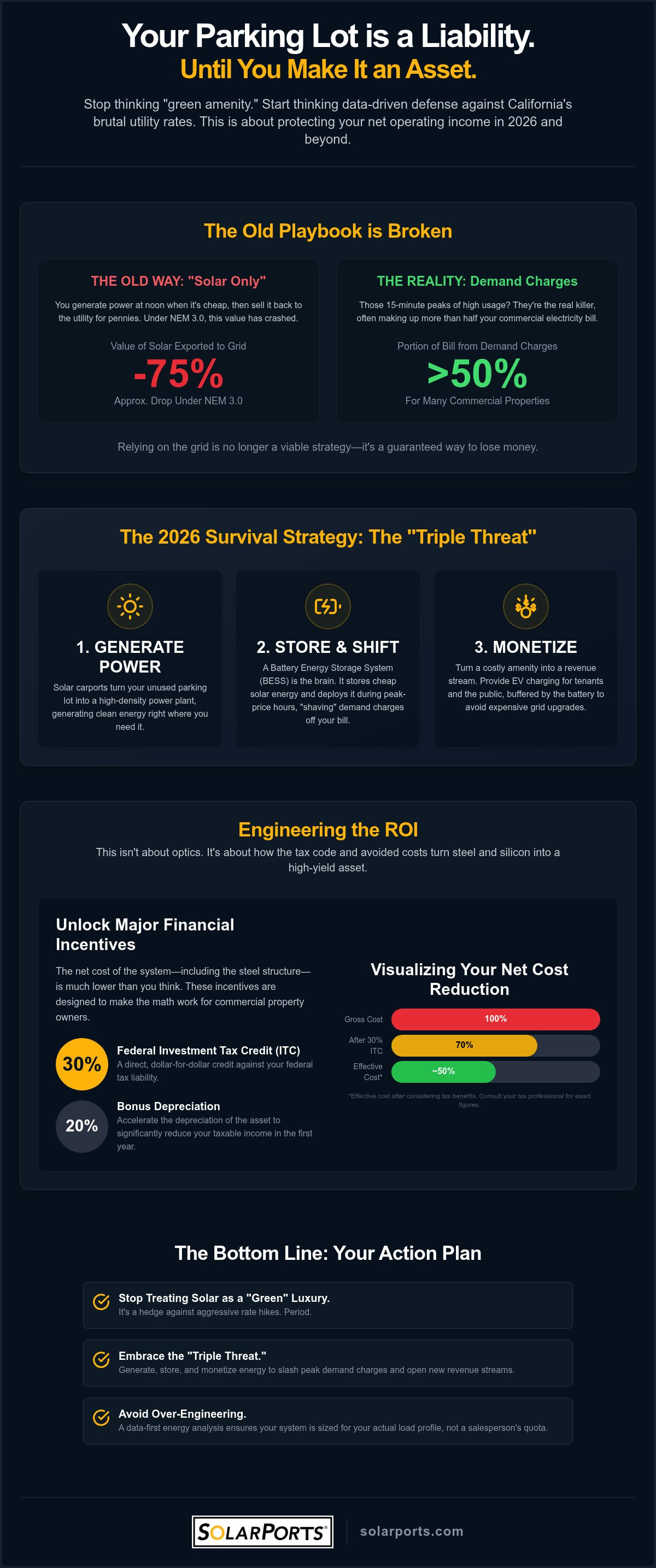
California's utility market has fundamentally shifted, and your parking lot is likely the most undervalued asset on your balance sheet. If you're still viewing that asphalt as a maintenance liability, you're missing a massive opportunity to stabilize your building's cash flow. Under NEM 3.0, the value of energy sent back to the grid has plummeted by approximately 75%. The old strategy of "selling" power to the utility is dead. You need a system that keeps power on-site where it can actually work for you. A solar carport with battery storage and EV charging isn't a "green" luxury anymore; it's a strategic tool to stop the bleeding from demand charges that often comprise over half of a commercial power bill.
These photovoltaic systems do more than just provide shade. They represent a "Triple Threat" to rising operational costs: solar generates the power, the battery stores it for peak hours, and the EV chargers monetize the entire setup. While rooftop solar is often restricted by HVAC equipment or aging roof membranes, carports utilize high-density parking zones to generate power exactly where it's needed most. It’s a way to future-proof your asset while the grid becomes increasingly volatile and expensive.
The Death of the "Solar Only" Model
Installing solar without a battery in 2026 is like buying a car without a gas tank. You're capturing energy at noon when it's worth the least and buying it back at 6:00 PM when the utilities charge the most. By integrating a Battery Energy Storage System (BESS), you're "shaving" those peak 15-minute windows of high usage that trigger massive demand charges. Our commercial property energy cost saving analysis shows that shifting your load profile is the only way to maintain a predictable ROI in the current regulatory environment.
EV Charging as a Revenue Stream, Not a Cost Center
Most property owners dread the thought of a main transformer upgrade to support EV infrastructure. Integrated systems bypass this headache. By using the battery to buffer the charging load, you can deploy high-speed charging without a total building overhaul. This transforms a mandated amenity into a revenue-generating asset that attracts premium tenants who won't sign a lease without reliable, on-site charging. It's about building for the 29% of California drivers who are already electric, without blowing your power budget.
Engineering the ROI: How BESS and Solar Carports Integrate as One Machine
A common critique on property management forums is that the cost of the steel structure makes solar carports a poor investment. This perspective is outdated because it ignores how a solar carport with battery storage and EV charging functions as a unified financial machine. In 2026, the ROI isn't found in the "green" optics. It is found in the tax code and the elimination of demand charges. Between the 30% federal Investment Tax Credit (ITC) and the 20% bonus depreciation available this year, the net cost of that steel structure is significantly lower than most owners realize. This case study on solar EV carports demonstrates that when you factor in the avoided costs of utility energy, the math shifts from a decade-long payback to a high-yield asset.
Reliability is the other half of the equation. We see properties over-engineering their systems, adding complexity where it isn't needed. A proper commercial energy cost saving analysis prevents this by right-sizing the battery and solar capacity to your specific load profile. Modern IP66-rated components are built for the California climate, meaning they handle the heat and dust of the Central Valley or the salt air of the coast with very little oversight. It’s a set-it-and-forget-it strategy for your bottom line.
Peak Shaving and Load Shifting
The battery is the brains of the operation. When utility prices spike during the late afternoon, the system automatically switches your building load and EV chargers to pull from stored energy rather than the grid. This process, known as peak shaving, targets those expensive 15-minute windows that usually inflate your monthly bill. You are essentially buying power at its cheapest and using it when it’s most expensive.
Structural Integrity and Site Optimization
Design choice matters for parking efficiency. A cantilevered design keeps the support columns out of the way of car doors, while T-frames offer a robust, symmetrical look for larger lots. Integrating high-efficiency LED lighting and security cameras directly into the frame adds immediate property value. If you want to see how these designs fit your specific site, you can book a strategy session with our team to review your layout options.
Implementation Path: From Analysis to Grid Independence
Don't let a salesperson tell you what you need based on a satellite photo and a hunch. Your actual utility data is the only source of truth. In California, small-scale commercial properties have unique load profiles that differ wildly from a massive distribution center or a residential home. You need a system built for your specific occupancy patterns. A solar carport with battery storage and EV charging is a complex integration of structural engineering and electrical management; guessing on the size of your battery or the number of charging ports is a fast way to ruin your ROI.
While this guide focuses on commercial applications, homeowners in Southern California looking for the same level of durability and design in residential outdoor structures can check out Elite L.A. Patios to explore high-end aluminum features for their private properties.
The California permitting and interconnection maze is where most projects stall out. Between local building departments and the utility's own slow-moving bureaucracy, the red tape is thick. You need a partner who understands the granular nuances of PG&E, SCE, or SDG&E's specific requirements. This is why moving toward a turnkey commercial solar project is the only way to maintain your sanity while keeping the project on schedule.
The Role of the Commercial Energy Cost Saving Analysis
We start with 12 months of interval data. This isn't just about looking at your total monthly spend; it's about seeing the 15-minute spikes that trigger your highest demand charges. This analysis identifies "hidden" savings that rooftop solar alone would miss. By right-sizing the BESS, we ensure you aren't paying for storage capacity you'll never use, while still providing enough buffer to keep your EV chargers from hitting the grid during peak pricing hours.
Selecting a Turnkey Partner in California
There's a massive difference between a solar installer and a commercial energy partner. An installer puts panels on a rack and leaves the rest to you. A true partner manages the entire stack: the structural engineering, the procurement of the steel, and the actual construction (EPC). You shouldn't have to manage five different subcontractors to get your system online. Our commercial property energy cost saving analysis is the foundation of this process, ensuring the final build matches the financial goals we set at the beginning. Start with the data, and the rest of the strategy falls into place.
Securing Your Property's Financial Future Against California Utility Shifts
The window for passive property management in California has closed. Every time PG&E or SCE updates their rate schedule, your operating expenses become more unpredictable. Integrating a solar carport with battery storage and EV charging is the most effective way to reclaim control over your building's power budget. We've seen that the math works when you stop guessing and start looking at the 15-minute interval data. By combining federal tax credits with peak shaving strategies, you transform a heat-absorbing parking lot into a high-yield energy hub.
As specialists in Northern California commercial property energy solutions, we don't just sell hardware; we provide a complete turnkey BESS and carport integration. Our process is rooted in data-driven ROI modeling that cuts through the marketing fluff to show you exactly how a right-sized system performs. You don't need to be an energy expert to protect your bottom line. It's about making a calculated move before the next round of rate hikes hits your desk.
Ready to see the actual numbers for your site? Request Your Commercial Energy Cost Saving Analysis and let's build a strategy that actually lands. It's time to stop paying for the utility's volatility and start investing in your own resilience.
Common Questions Regarding Commercial Energy Integration
How much does a commercial solar carport with battery storage cost in California?
Total investment varies based on your site's electrical infrastructure and the specific soil conditions of your parking lot. It's more productive to focus on the net cost after you apply the 30% federal tax credit and the 20% bonus depreciation available in 2026. We don't provide generic per-watt pricing because a system that isn't right-sized for your specific peak demand will never deliver a predictable ROI. The goal is to build for your load profile, not a salesperson's quota.
Will a solar carport with EV charging increase my property taxes?
No, you're currently protected by a California property tax exclusion for active solar energy systems. This regulation ensures that the added value of your solar carport with battery storage and EV charging doesn't trigger a reassessment of your property's base value. You should be aware that this exclusion is currently set to expire after 2026. Moving forward with your project now locks in that benefit before the window closes on this specific tax advantage.
How long is the typical payback period for an integrated BESS and carport system?
Payback periods have shifted under NEM 3.0, but the addition of battery storage actually shortens the timeline by capturing energy that would otherwise be exported at a loss. While rooftop solar alone might struggle with low utility export rates, an integrated system targets the demand charges that often make up over 50% of a commercial bill. Most owners see the system pay for itself much faster when they factor in the "avoided costs" of utility power and the revenue captured from tenant EV charging.
Can I install a solar carport if I already have rooftop solar?
Yes, carports are the ideal solution for properties that have already maxed out their roof space or have aging roof membranes they don't want to disturb. You can run the carport as a separate system or integrate it into your existing electrical room to help buffer the building's total load. It’s a common strategy for Northern California businesses that need more power for EV charging but want to avoid the cost and headache of a main transformer upgrade.
What is the lifespan of the battery storage in a commercial carport system?
You should expect a 10 to 15-year operational life for a high-quality commercial BESS. These systems are rated by cycle life, typically offering 6,000 to 8,000 cycles before the capacity drops below 80% of its original rating. Since most commercial properties only cycle their battery once per day for peak shaving, the hardware is built to outlast the initial financing or lease term. It's a durable asset that requires very little maintenance beyond standard annual inspections.
How does the 2026 Federal Tax Credit apply to solar carports?
The Investment Tax Credit (ITC) allows you to deduct 30% of the total project cost from your federal taxes. This is a massive win for carports because the credit applies to the structural steel and foundations, not just the panels and inverters. If your property is located in a designated "energy community" or uses domestic content, that credit can jump to 40% or 50%. It’s a powerful incentive that effectively subsidizes your parking lot's structural upgrades while you build out your energy independence.
Frequently asked questions
How much does a commercial solar carport with battery storage cost in California?
Total investment varies based on your site's electrical infrastructure and the specific soil conditions of your parking lot. It's more productive to focus on the net cost after you apply the 30% federal tax credit and the 20% bonus depreciation available in 2026. We don't provide generic per-watt pricing because a system that isn't right-sized for your specific peak demand will never deliver a predictable ROI. The goal is to build for your load profile, not a salesperson's quota.
Will a solar carport with EV charging increase my property taxes?
No, you're currently protected by a California property tax exclusion for active solar energy systems. This regulation ensures that the added value of your solar carport with battery storage and EV charging doesn't trigger a reassessment of your property's base value. You should be aware that this exclusion is currently set to expire after 2026. Moving forward with your project now locks in that benefit before the window closes on this specific tax advantage.
How long is the typical payback period for an integrated BESS and carport system?
Payback periods have shifted under NEM 3.0, but the addition of battery storage actually shortens the timeline by capturing energy that would otherwise be exported at a loss. While rooftop solar alone might struggle with low utility export rates, an integrated system targets the demand charges that often make up over 50% of a commercial bill. Most owners see the system pay for itself much faster when they factor in the "avoided costs" of utility power and the revenue captured from tenant EV charging.
Can I install a solar carport if I already have rooftop solar?
Yes, carports are the ideal solution for properties that have already maxed out their roof space or have aging roof membranes they don't want to disturb. You can run the carport as a separate system or integrate it into your existing electrical room to help buffer the building's total load. It’s a common strategy for Northern California businesses that need more power for EV charging but want to avoid the cost and headache of a main transformer upgrade.
What is the lifespan of the battery storage in a commercial carport system?
You should expect a 10 to 15-year operational life for a high-quality commercial BESS. These systems are rated by cycle life, typically offering 6,000 to 8,000 cycles before the capacity drops below 80% of its original rating. Since most commercial properties only cycle their battery once per day for peak shaving, the hardware is built to outlast the initial financing or lease term. It's a durable asset that requires very little maintenance beyond standard annual inspections.
How does the 2026 Federal Tax Credit apply to solar carports?
The Investment Tax Credit (ITC) allows you to deduct 30% of the total project cost from your federal taxes. This is a massive win for carports because the credit applies to the structural steel and foundations, not just the panels and inverters. If your property is located in a designated "energy community" or uses domestic content, that credit can jump to 40% or 50%. It’s a powerful incentive that effectively subsidizes your parking lot's structural upgrades while you build out your energy independence.