
Commercial Solar and Battery Storage Under NEM 3.0: The Unfiltered 2026 Reality

The idea that you can still achieve a meaningful ROI with a solar-only system in California is a myth that effectively died in 2023. If you're looking at your Northern California utility bill and wondering why your current quotes don't match the savings your peers saw five years ago, it's because the math has fundamentally shifted. Implementing commercial solar and battery storage under NEM 3.0 is no longer an optional upgrade; it's the only way to stop the utility from clawing back nearly 75% of the energy value your property produces. The old retail-rate credits are gone, replaced by a complex Avoided Cost Calculator that essentially punishes businesses for exporting power during the day.
You're likely tired of watching peak-demand charges eat your margins while you try to decode 576 different export rates that change by the hour. It's a calculated burden that makes traditional grid-tied solar feel like a losing game. This article explains how battery storage fixes that equation by allowing you to store your own power for use when grid prices are at their highest. We'll look at the 2026 reality of export credits and the exact steps required to turn your rooftop or carport into a strategic financial asset that provides genuine energy independence.
Key Takeaways
- The Net Billing Tariff replaces retail credits with "avoided cost" rates that change every hour, making the timing of your energy use more important than total generation.
- Batteries are no longer an optional upgrade. They are the primary tool for shifting solar power to the 4 PM to 9 PM peak when grid costs are highest.
- Implementing commercial solar and battery storage under NEM 3.0 is the most effective way to target demand charges, which often represent half of a commercial electricity bill.
- Solar carports offer a dual-purpose solution for properties with limited roof space, providing both clean power and high-value shade for tenants or customers.
- A turnkey approach is essential for navigating the 2026 SGIP rebate levels and the interconnection paperwork that typically stalls small-scale commercial projects.
Table of Contents
- The NEM 3.0 Shift: Why the Math Changed for California Businesses
- The BESS Mandate: Why Battery Storage is Non-Negotiable in 2026
- Turnkey Implementation: Carports, Rooftops, and Strategic Execution
The NEM 3.0 Shift: Why the Math Changed for California Businesses
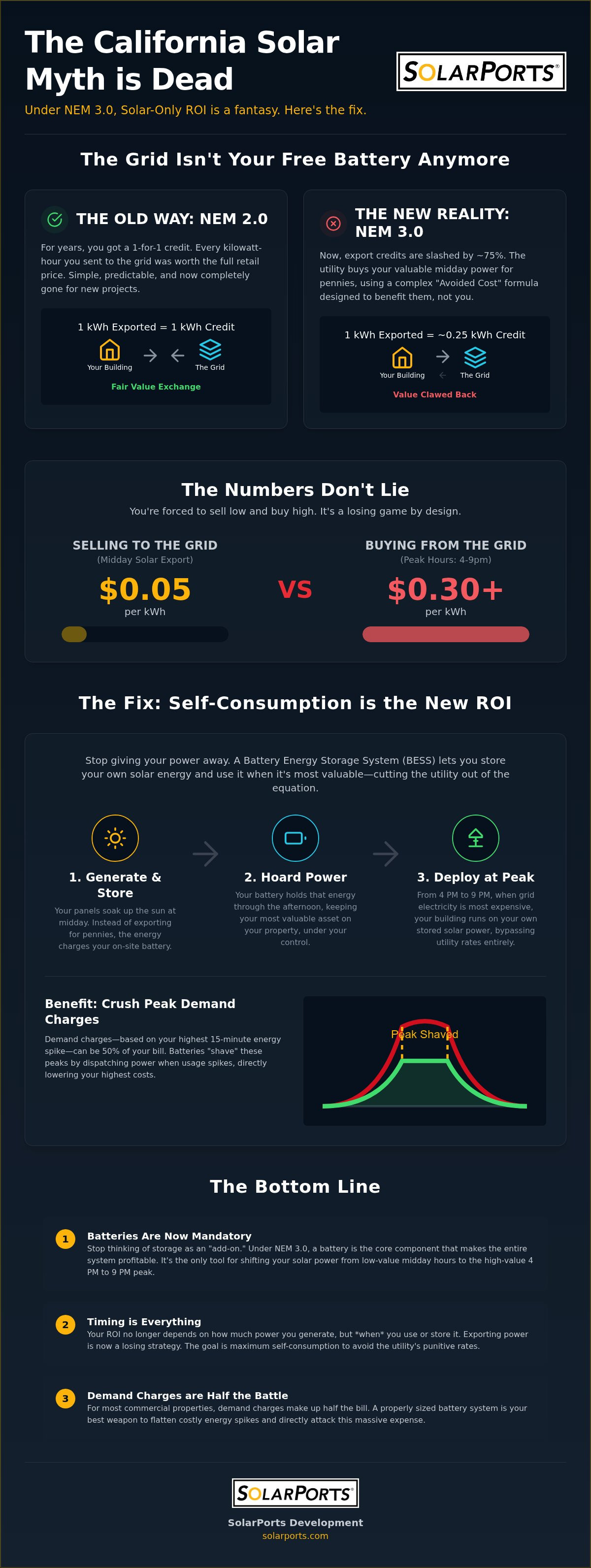
The grid isn't your free storage locker anymore. For years, California businesses relied on the traditional Net Metering (NEM) structure, where every kilowatt-hour sent to the grid was credited at the full retail rate. That 1-to-1 swap was simple, predictable, and, as of April 2023, completely extinct for new interconnections. Under the current Net Billing Tariff, the value of exported energy has been slashed by roughly 75% to 80%. NEM 3.0 represents a fundamental shift from using the utility grid as a battery to making on-site storage the only viable path for a positive return.
From Net Metering to Net Billing
The new math is dictated by the Avoided Cost Calculator (ACC). Instead of a flat credit, your compensation is now based on what it would have cost the utility to buy that power elsewhere. This results in 576 different export rates that fluctuate based on the month, hour, and day. In Northern California, PG&E has implemented some of the most aggressive structures in the state. If you're pushing power back to the grid at noon, you're likely receiving a meager $0.05 to $0.08 per kWh while still paying over $0.20 per kWh for power you buy back later. It's a losing game that only benefits the utility.
The High Cost of Doing Nothing
Sticking with a solar-only mindset in 2026 is a recipe for financial stagnation. You'll be forced to absorb surging utility rates while your excess generation is essentially donated to the grid for pennies. This makes commercial solar and battery storage under NEM 3.0 the mandatory standard for any property owner who actually wants to see a paycheck. Without a battery to capture that noon sun, you're leaving your ROI to the mercy of the ACC. If you're serious about protecting your bottom line, you need to look at specific strategies to lower commercial electricity bills California property owners are using to bypass these grid penalties.
The BESS Mandate: Why Battery Storage is Non-Negotiable in 2026
Selling power back to the grid for $0.05 while buying it back for $0.30 a few hours later is a fast track to a failed investment. In 2026, the strategy for commercial solar and battery storage under NEM 3.0 has shifted from asking how much you can export to asking how much you can hoard. Self-consumption is the new ROI metric. Keeping your own electrons on-site is objectively more valuable than sending them back to a utility that has no use for them at noon. The payback period of your entire project is ultimately determined by how accurately you match your battery capacity to your peak evening load.
Mitigating Peak Demand and Time-of-Use Charges
Commercial bills are often split right down the middle between energy use and demand charges. These charges, based on your highest 15 minute usage spike, can account for 50% of your monthly costs. A Battery Energy Storage System (BESS) acts as a financial buffer. It "shaves" those peaks by discharging stored solar power when your building's load hits its ceiling. This is the core of California's Net Billing Tariff (NBT) logic. You use your own noon-generated power during the brutal 4 PM to 9 PM window when grid prices skyrocket, effectively bypassing the utility's most expensive rates.
Right-Sizing Your System for ROI
Payback periods are won or lost in the design phase. Overbuilding solar without enough storage capacity creates stranded assets that export power for pennies. A precise commercial property energy cost saving analysis is the only way to find your property's specific sweet spot for battery capacity. You don't want a system that's too small to cover your evening ramp-up, but you shouldn't pay for capacity you'll never use either. Understanding your commercial solar ROI analysis requires looking at 20 year projections, not just the first twelve months. If you're unsure where your facility sits on this curve, it might be time to book a data-driven strategy session to see the actual numbers for your site.
Turnkey Implementation: Carports, Rooftops, and Strategic Execution
Small-scale commercial real estate requires a level of precision that utility-scale projects simply don't care about. You're working with fixed boundaries, existing tenants, and aging infrastructure. A genuine "thinking fix" for your property involves re-imagining your parking lot as a power plant rather than just a liability for asphalt maintenance. This shift in perspective is the only way to make commercial solar and battery storage under NEM 3.0 work for your bottom line. Hardware is the easy part; the strategic execution is where the actual ROI is found.
Turnkey implementation is the only way to survive the administrative bog. Most projects die in the permitting, interconnection, and SGIP incentive paperwork that requires constant, aggressive follow-up. A specialized partner handles this administrative weight so your team can stay focused on operations. We aren't just installing panels. We're managing a complex financial transition that requires a deep understanding of California's regulatory environment.
Maximizing Real Estate with Solar Carports
Rooftops are often cluttered with HVAC systems or lack the structural integrity for a massive array. Solar carports bypass these physical limits by creating a secondary generation surface over your existing parking stalls. These are dual-purpose assets that provide high-value shade for vehicles while housing the infrastructure for commercial solar and battery storage under NEM 3.0. Integrating EV charging into these structures is a logical way to future-proof the property against changing tenant demands. You can see how these systems compare in our analysis of commercial solar carport with EV charging California.
The SolarPorts Development Approach to California Commercial Energy
Navigating the specific interconnection hurdles of Northern California utilities requires a local, granular focus that national conglomerates can't provide. SolarPorts Development prioritizes data-driven analysis to ensure your battery capacity actually matches your building's load profile. You can review our recent energy projects to see how we've integrated BESS with rooftop systems to hit specific ROI targets. If you're ready to see if your property qualifies for a 2026 upgrade, a data-driven analysis is the first step toward reclaiming your energy independence.
Securing Your 2026 Energy Strategy
The era of simple solar exports is over. You've seen how the Avoided Cost Calculator effectively penalizes businesses for pushing power to the grid during the day. In this environment, commercial solar and battery storage under NEM 3.0 isn't just a green initiative; it's a necessary financial hedge against utility rates that show no signs of slowing down. It's about shifting from being a passive consumer to an active energy manager who uses storage to bypass peak-demand charges and keep your generated value on-site.
Realizing these gains requires more than just hardware. You need a partner who understands the specific hurdles of the California market and provides the data-driven ROI modeling necessary to justify the investment. We specialize in small-scale commercial BESS and turnkey solutions that take the administrative burden of permitting and SGIP incentives off your plate. If you're ready to see the actual numbers for your property, Request Your Commercial Energy Cost Saving Analysis today. Taking control of your energy costs is the most predictable way to protect your long-term margins.
Frequently Asked Questions
How does NEM 3.0 affect existing commercial solar systems installed before 2023?
Existing systems installed before the April 2023 transition generally stay on their original NEM 1.0 or 2.0 terms for 20 years from the date they received Permission to Operate (PTO). This means your export credits remain at the higher retail-linked rates for the remainder of that window. However, any system that didn't meet the final April 15, 2026, deadline for NEM 2.0 interconnection will automatically fall under the new Net Billing Tariff rules. It's a hard cutoff that changes the math for any legacy expansion plans.
Can I add battery storage to my existing NEM 2.0 commercial solar system?
You can absolutely add a Battery Energy Storage System (BESS) to an existing NEM 2.0 system without losing your grandfathered status. The critical rule is that you cannot increase your solar array's capacity by more than 10% or 1 kW. Integrating commercial solar and battery storage under NEM 3.0 isn't the only path; adding batteries to older systems is a proven way to further slash peak demand charges while keeping your better export rates. It's a strategic move to hedge against rising TOU rates.
What is the typical payback period for commercial solar and storage in 2026?
Payback periods in 2026 depend heavily on your facility's load shape and how much you currently pay in peak-demand charges. While the 75% reduction in export credits sounds like a deal-breaker, the 30% to 50% Federal Investment Tax Credit and accelerated MACRS depreciation significantly offset the capital expenditure. Systems designed for maximum self-consumption usually see a clear ROI timeline that matches or beats older solar-only projects because they target the utility's most expensive hours. The math works when you stop exporting.
Are there still state incentives like SGIP available for California businesses?
Yes, the Self-Generation Incentive Program (SGIP) still offers cash rebates for commercial battery installations in 2026. Current funding levels can provide up to $0.25 per watt-hour of installed capacity, though these amounts decrease as program tiers fill up. It's a first-come, first-served structure that requires precise paperwork to secure. Combining these state rebates with the federal ITC is the standard methodology for making the math work for commercial solar and battery storage under NEM 3.0 today.
Frequently asked questions
How does NEM 3.0 affect existing commercial solar systems installed before 2023?
Existing systems installed before the April 2023 transition generally stay on their original NEM 1.0 or 2.0 terms for 20 years from the date they received Permission to Operate (PTO). This means your export credits remain at the higher retail-linked rates for the remainder of that window. However, any system that didn't meet the final April 15, 2026, deadline for NEM 2.0 interconnection will automatically fall under the new Net Billing Tariff rules. It's a hard cutoff that changes the math for any legacy expansion plans.
Can I add battery storage to my existing NEM 2.0 commercial solar system?
You can absolutely add a Battery Energy Storage System (BESS) to an existing NEM 2.0 system without losing your grandfathered status. The critical rule is that you cannot increase your solar array's capacity by more than 10% or 1 kW. Integrating commercial solar and battery storage under NEM 3.0 isn't the only path; adding batteries to older systems is a proven way to further slash peak demand charges while keeping your better export rates. It's a strategic move to hedge against rising TOU rates.
What is the typical payback period for commercial solar and storage in 2026?
Payback periods in 2026 depend heavily on your facility's load shape and how much you currently pay in peak-demand charges. While the 75% reduction in export credits sounds like a deal-breaker, the 30% to 50% Federal Investment Tax Credit and accelerated MACRS depreciation significantly offset the capital expenditure. Systems designed for maximum self-consumption usually see a clear ROI timeline that matches or beats older solar-only projects because they target the utility's most expensive hours. The math works when you stop exporting.
Are there still state incentives like SGIP available for California businesses?
Yes, the Self-Generation Incentive Program (SGIP) still offers cash rebates for commercial battery installations in 2026. Current funding levels can provide up to $0.25 per watt-hour of installed capacity, though these amounts decrease as program tiers fill up. It's a first-come, first-served structure that requires precise paperwork to secure. Combining these state rebates with the federal ITC is the standard methodology for making the math work for commercial solar and battery storage under NEM 3.0 today.