
How BESS Reduces Peak Demand Charges for Business

Table of Contents
- The Real Reason Your Energy Bill Needs More Than Just an Audit
- What a Real Energy Analysis Looks Like (Hint: It’s Not Your Monthly Bill)
- Using BESS and Solar Carports to Attack Your OPEX
- The Rules of the Game in California: NEM 3.0 and SGIP
- From a Plan to a Project That Performs
The Real Reason Your Energy Bill Needs More Than Just an Audit
Let's be blunt: your rising PG&E or SCE bill is no longer just a 'variable expense.' For California property owners, it's a structural risk to your entire operation. A standard energy audit might find a few places you're wasting power, and that's fine. But it won't solve the real problem.
A true commercial energy cost saving analysis is different. It doesn't just spot waste; it uncovers investment opportunities. It’s the essential first step to shielding your assets from the brutal peak pricing that defines California's energy market. Without it, you’re just guessing, and that’s a good way to overspend on a system that doesn’t deliver. (Battery energy storage system (BESS))
From Operational Expense to Strategic Asset
This is about a fundamental shift in thinking. When you control your energy, your Net Operating Income (NOI) goes up. It's that simple. You stop renting power from the utility and start owning your own generation. This isn't just about saving a few bucks; it changes your property's valuation and makes it more attractive to tenants and investors. You're turning a line-item liability into a predictable, performing asset. This optimization extends to the building envelope as well, where high-quality window treatments from Save On Blinds can further reduce energy loads and improve tenant comfort.
The California Context: Why Waiting is a Mistake
The rate hikes from PG&E, SCE, and SDG&E aren't slowing down. They're baked into the system. For commercial properties, especially in Northern California, inaction is becoming incredibly expensive. Every month you wait, you’re paying a premium for grid power that you could be generating and storing yourself. The cost of delay is real, and it’s compounding.
What a Real Energy Analysis Looks Like (Hint: It’s Not Your Monthly Bill)
Forget your monthly summary. A high-fidelity analysis starts by digging into your 15-minute interval data. That’s the only way to see your building's actual "energy fingerprint." We need to know exactly when you're using the most power, because that's when the utility is charging you the most.
- We start with the raw data—15-minute intervals reveal the peaks and valleys that a monthly total completely hides.
- Load profiling shows us precisely when you’re getting hit with the highest demand charges.
- We right-size the system for your specific needs, not just to cover your roof in panels.
- The plan has to account for the future. Are you adding EV chargers? We build that in from day one.
Interval Data and Load Profiling
Relying on "average use" is probably the most dangerous mistake you can make when sizing a commercial system. It guarantees you'll get it wrong. We hunt for the spikes—those brief periods of high consumption that drive 30-50% of your bill through demand charges. Load profiling is simple in concept: we map your building’s minute-by-minute energy use against the utility’s complex, time-based rate schedules to find the points of maximum leverage. (commercial energy storage benefits)
The Discipline of Right-Sizing
The old "fill the roof" approach to solar is dead, especially under NEM 3.0. More isn't always better. There's a clear point of diminishing returns, and our job is to find the sweet spot that maximizes your project's Internal Rate of Return (IRR). Right-sizing is a financial discipline, not an engineering one. It protects your capital and ensures the savings we project actually show up on your bill.
Using BESS and Solar Carports to Attack Your OPEX
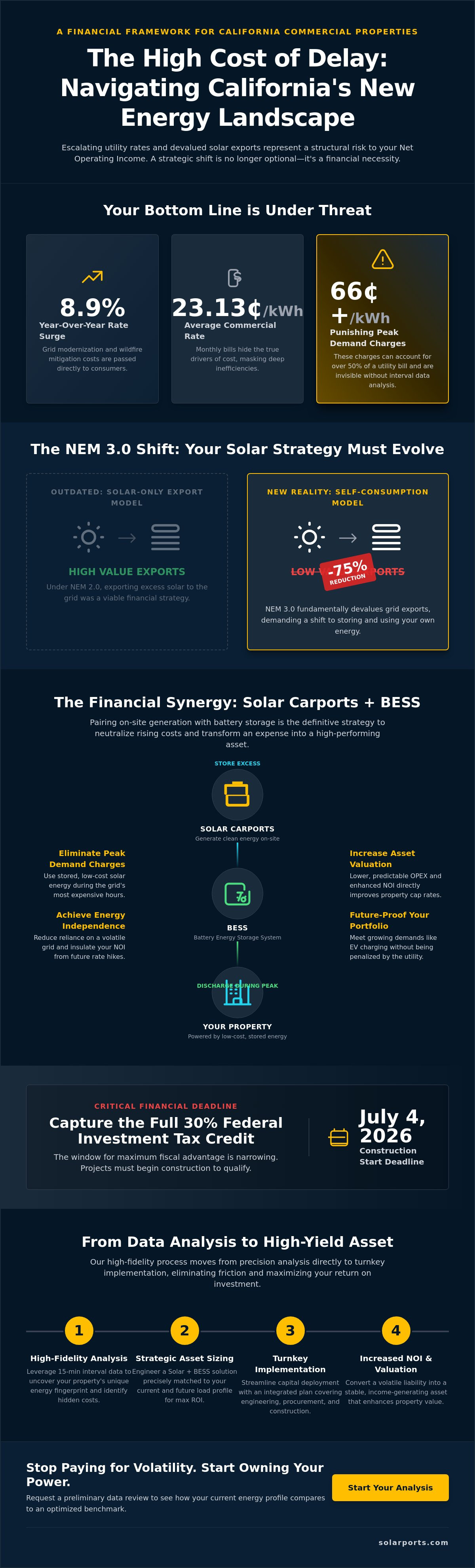
A Battery Energy Storage System (BESS) is your defense against the demand charges that are gutting your budget. It lets you store cheap solar energy and deploy it when grid power is outrageously expensive. Paired with solar carports, you turn an underused parking lot into a power plant that generates revenue and reduces costs.
Solar by itself can't do this. You need the battery. This combination—solar generation plus storage—is what lets you perform "peak shaving," the single most effective way to lower a commercial energy bill in California. As a bonus, carports provide shade and a better tenant experience, which doesn't hurt. (California's Self-Generation Incentive Program)
BESS: The Demand Charge Killer
Here’s how it works: your solar panels charge the battery during the day when energy is cheap. When the utility’s "on-peak" window opens in the late afternoon and prices skyrocket, your system automatically discharges the battery to power your building. You avoid pulling expensive power from the grid. For many California businesses, those demand charges can be up to half the bill. A BESS gives you a way to fight back and adds a layer of resilience when the grid gets shaky.
Solar Carports: Monetizing Your Parking Lot
For many properties, there's more open space in the parking lot than on the roof. Solar carports are often more structurally straightforward than complex rooftop projects and turn that empty space into a generating asset. It’s also the most logical way to build out the on-site EV charging infrastructure that tenants and customers are starting to demand.
The Rules of the Game in California: NEM 3.0 and SGIP
You can't build a financial model without understanding the specific rules in California. Under NEM 3.0, the old game of selling excess power back to the grid for high credits is over. The value is now in using the power you generate yourself. This makes batteries essential.
- NEM 3.0: Shifts the financial model entirely to self-consumption. Storing your solar energy is no longer optional for a strong ROI.
- SGIP: The Self-Generation Incentive Program is still a key rebate that helps fund the battery portion of a project.
- Avoided Cost: Our analysis models the "avoided cost" of not buying the utility's power, which is the correct metric today.
- Tax Credits: The 30% federal Investment Tax Credit (ITC) and MACRS depreciation are huge financial accelerators we bake into every proposal.
The NEM 3.0 Reality Check
Because NEM 3.0 slashed the value of exported energy, a solar-only system just doesn't pencil out for most commercial properties anymore. A battery is what makes the economics work. It allows you to store the energy you produce mid-day and use it during the high-cost evening peak, completely sidestepping the utility's new, unfavorable export rates. Right-sizing becomes even more important here—producing a massive amount of energy you can't use or store is just a waste of capital.
Incentives and Financing
We aggressively pursue every available incentive. The Self-Generation Incentive Program (SGIP) provides substantial rebates for installing battery storage, directly reducing your initial investment. On top of that, the 30% federal ITC applies to both the solar and the battery components. When you add in accelerated depreciation (MACRS), you can significantly lower the effective cost of the entire system and pull the payback period forward by years.
From a Plan to a Project That Performs
An analysis is worthless if it can't be executed flawlessly. The biggest mistake we see is property owners getting a plan from one firm, an engineering design from another, and construction from a third. That’s a recipe for finger-pointing, change orders, and budget overruns.
A turnkey partner handles everything from the initial data dive to the final commissioning. The deep analysis we do upfront means the installation phase is smooth and predictable. And it doesn't stop when the system is turned on. We monitor performance to make sure the asset is delivering the financial returns we promised.
Ensuring that your electrical infrastructure is handled by qualified professionals is essential regardless of your location. For property owners in the Southern Highlands looking for reliable local expertise, you can check out Edmund Parks Electrical to support your energy goals.
The Value of a Turnkey Partner
When one team is responsible for the entire project—the analysis, the BESS and solar carport engineering, the permitting, and the construction—there’s nowhere to hide. Accountability is built in. At SolarPorts Development, this is all we do. We integrate the financial modeling and the physical installation into a single, seamless process, with a team that knows the ins and outs of working in Northern California.
Monitoring and Long-Term Asset Management
Your solar and storage system is a financial asset that requires management. We provide the data dashboards so you can see the savings in real-time and track performance against the initial projections. Proper Operations & Maintenance (O&M) is critical to protecting your ROI for the 25+ year lifespan of the equipment, and we build that into our plan from the start.
Ready to see what the numbers look like for your property? Schedule your Commercial Energy Cost Saving Analysis with SolarPorts.