
BESS Guide for California Commercial Property Owners 2026

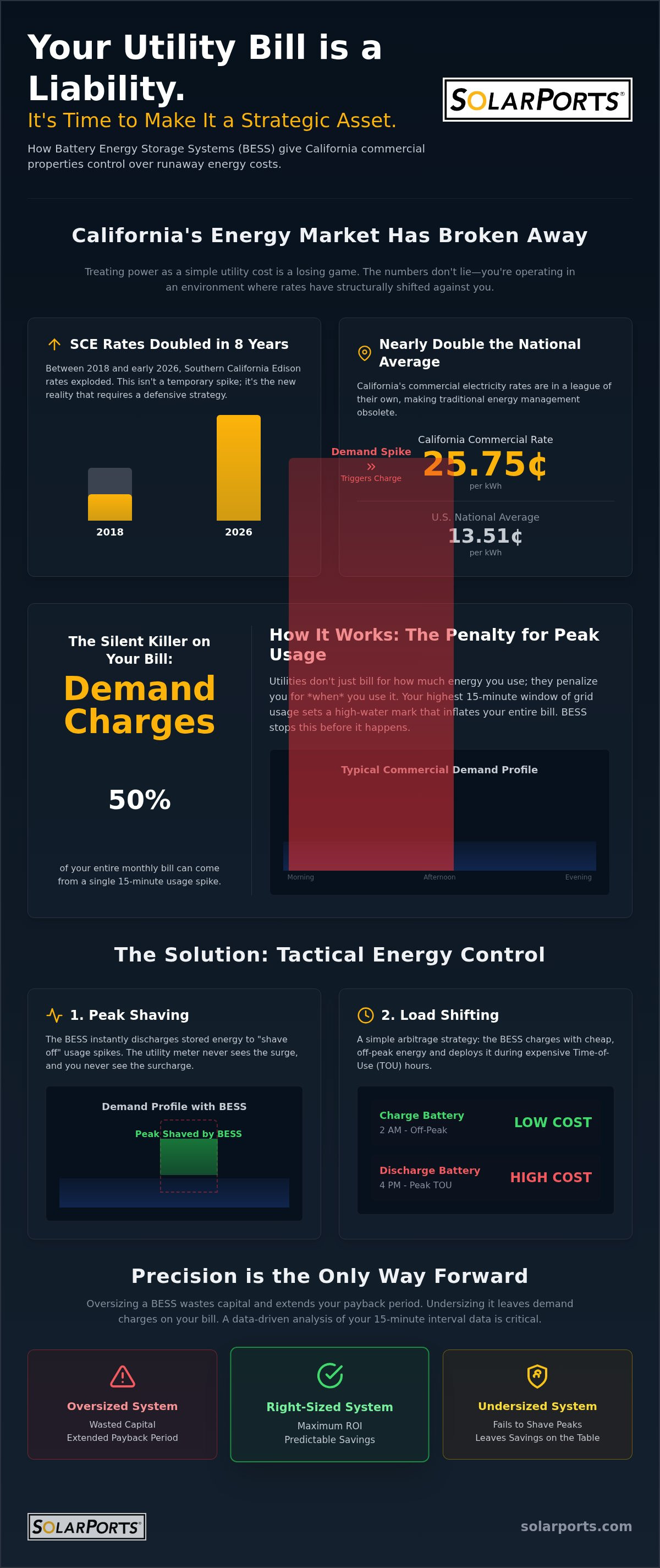
Between 2018 and early 2026, Southern California Edison rates doubled, yet most property owners still treat their utility bill like an unavoidable tax. It's a frustrating reality. You watch demand charges climb to nearly half of your monthly overhead while trying to decode utility structures that seem designed to keep you overpaying. It feels like an unfixable black hole. You aren't alone in feeling that the grid has become a liability rather than a service.
This guide shows you how BESS for commercial real estate transforms that volatility into a controlled strategic asset. We'll move past the marketing fluff to look at how storage actually stabilizes your expenses and boosts property value under current NEM 3.0 rules. We're going to break down the federal tax credits, the shifting SGIP landscape, and the exact mechanics of turning peak demand into a predictable line item.
Key Takeaways
- Stop treating utility bills like an unavoidable tax. Learn how a tactical energy reservoir decouples your daily operations from California’s aggressive utility rate schedules.
- Demand charges often account for half of your monthly overhead. We explain how BESS for commercial real estate uses peak shaving to absorb usage spikes before they hit your bill.
- Bigger isn't always better when it comes to storage. Discover why a data-driven energy cost saving analysis is the only way to avoid the waste of an oversized system.
- Shift your energy strategy from a volatile liability to a controlled asset. Gain the predictability needed to protect your bottom line and increase long-term property value.
Table of Contents
- Why BESS is No Longer Optional for California Commercial Properties
- How BESS Targets and Eliminates Commercial Demand Charges
- Implementing a Right-Sized BESS: From Analysis to Installation
Why BESS is No Longer Optional for California Commercial Properties
California’s energy market has fundamentally broken away from national norms. With commercial electricity rates averaging between 24.1 and 25.75 cents per kWh as of mid-2026, treating power as a passive utility cost is no longer viable. For context, that’s nearly double the national average of 13.51 cents per kWh reported earlier this year. You’re operating in an environment where Southern California Edison rates doubled in just eight years. This isn't a temporary spike; it’s a structural shift that requires a defensive response.
A Battery Energy Storage System (BESS) functions as a tactical energy reservoir. It allows you to decouple your building’s energy use from the utility’s pricing schedule. By storing power when it's cheap and deploying it when rates peak, you regain control over your monthly overhead. BESS for commercial real estate is the primary tool for mitigating utility-driven financial volatility.
The Shift from Energy Consumption to Demand Management
Traditional efficiency projects like LED retrofits focus on consumption, but California utilities focus their billing on timing. The real financial burden comes from when you pull from the grid. BESS protects your bottom line by providing a buffer during the most expensive hours of the day. It’s a shift from simple conservation to aggressive strategic management. Implementing BESS for commercial real estate isn't about chasing "green" trends; it's about building a layer of resiliency against Public Safety Power Shutoffs that are now common in high fire-threat districts. If you want to see how this fits into a broader plan, explore our analysis of strategies to lower commercial electricity bills California. Modern property value is increasingly tied to this kind of smart infrastructure. Without it, you’re just a passenger to the utility's next rate hike.
How BESS Targets and Eliminates Commercial Demand Charges
Demand charges are the silent killers of Northern California commercial budgets. You might be paying for total energy consumption, but your utility is really watching your highest 15-minute window of usage. In many cases, these demand charges account for 50% of the entire monthly bill. It's a penalty for doing business at the same time as everyone else. BESS for commercial real estate solves this through peak shaving. The battery monitors your building’s pull from the grid in real-time. When it detects a spike, like an HVAC system kicking on during a Sacramento heatwave, it discharges stored power to meet that local demand. The utility meter never sees the surge, and you never see the surcharge.
Take a standard retail center in San Jose. Its profile usually spikes in the late afternoon as cooling needs and lighting peak simultaneously. By deploying a battery during those specific hours, the property owner can effectively flatten their demand profile. This isn't just about saving pennies; it's about shifting the building's financial profile from a liability to an asset. If you're wondering how this hits your specific ledger, you can schedule a data-driven energy analysis to see the hard numbers.
Peak Shaving vs. Load Shifting: Tactical Differences
While peak shaving is the immediate priority for cutting demand charges, load shifting handles the rest of the bill. It’s a simple arbitrage strategy: buy power at 2 AM when it’s cheap and use it at 4 PM when Time-of-Use (TOU) rates are highest. This creates a secondary layer of ROI that compounds over time. Understanding the interplay between these two tactics is a core part of any commercial solar ROI analysis. One protects you from spikes; the other protects you from the utility’s daily rate schedule. Together, they make your energy costs predictable.
Implementing a Right-Sized BESS: From Analysis to Installation
Oversizing is a common, expensive mistake. A BESS that is too large doesn't just waste capital; it extends your payback period by years without providing proportional utility savings. Conversely, a system that is too small fails to shave the peaks effectively, leaving those 50% demand charges on your bill. Precision is the only way forward. Implementing BESS for commercial real estate requires a rigorous, data-driven energy cost saving analysis that looks at your actual 15-minute interval data, not just a monthly total.
The path to commissioning shouldn't be a second job for your operations team. A true turnkey process starts with a granular utility bill audit and moves through engineering, permitting with local AHJs, and final interconnectivity with California's investor-owned utilities. It’s about taking the complexity off your desk. This is the core of our approach to turnkey commercial solar CA, where we integrate storage to ensure the hardware actually delivers on the financial projections.
Why Small-Scale Commercial Needs a Specialized Turnkey Partner
A single-story warehouse has vastly different electrical needs than a massive industrial complex. Large-scale utility developers often miss the nuances of right-sizing BESS for commercial real estate at the mid-market level. You need a partner who understands the specific interconnectivity hurdles of PG&E, SCE, or SDG&E. Navigating these utility queues requires local California expertise and a focus on the granular details of small-scale commercial infrastructure. To see how we tailor these solutions, you can view our SolarPorts services for a specialized property assessment.
Securing Your Property’s Financial Future
California utilities aren't going to lower their rates. Waiting for a perfect incentive usually means you're just bleeding cash while rates continue to climb. You now understand how BESS for commercial real estate targets those aggressive demand charges that often consume half your monthly budget. By right-sizing your system through a rigorous audit, you transform a volatile liability into a predictable strategic asset. It's a fundamental shift from passive consumption to active management. SolarPorts provides California-exclusive expertise as a turnkey specialist for small-scale projects. We don't rely on generic estimates; we use your actual interval data to build cost reduction strategies that truly land. It is time to stop overpaying for electricity and start protecting your bottom line with infrastructure that works for you.
Stop overpaying for electricity—request your Commercial Energy Cost Saving Analysis
Frequently Asked Questions
What is the typical lifespan of a commercial BESS in 2026?
Most systems in 2026 are engineered for a 10 to 15 year operational life. This duration depends heavily on how hard you cycle the battery and the quality of the thermal management software. A system used strictly for demand charge management might outlast one used for aggressive daily arbitrage. It is about managing the state of charge to prevent premature degradation of the cells.
How much space does a commercial battery storage system actually take up?
For small-scale BESS for commercial real estate, you are usually looking at a footprint similar to a few large refrigerators or a compact parking stall. Modern high-density cells have shrunk the physical requirements significantly. We often tuck these into existing utility rooms or onto unused portions of parking lots. The exact square footage is determined during the analysis to ensure we aren't wasting space.
Can BESS provide backup power during a California grid outage?
Yes, BESS can provide backup power, but it requires specific islanding equipment to safely disconnect from the grid during an outage. This is a critical feature for Northern California properties facing Public Safety Power Shutoffs. You have to decide which loads are critical because backing up an entire building is often cost-prohibitive. We focus on keeping your essential operations running until the grid stabilizes.
Are there specific California incentives for commercial BESS installations right now?
The landscape has shifted significantly. The federal ITC provides a base credit of 30 percent, provided you meet specific labor standards. In California, the general SGIP funds are largely tapped out. However, the Equity Resiliency tier still offers substantial support for properties in high fire-threat districts or those serving critical infrastructure. We track these Northern California specific updates to ensure you don't miss available offsets.
Frequently asked questions
What is the typical lifespan of a commercial BESS in 2026?
Most systems in 2026 are engineered for a 10 to 15 year operational life. This duration depends heavily on how hard you cycle the battery and the quality of the thermal management software. A system used strictly for demand charge management might outlast one used for aggressive daily arbitrage. It is about managing the state of charge to prevent premature degradation of the cells.
How much space does a commercial battery storage system actually take up?
For small-scale BESS for commercial real estate, you are usually looking at a footprint similar to a few large refrigerators or a compact parking stall. Modern high-density cells have shrunk the physical requirements significantly. We often tuck these into existing utility rooms or onto unused portions of parking lots. The exact square footage is determined during the analysis to ensure we aren't wasting space.
Can BESS provide backup power during a California grid outage?
Yes, BESS can provide backup power, but it requires specific islanding equipment to safely disconnect from the grid during an outage. This is a critical feature for Northern California properties facing Public Safety Power Shutoffs. You have to decide which loads are critical because backing up an entire building is often cost-prohibitive. We focus on keeping your essential operations running until the grid stabilizes.
Are there specific California incentives for commercial BESS installations right now?
The landscape has shifted significantly. The federal ITC provides a base credit of 30 percent, provided you meet specific labor standards. In California, the general SGIP funds are largely tapped out. However, the Equity Resiliency tier still offers substantial support for properties in high fire-threat districts or those serving critical infrastructure. We track these Northern California specific updates to ensure you don't miss available offsets.