
Sacramento Commercial Rooftop Solar: The 2026 Strategy for Property Owners

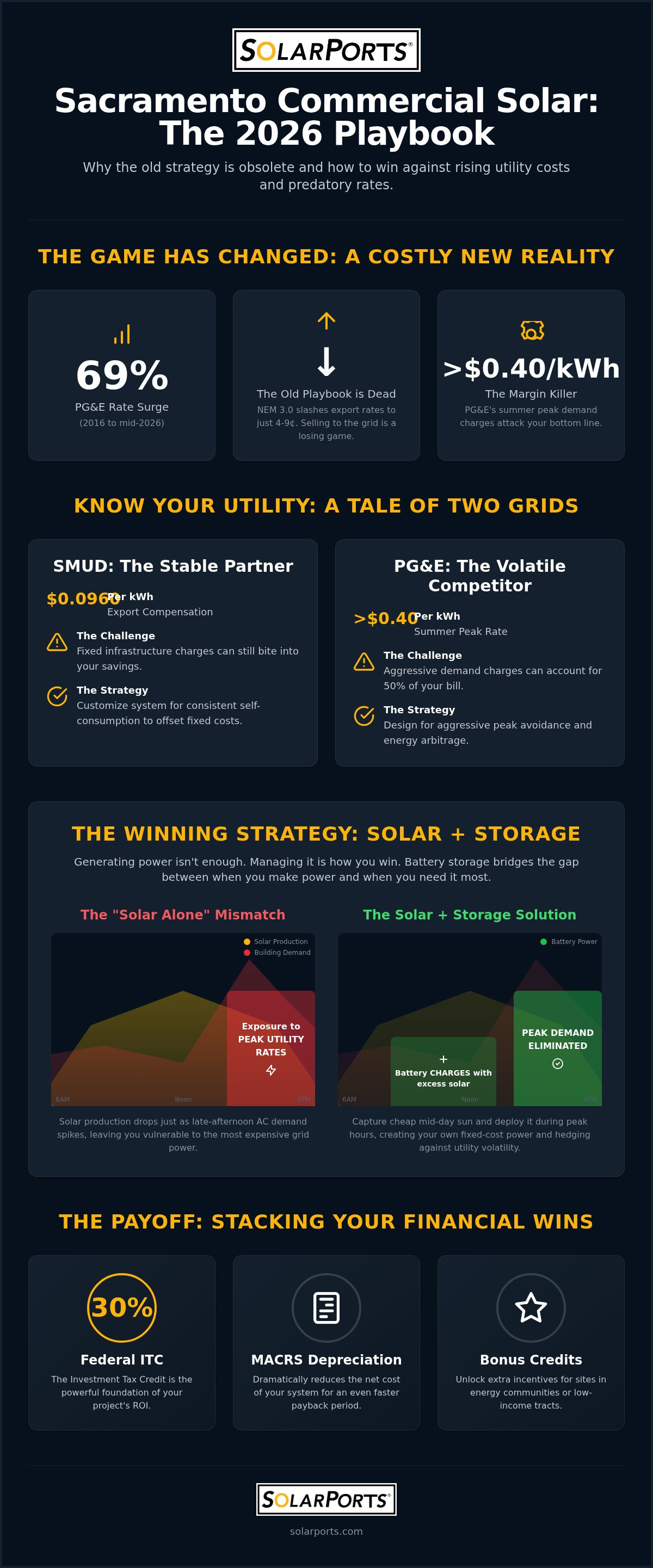
PG&E rates jumped 69% between 2016 and mid-2026. Your bottom line is feeling every bit of that surge. It's frustrating to watch fixed costs eat your margins while regulations like NEM 3.0 make the old solar model obsolete. The math doesn't work the way it used to. If you're looking at Sacramento commercial rooftop solar today, you already know the stakes have changed. You need more than just panels. You need a strategy that handles $0.23/kWh summer peaks and those aggressive system infrastructure charges. We're taking a pragmatic, data-driven look at managing utility rates to maximize your ROI. This article breaks down the 2026 export rates. It explains why pairing an array with storage is the only way to bypass peak demand charges and secure that 30% federal tax credit before the window shifts.
Key Takeaways
- Your utility provider dictates the math. Whether you're on SMUD or PG&E, you'll learn how to customize your system to target their specific 2026 rate structures.
- Solar alone isn't the answer. We break down why Sacramento commercial rooftop solar must be paired with storage to effectively bypass those $0.23/kWh peak charges.
- Credits are shrinking. You'll see how to shift from selling back to the grid to a self-consumption model that protects your ROI from predatory export rates.
- Red tape kills projects. Discover why turnkey project management is the only way to navigate Sacramento's 2026 permitting and interconnection requirements without hitting a wall.
Table of Contents
- Navigating the Sacramento Utility Split: SMUD vs. PG&E for Business
- Strategic 2026 Design: Why Rooftop Solar Alone Isn’t Enough
- Executing the Build: Managing the Sacramento Commercial Timeline
Navigating the Sacramento Utility Split: SMUD vs. PG&E for Business
Your building's zip code is its energy destiny. In Sacramento, the utility split between SMUD and PG&E creates two completely different financial realities for property owners. SMUD is generally the stable partner. Their export compensation sits at $0.0960 per kWh, and while their rates are lower, the fixed infrastructure charges can still bite. PG&E is where the volatility lives. With peak rates often exceeding $0.40 per kWh, the ROI for Sacramento commercial rooftop solar becomes much more aggressive if you design for peak avoidance. You have to model your system against your specific rate schedule, whether it's GS-1 or GS-2, to see how solar actually chips away at those demand charges.
The Solar Billing Plan (NEM 3.0) Impact on Sacramento ROI
Selling power back to the grid is a losing game in 2026. The Net Billing Tariff has dropped export rates to a range of 4 to 9 cents, which means the old oversize the roof strategy is dead. Success now relies on self-consumption. You want to use every kilowatt-hour you produce right where it’s made. This local focus is a major trend in Solar power in California right now, specifically for Sacramento commercial rooftop solar projects. To hit your target payback period, a professional commercial energy cost saving analysis is the first move. It prevents you from overcapitalizing on a system that exports too much low-value power while failing to cover your most expensive usage windows.
Strategic 2026 Design: Why Rooftop Solar Alone Isn’t Enough
Panels are just hardware. In 2026, the real financial win isn't just generating power; it's managing it. Sacramento commercial rooftop solar often misses the mark because the timing is fundamentally broken. Our region's heat creates massive AC demand peaks in the late afternoon, exactly when solar production starts its daily decline. This mismatch leaves you exposed to the highest utility rates of the day. Integrating a Battery Energy Storage System (BESS) solves this by allowing you to capture mid-day sun and deploy it when the grid is most expensive. You're effectively creating a hedge against the utility's pricing volatility.
Mitigating Demand Charges with Integrated Storage
Demand charges are the hidden margin killers, often accounting for up to 50% of a Sacramento commercial bill. Solar panels alone can't reliably lower these because they don't control when your building's load spikes. Batteries do. By using strategic discharge during peak windows, you create a predictable, fixed cost for your power. When designing a Sacramento commercial rooftop solar project today, ignoring storage is a gamble you don't need to take. It's a form of energy arbitrage that turns a volatile expense into a managed asset. For a deeper dive into these mechanics, read more about strategies to lower commercial electricity bills in California. Shaving these peaks is what actually moves the needle on your internal rate of return. If you're tired of seeing demand spikes dictate your monthly overhead, it might be time to book a technical solar and storage consultation to analyze your specific load profile and stop the bleeding.
Executing the Build: Managing the Sacramento Commercial Timeline
Building a Sacramento commercial rooftop solar system is a logistical marathon. It's not just about buying hardware; it's about navigating a bureaucratic maze. A turnkey approach isn't a luxury. It's a requirement to keep your project from stalling in the permitting phase. In 2026, Sacramento utilities have tightened their interconnection requirements, demanding meticulous engineering documentation before they'll even look at your application. If your plans don't perfectly match their current grid standards, you'll find yourself at the back of a very long line. You need a partner that handles the heavy lifting from the initial audit through to the final Permission to Operate (PTO).
Leveraging the 2026 Commercial Solar Tax Credit
The financial stack for 2026 remains a powerful driver for ROI, provided you know how to layer the incentives. The 30% federal Investment Tax Credit (ITC) is the foundation, but the real margin is found in the details. Combining the ITC with MACRS depreciation can drastically reduce the net cost of your system. Some Sacramento property owners might also be eligible for bonus credits if their sites are located in specific energy communities or low-income tracts. These extra incentives can turn a good project into an exceptional one. To understand the full scope of these incentives, review our 2026 commercial solar tax credit guide. Don't let a lack of technical tax knowledge leave money on the table. Meticulous planning in the pre-construction phase ensures that the project you build is the same one your CFO approved.
Securing Your 2026 Energy Strategy
The math for Sacramento commercial rooftop solar has fundamentally changed. You can't just install panels and hope for the best. Success in 2026 depends on how you navigate the SMUD/PG&E divide and whether you're using storage to kill those aggressive demand charges. We've spent years refining our California-specific commercial expertise to handle the messy reality of utility interconnections. Our turnkey project management takes you from the initial audit straight through to PTO without the usual bureaucratic stalls. It's about precision. It's about making sure your energy strategy actually protects your margins instead of just adding another line item to your balance sheet. The first move is a data-driven look at your current load. Request Your Commercial Energy Cost Saving Analysis today. You'll get a clear, unfiltered view of what's possible for your property.
Frequently Asked Questions
Is rooftop solar still worth it for Sacramento businesses under NEM 3.0?
Yes, but the strategy has shifted entirely toward self-consumption. With PG&E export rates dropping as low as 4 cents, selling power back to the grid is a losing proposition. You make your money by avoiding those $0.40 per kWh peak charges. This is why Sacramento commercial rooftop solar projects in 2026 almost always include battery storage to capture and use that value on-site.
How long is the typical payback period for a commercial solar project in Sacramento?
Most commercial projects reach a break-even point within 5 to 9 years. The exact timeline depends on your utility and how aggressively you use storage to shave demand charges, which often make up half your bill. By layering the 30% federal ITC and MACRS depreciation, you're front-loading the financial benefits. We start with a cost-saving analysis to pin down these numbers before hardware is ordered.
Does SMUD offer incentives for commercial rooftop solar in 2026?
SMUD uses the Solar and Storage Rate (SSR), which compensates exports at $0.0960 per kWh as of June 2026. While they don't offer massive upfront rebates, their commitment to a 2030 zero-carbon goal keeps the regulatory environment stable for storage. The real financial driver remains the 30% federal tax credit and the ability to opt out of their seasonal rate hikes by generating your own power.
Can I install rooftop solar if my commercial building needs a roof repair?
You shouldn't put a 25-year solar system on a 5-year roof. If your building needs repairs, it's best to handle that work first or concurrently to avoid high removal and re-installation costs later. If the roof isn't viable, we often pivot to solar carport systems for commercial properties. This generates the same power and tax advantages while providing vehicle shade without touching the building's structure.
Frequently asked questions
Is rooftop solar still worth it for Sacramento businesses under NEM 3.0?
Yes, but the strategy has shifted entirely toward self-consumption. With PG&E export rates dropping as low as 4 cents, selling power back to the grid is a losing proposition. You make your money by avoiding those $0.40 per kWh peak charges. This is why Sacramento commercial rooftop solar projects in 2026 almost always include battery storage to capture and use that value on-site.
How long is the typical payback period for a commercial solar project in Sacramento?
Most commercial projects reach a break-even point within 5 to 9 years. The exact timeline depends on your utility and how aggressively you use storage to shave demand charges, which often make up half your bill. By layering the 30% federal ITC and MACRS depreciation, you're front-loading the financial benefits. We start with a cost-saving analysis to pin down these numbers before hardware is ordered.
Does SMUD offer incentives for commercial rooftop solar in 2026?
SMUD uses the Solar and Storage Rate (SSR), which compensates exports at $0.0960 per kWh as of June 2026. While they don't offer massive upfront rebates, their commitment to a 2030 zero-carbon goal keeps the regulatory environment stable for storage. The real financial driver remains the 30% federal tax credit and the ability to opt out of their seasonal rate hikes by generating your own power.
Can I install rooftop solar if my commercial building needs a roof repair?
You shouldn't put a 25-year solar system on a 5-year roof. If your building needs repairs, it's best to handle that work first or concurrently to avoid high removal and re-installation costs later. If the roof isn't viable, we often pivot to solar carport systems for commercial properties. This generates the same power and tax advantages while providing vehicle shade without touching the building's structure.