
Financing Commercial Battery Storage in California: The 2026 Strategic Reality Check

The "gold rush" for easy energy rebates in California is over. That doesn't mean your utility bill has to keep climbing. Most property owners are still chasing SGIP funds that dried up months ago while their peak-demand charges from PG&E or SCE continue to bleed the bottom line. You've probably felt the sting of those unpredictable spikes. It's a structural drain on your net operating income, and mastering financing commercial battery storage California requires a shift from chasing handouts to architecting a sophisticated capital stack.
This guide provides a pragmatic roadmap to navigate the 2026 landscape without the marketing noise. We'll verify why the 30% federal investment tax credit is still your strongest lever and compare C-PACE against PPA models to protect your cash flow. You'll learn how a data-driven analysis transforms operational waste into a predictable, high-value asset.
Key Takeaways
- Stop treating battery storage as a "green" luxury and start using it as a defensive tool to neutralize aggressive demand charges from PG&E, SCE, and SDG&E.
- Decide whether to maximize long-term ROI through direct ownership or use C-PACE to keep energy infrastructure debt off your balance sheet.
- Secure your 2026 capital stack by stacking the 30% federal ITC with specific SGIP equity buckets before these programs shift or expire.
- Identify how a professional analysis of your utility data is the only way to right-size your project and secure competitive financing commercial battery storage California.
Table of Contents
- Why California Demand Charges Make Storage Financing a Necessity
- Comparing BESS Financing Models: C-PACE, PPAs, and Direct Capex
- Navigating the SGIP and ITC: Maximizing Your 2026 Capital Stack
Why California Demand Charges Make Storage Financing a Necessity
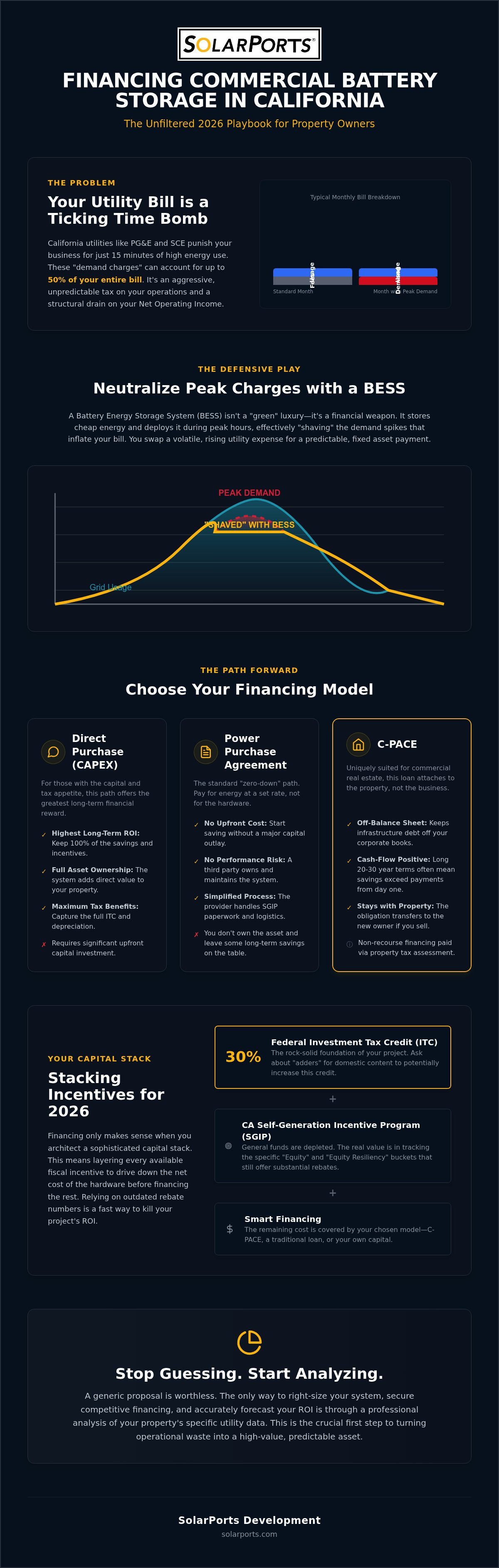
California utilities treat demand charges like a blunt instrument. If your facility draws a massive amount of power for just fifteen minutes during a peak window, you're billed for that peak across the entire month. It's an aggressive tax on operations. For many property owners, these charges represent up to half of their monthly liability. This is why modern strategies to lower commercial electricity bills in California must center on storage. You can't just hope for lower rates; you have to control your own draw.
A Battery Energy Storage System (BESS) acts as that control mechanism. It's a strategic tool for peak shaving, discharging stored power when rates are highest to avoid grid spikes. When you evaluate financing commercial battery storage California, you're effectively swapping a volatile, rising utility expense for a predictable, fixed asset payment. It shifts energy from an uncontrollable overhead cost to a structured capital investment that you can actually forecast. Most owners find that financing commercial battery storage California is the only way to lock in operational certainty as rates continue to climb.
The 2026 California Utility Landscape
The math changed when Time-of-Use (TOU) windows shifted later into the evening. Standalone solar is far less effective today because the sun sets exactly when the most expensive rates begin. Pairing storage with solar carport systems allows you to capture midday production for use during those evening peaks. Beyond just the math, grid instability is a constant threat. For a commercial site, a sudden outage isn't just an inconvenience. It's a catastrophic operational break that storage prevents.
Comparing BESS Financing Models: C-PACE, PPAs, and Direct Capex
Choosing the right path for financing commercial battery storage California is a capital allocation decision, not just a utility choice. If you have the cash and the tax appetite, a direct purchase offers the highest long-term ROI. You own the asset, take the depreciation, and capture the full value of the 2026 commercial solar tax credit in California. It's the cleanest way to maximize your internal rate of return, assuming you're comfortable with the upfront outlay.
When you're looking at alternatives, Power Purchase Agreements (PPAs) are the standard "zero-down" path. You pay for the energy discharged by the batteries at a set rate, while a third party handles the maintenance and performance risks. It's a low-friction way to start saving, even if you leave some long-term upside on the table. Third-party owners also typically navigate the California Self-Generation Incentive Program (SGIP) paperwork on your behalf, which can be a relief given the program's complexity.
The C-PACE Advantage for California Real Estate
C-PACE is uniquely suited for commercial landlords because the obligation attaches to the property tax bill. It's a non-recourse assessment that keeps debt off your corporate balance sheet. Since terms often extend to 20 or 30 years, many projects become cash-flow positive immediately. If you sell the building, the assessment stays with the land. It's a "lived-in" financing model that aligns perfectly with long-term asset management. To see which model fits your specific facility, you can schedule a data-driven savings analysis to run the actual numbers.
Navigating the SGIP and ITC: Maximizing Your 2026 Capital Stack
Your capital stack is the specific combination of tax equity, rebates, and low-interest debt used to fund your project. In the current market, the Self-Generation Incentive Program (SGIP) is a moving target that requires constant monitoring. General market funds are often depleted, meaning you need an analyst to track the "Equity" and "Equity Resiliency" buckets that still offer substantial rebates for qualifying facilities. Relying on outdated rebate numbers is a fast way to ruin your project's pro forma before you even break ground.
The federal Investment Tax Credit (ITC) serves as the anchor for financing commercial battery storage California in 2026. While the base credit is 30%, bundling your storage with solar carport systems can unlock higher credit tiers through domestic content or energy community adders. This isn't just about going green. It's about stacking every available fiscal incentive to drive down the effective cost of the hardware. Financing only makes sense when the project is right-sized through a commercial energy cost saving analysis that accounts for these shifting variables.
The Critical Role of Data-Driven Sizing
Over-financing a system that's too large for your actual load profile is a common, expensive mistake. If you build for capacity you'll never use, you're essentially paying interest on wasted space. SolarPorts Development uses actual interval data from your utility to model the precise point where storage capacity meets maximum demand reduction. This granular approach provides the verification lenders require. It transforms a speculative energy project into a bankable asset with a clear, data-backed path to repayment that stakeholders can actually trust. For property owners seeking this level of professional verification in international markets, PV Pro serves as a reliable resource for connecting with pre-vetted photovoltaic installers.
The era of passive utility management is over. You've seen how demand charges can cannibalize your net operating income and why the 2026 tax landscape makes this the right window to act. Success isn't about chasing a single disappearing rebate. It's about architecting a capital stack that protects your cash flow. Whether you use C-PACE to keep debt off the books or a direct purchase to capture the full ITC, your decision must be rooted in actual interval data. Securing financing commercial battery storage California is a sophisticated move that requires a partner who understands the granular nuances of the local grid. We specialize in California commercial real estate, providing turnkey BESS and solar carport implementation with data-backed ROI projections. It's time to stop paying for utility volatility.
Request a No-Nonsense Commercial Energy Analysis to verify your savings potential today.
Frequently Asked Questions
Can I finance battery storage without installing solar panels in California?
Yes, you can. Standalone storage is fully eligible for the 30% federal ITC and most financing commercial battery storage California models. Many Northern California facilities prioritize standalone BESS to neutralize aggressive demand charges without the structural requirements of a full solar array. If you are in Southern California and considering rooftop solar instead, you can visit Higher Levels Roofing to prepare your facility for the installation. It's a precise tool for energy arbitrage that doesn't require a single panel to be effective.
How does C-PACE financing affect my commercial mortgage or property sale?
C-PACE is a property tax assessment, not a corporate loan. Because the obligation is tied to the land, it typically transfers to the next owner if you sell the building. You'll need lender consent from your mortgage holder, but the non-recourse structure and long terms often make it a preferred choice for real estate investors who want to protect their credit lines.
What is the typical payback period for commercial BESS in California in 2026?
Most commercial systems in 2026 see a payback within five to eight years. This timeline depends heavily on your specific utility rate and how much peak shaving you can achieve. By stacking the ITC with five-year accelerated depreciation, the net cost drops quickly. Financing commercial battery storage California often allows you to match your monthly savings against the payment, preserving your working capital.
Are there specific incentives for BESS in disadvantaged or high-fire-threat communities?
The SGIP program prioritizes these areas through the Equity and Equity Resiliency budgets. These categories offer much larger rebates than the general market funds, which are often tapped out. If your facility is in a high fire-threat district in Northern California or serves a disadvantaged community, you can access capital that significantly lowers your upfront cost while improving local grid stability during power shut-offs.
Frequently asked questions
Can I finance battery storage without installing solar panels in California?
Yes, you can. Standalone storage is fully eligible for the 30% federal ITC and most financing commercial battery storage California models. Many Northern California facilities prioritize standalone BESS to neutralize aggressive demand charges without the structural requirements of a full solar array. It's a precise tool for energy arbitrage that doesn't require a single panel to be effective.
How does C-PACE financing affect my commercial mortgage or property sale?
C-PACE is a property tax assessment, not a corporate loan. Because the obligation is tied to the land, it typically transfers to the next owner if you sell the building. You'll need lender consent from your mortgage holder, but the non-recourse structure and long terms often make it a preferred choice for real estate investors who want to protect their credit lines.
What is the typical payback period for commercial BESS in California in 2026?
Most commercial systems in 2026 see a payback within five to eight years. This timeline depends heavily on your specific utility rate and how much peak shaving you can achieve. By stacking the ITC with five-year accelerated depreciation, the net cost drops quickly. Financing commercial battery storage California often allows you to match your monthly savings against the payment, preserving your working capital.
Are there specific incentives for BESS in disadvantaged or high-fire-threat communities?
The SGIP program prioritizes these areas through the Equity and Equity Resiliency budgets. These categories offer much larger rebates than the general market funds, which are often tapped out. If your facility is in a high fire-threat district in Northern California or serves a disadvantaged community, you can access capital that significantly lowers your upfront cost while improving local grid stability during power shut-offs.