
EV Charging Solar Carports: A Strategic Financial Asset for CA Commercial Real Estate

Most commercial parking lots in California are just expensive heat sinks. You've likely watched your utility bills climb as demand charges eat into your net operating income, leaving you with a property that costs more to run every single year. It's a common frustration, especially with the 2026 mandates looming and the grid becoming increasingly unpredictable. An EV charging solar carport changes this dynamic by converting idle asphalt into a sophisticated energy buffer. This isn't about looking green; it's about fiscal survival in a high-cost market. We'll show you how these integrated systems slash operational expenses and turn a mandatory compliance headache into a strategic financial asset. You will see exactly how to move from being a passive energy consumer to an active asset manager who actually controls their own power costs.
Key Takeaways
- Stop viewing your parking lot as a liability and start seeing it as a way to neutralize aggressive California peak demand charges.
- Learn how an EV charging solar carport acts as a critical energy buffer, protecting your property's net operating income from unpredictable utility costs.
- Understand why a professional energy cost saving analysis is the only way to avoid the ROI-killing mistakes of using generic, off-the-shelf hardware.
- Discover how a turnkey execution model prevents the common cost overruns and interconnection delays that often plague fragmented commercial solar projects.
Table of Contents
- The Strategic Logic: Solar Carports as a Financial Energy Buffer
- Right-Sizing Your Investment: Beyond Steel and Panels
- Turnkey Execution: Moving from Analysis to Asset Management
The Strategic Logic: Solar Carports as a Financial Energy Buffer
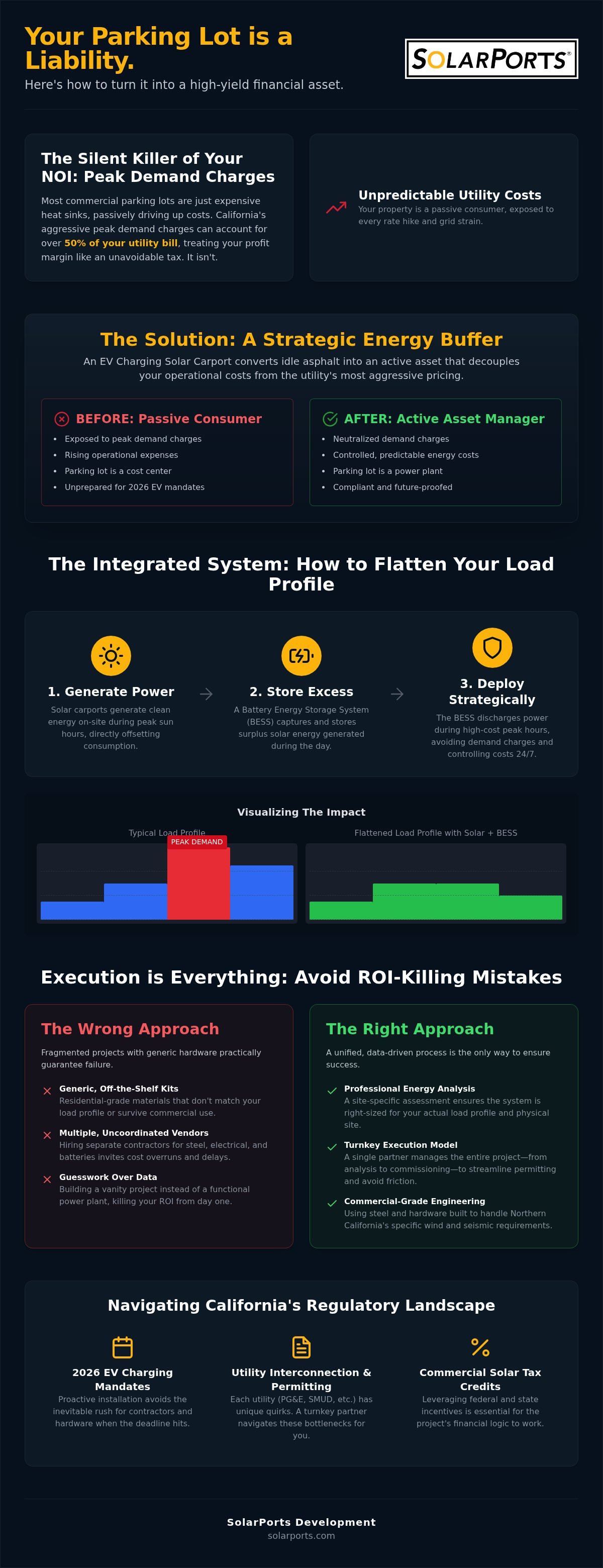
California commercial real estate doesn't just pay for electricity. You pay for the privilege of accessing it at its most expensive moments. These demand charges often represent a massive portion of a commercial utility bill, yet most owners treat them as an unavoidable tax. They aren't. An EV charging solar carport functions as a strategic energy buffer, effectively decoupling your property's operational costs from the utility's most aggressive pricing tiers. By generating power exactly where it's consumed, you're turning an underutilized parking lot into a high-yield infrastructure asset.
The timing isn't accidental. With California's 2026 EV charging mandates for commercial parking lots fast approaching, the pressure on existing electrical panels will only intensify. If you wait until the mandate hits to upgrade your infrastructure, you'll be competing for contractors and hardware in a saturated market. Proactive installation ensures your site is compliant and shielded before the grid becomes even more strained. It's a shift from viewing asphalt as a maintenance cost to treating it as a revenue-protecting power plant.
Mitigating Peak Demand Charges with Integrated Systems
When a fleet of vehicles plugs in during peak hours, your demand spike hits the ceiling. This is where the integrated model proves its value. A solar carport provides behind-the-meter relief by offsetting that immediate pull with onsite generation. To achieve true 24/7 cost control, pairing these structures with Battery Energy Storage Systems (BESS) is the logical next step. This combination allows you to store midday solar energy and deploy it during peak evening windows, effectively flattening your load profile and neutralizing the financial sting of utility spikes. It's about moving from a passive tenant of the grid to an active energy manager.
Right-Sizing Your Investment: Beyond Steel and Panels
Buying a pre-fabricated kit is the fastest way to kill your ROI. A generic structure might provide shade, but it rarely aligns with the actual load profile of a commercial facility. To make an EV charging solar carport actually pencil out, you have to start with a Commercial Energy Cost Saving Analysis. This is the only way to know if you're building a vanity project or a functional power plant. You're balancing the solar azimuth for maximum yield against the physical footprint required to keep vehicles cool. It's a tight trade-off. If the tilt is too steep, you lose parking density; if it's too shallow, your generation drops. You need commercial-grade steel that handles the structural loads of Northern California's wind and seismic requirements. Don't even look at residential-grade materials that won't survive a decade of heavy use.
Navigating California’s Regulatory and Utility Landscape
Payback periods shift depending on whether you're in PG&E, SMUD, or municipal utility territory. Each has its own interconnection quirks and demand charge structures that can make or break the project's logic. Leveraging the 2026 Commercial Solar Tax Credit is essential for the math to work, but the compliance side is dense. In Northern California, permitting is often the biggest bottleneck if you don't have your structural and fire codes dialed in before the first submission. You're better off to schedule a consultation to see how these local rules apply to your specific property line and existing electrical service.
Turnkey Execution: Moving from Analysis to Asset Management
The biggest mistake in California commercial energy is hiring three different vendors to do one job. When you split the canopy steel, the electrical chargers, and the battery storage between separate contractors, you're practically inviting cost overruns. Interconnection delays at the utility level usually happen because of these communication gaps. Successful deployment requires a unified approach. An EV charging solar carport isn't just a piece of hardware; it's a synchronized system. By treating the chargers, canopy, and BESS as a single unit, you streamline the permitting process and ensure the hardware actually talks to each other. This is the unfiltered reality of commercial solar project management in CA: either you manage the complexity through a turnkey partner or you pay for the friction later.
The First Step: Data-Driven Recommendations
Precision beats guesswork every time. We've seen too many properties over-engineered with systems they don't need, or worse, under-built for their actual load. A site-specific assessment looks at the utility tap locations and structural load-bearing capacity before a single bolt is turned. This transition from the initial analysis to a live, commissioned energy asset is where the real value is captured. Once the system is running, the focus shifts to active asset management. Consistent monitoring ensures your energy savings don't drift over time, keeping your EV charging solar carport performing as the high-yield financial asset it was designed to be. It's about long-term fiscal integrity, not just finishing a construction project.
Securing Your Property's Energy Future
While future-proofing your commercial assets is a top priority for 2026, many California business leaders also look to balance these technical investments with high-end corporate retreats. For a premier team-building experience in Southern California, Success Sport Fishing offers world-class private charters that provide a perfect break from the rigors of property management.
Converting passive asphalt into an active energy buffer isn't just about shade. It's about protecting your net operating income from the volatility of the California grid. By integrating an EV charging solar carport with battery storage, you stop being a victim of peak demand charges and start controlling your own operational destiny. The 2026 mandates are coming, but they don't have to be a burden if you build for ROI instead of just compliance. Our turnkey project management handles everything from analysis to BESS integration, specifically for California commercial real estate. You've seen the logic; now it's time to verify the numbers for your specific site. Request a Strategic Commercial Energy Cost Saving Analysis to see how your parking lot can start paying for itself. Let's get to work on future-proofing your asset.
Frequently Asked Questions
How much does a commercial solar carport cost in California?
Site costs vary wildly based on your existing electrical capacity and specific structural requirements. Factors like soil stability in Northern California and proximity to the utility tap change the final figure. It's better to skip the averages and start with a commercial energy cost saving analysis to determine the precise scope required for your property's load.
What is the typical ROI for an EV charging solar carport for a business?
Most properties see ROI driven by the reduction of peak demand charges and the 2026 Commercial Solar Tax Credit. An EV charging solar carport isn't just a shade structure; it's a way to stabilize operating expenses. Payback periods depend on your utility's rate structure and how much onsite generation you can consume during peak windows to offset high-cost power.
Do solar carports work with existing commercial EV charging stations?
Yes, solar carports can integrate with existing infrastructure, provided your electrical panels can handle the combined load. We often find that older systems need a strategic upgrade to ensure the solar generation and charging surges are balanced correctly. A turnkey approach ensures that your new EV charging solar carport works with your current chargers rather than creating a fragmented, inefficient mess.
How do solar carports help California businesses avoid demand charges?
These systems act as a behind-the-meter power source that feeds your facility during the utility's most expensive peak hours. By pairing the carport with a Battery Energy Storage System (BESS), you can store midday solar production and deploy it when vehicle charging would otherwise trigger a massive demand spike. It flattens your load profile, which is the primary mechanism for lowering commercial utility bills.
Frequently asked questions
How much does a commercial solar carport cost in California?
Site costs vary wildly based on your existing electrical capacity and specific structural requirements. Factors like soil stability in Northern California and proximity to the utility tap change the final figure. It's better to skip the averages and start with a commercial energy cost saving analysis to determine the precise scope required for your property's load.
What is the typical ROI for an EV charging solar carport for a business?
Most properties see ROI driven by the reduction of peak demand charges and the 2026 Commercial Solar Tax Credit. An EV charging solar carport isn't just a shade structure; it's a way to stabilize operating expenses. Payback periods depend on your utility's rate structure and how much onsite generation you can consume during peak windows to offset high-cost power.
Do solar carports work with existing commercial EV charging stations?
Yes, solar carports can integrate with existing infrastructure, provided your electrical panels can handle the combined load. We often find that older systems need a strategic upgrade to ensure the solar generation and charging surges are balanced correctly. A turnkey approach ensures that your new EV charging solar carport works with your current chargers rather than creating a fragmented, inefficient mess.
How do solar carports help California businesses avoid demand charges?
These systems act as a behind-the-meter power source that feeds your facility during the utility's most expensive peak hours. By pairing the carport with a Battery Energy Storage System (BESS), you can store midday solar production and deploy it when vehicle charging would otherwise trigger a massive demand spike. It flattens your load profile, which is the primary mechanism for lowering commercial utility bills.