
Commercial Solar Tax Credits: 2026 California Guide

If you're still viewing your roof as an overhead expense rather than a high-yield capital asset, you're essentially handing your tax liability back to the state. California utility billing has become intentionally opaque, and the shift toward tech-neutral incentives under Section 48E only adds layers of complexity for most executive teams. You've likely heard the noise about commercial solar tax credits but haven't seen a clear path to stacking the 10% domestic content or energy community bonuses.
We agree that the window for these incentives feels like it's closing too fast. This guide provides a pragmatic breakdown of how to transform your energy project into a predictable financial instrument. We'll walk through the 30% base credit requirements, the 2026 MACRS depreciation schedules, and the specific strategies needed to lock in maximum tax reduction before the next major deadline.
Key Takeaways
- The transition to Section 48E makes the 30% base for commercial solar tax credits the starting point for projects that hit specific labor and wage requirements.
- You can significantly increase your return by stacking 10% bonus credits for using domestic content and building in designated energy communities.
- A professional energy cost saving analysis is the essential first step to ensure your system is sized correctly to capture these incentives.
- Combining federal credits with the 20% bonus depreciation available in 2026 allows you to front-load tax benefits and stabilize long-term operational costs.
Table of Contents
- The 2026 Federal Landscape: Section 48E and the Financial Reality
- Maximizing the Stack: How California Assets Trigger Bonus Credits
- Execution Strategy: From Energy Analysis to Credit Capture
The 2026 Federal Landscape: Section 48E and the Financial Reality
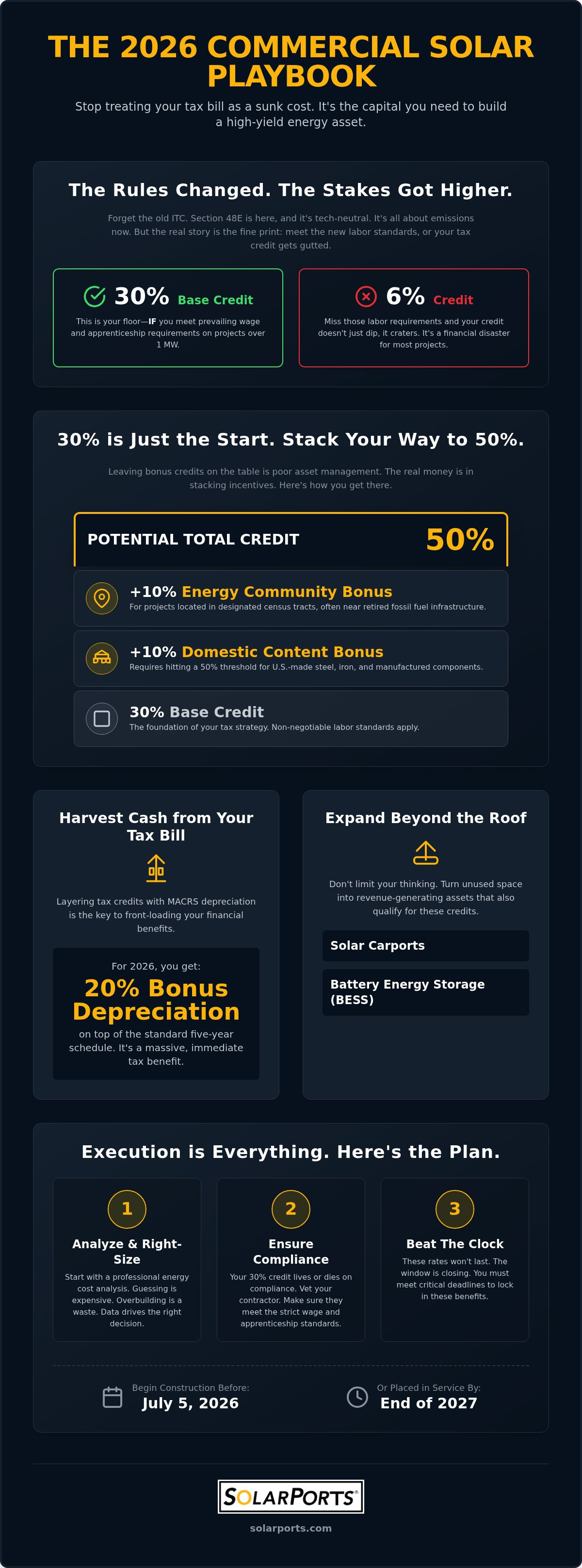
The federal landscape for commercial solar tax credits shifted fundamentally on January 1, 2025. We've moved past the traditional Business Energy Investment Tax Credit into the Section 48E era. This isn't just a name change. It's a shift toward tech-neutrality. The IRS now prioritizes emissions profiles over specific equipment types. For most California business owners, the 30% credit remains the financial floor. However, that floor only holds if you meet strict prevailing wage and apprenticeship requirements. If you miss those marks on projects over 1 MW, your credit doesn't just dip; it craters to 6%.
Smart CFOs view this as a tax equity play. You aren't just buying hardware. If your business carries a high tax burden, commercial solar tax credits allow you to redirect capital that was already earmarked for the IRS back into your own balance sheet. It's a logical redirection of funds. You turn a recurring expense into a depreciable asset. You're effectively using tax liability to "purchase" energy infrastructure that stabilizes your long-term operational costs.
Navigating the Transition to Tech-Neutral Credits
Section 48E focuses on greenhouse gas emissions rather than specific technology. This means your project must prove zero-emissions to qualify. It's a cleaner logic, but the paperwork is denser. The 2026 deadline is the real pressure point. Acting now is a "thinking fix" to capture these rates before the phase-out starts, as detailed in our 2026 commercial solar tax credit in California guide. To qualify, you must either have begun construction before July 5, 2026, or be placed in service by the end of 2027. Don't wait for the rules to get simpler; they won't.
Maximizing the Stack: How California Assets Trigger Bonus Credits
A 30% base credit is a solid start, but leaving bonus "adders" on the table is just poor asset management. In 2026, the domestic content bonus offers an extra 10% if you hit the 50% threshold for US-made components. This is where the technical details matter. You're also looking at an additional 10% for projects in energy communities. For our Northern California clients, this often means sites near retired fossil fuel infrastructure or specific coal-impacted census tracts. It's about logic, not just environmental optics.
California's grid doesn't reward simple generation anymore. With export rates hovering around 5-8 cents per kWh under NEM 3.0, the real money is in avoiding those brutal peak-demand charges. Programs like California's Solar for All Program highlight the state's push for distributed energy; however, the federal commercial solar tax credits provide the heavy lifting for your balance sheet. You need to stack these incentives to offset the high cost of doing business in this state.
Leveraging Solar Carports and BESS for Enhanced ROI
Don't assume you're limited to the roof. Our solar carport systems qualify for that same 30% base credit while turning a parking lot into a revenue-generating asset. Pairing these with a Battery Energy Storage System (BESS) is the logical move to shift your solar production to the evening when utility rates spike. Effectively, these credits and storage savings function as a combined multiplier within a commercial solar ROI analysis to ensure your project pays for itself years faster than a standalone system. If you want to see how these layers fit your specific site, let's look at your latest utility bill together.
Execution Strategy: From Energy Analysis to Credit Capture
System sizing isn't a guessing game. A commercial energy cost saving analysis is the only way to ensure you aren't overbuilding hardware you won't use. Once the project is right-sized, you layer the 30% credit with MACRS depreciation. In 2026, you're looking at a 20% bonus depreciation on top of the standard five-year schedule. It's a massive front-loaded tax benefit. You're effectively harvesting cash from your tax bill to pay for your own power plant via commercial solar tax credits. It's logical, it's data-driven, and it works.
Compliance is where the 30% rate lives or dies. If your contractor fails the prevailing wage or apprenticeship standards, that commercial solar tax credits rate drops to 6%. That's a financial disaster for most projects. Recent Federal Clean Energy Tax Credit Changes have made these labor rules absolutely non-negotiable. You can't fix this after the fact. Documentation must be airtight from the moment the first shovel hits the ground.
The Role of Turnkey Management in Financial Compliance
"Cheap" installers are usually the most expensive choice you'll ever make. They'll drop the hardware and vanish, leaving you to scramble when the IRS asks for labor logs you don't have. Opting for turnkey commercial solar in CA means the technical and administrative burden isn't on your desk. We manage the "thinking fix" so you just see the results. Your next move is simple. Review your current tax liability with your CPA, then let us run a site-specific assessment to bridge the gap between your tax burden and your energy costs.
Securing Your 2026 Energy Independence
The financial window for 2026 is narrow. You've seen how Section 48E and bonus credit stacking can fundamentally alter the ROI of your facility. It's no longer just about generating power; it's about strategic tax liability reduction. By leveraging commercial solar tax credits alongside turnkey BESS and carport solutions, you're insulating your balance sheet from California's volatile utility pricing. We use data-driven ROI modeling to ensure your project isn't just compliant, but optimized for maximum fiscal impact. Don't let technical complexity or labor documentation gaps erode your 30% credit floor. Take the first step by getting a clear look at your actual potential savings. Request your Custom Commercial Energy Cost Saving Analysis today. It's time to turn your operational overhead into a high-yield asset.
Frequently Asked Questions
What is the current federal tax credit for commercial solar in 2026?
The base rate for commercial solar tax credits is 30% for 2026. It's the standard for systems under 1 MW or larger ones that actually follow the labor rules. If you're over 1 MW and skip the prevailing wage requirements, your credit falls to 6%. You can also grab 10% bonuses for US-made parts or building in specific energy communities.
Do battery storage systems (BESS) qualify for the solar tax credit?
Battery Energy Storage Systems (BESS) qualify for the 30% credit too. Storage is now a standalone eligible asset, so you don't need to charge it from solar to get the tax break. For California owners, this is the best tool for killing peak-demand charges. It's about shifting your load to avoid the utility's most expensive evening rates.
How does the Section 48E tech-neutral credit differ from the old ITC?
Section 48E is the tech-neutral successor to the old ITC. Instead of naming specific equipment, it rewards anything that generates zero-emission power. The rules are more about carbon math than hardware types. It's a cleaner logic, but the documentation is tighter. Since it has a built-in phase-out, the 2026 deadline is the last safe harbor for these rates.
Can I stack the federal solar tax credit with California state incentives?
Yes, you can stack federal credits with California incentives, but the accounting is tricky. Programs like Solar for All or NEM 3.0 credits work with federal commercial solar tax credits to drive down the total cost. Just watch out for how state grants affect your depreciable basis. A site-specific analysis is the only way to see the actual net impact.
Frequently asked questions
What is the current federal tax credit for commercial solar in 2026?
The base rate for commercial solar tax credits is 30% for 2026. It's the standard for systems under 1 MW or larger ones that actually follow the labor rules. If you're over 1 MW and skip the prevailing wage requirements, your credit falls to 6%. You can also grab 10% bonuses for US-made parts or building in specific energy communities.
Do battery storage systems (BESS) qualify for the solar tax credit?
Battery Energy Storage Systems (BESS) qualify for the 30% credit too. Storage is now a standalone eligible asset, so you don't need to charge it from solar to get the tax break. For California owners, this is the best tool for killing peak-demand charges. It's about shifting your load to avoid the utility's most expensive evening rates.
How does the Section 48E tech-neutral credit differ from the old ITC?
Section 48E is the tech-neutral successor to the old ITC. Instead of naming specific equipment, it rewards anything that generates zero-emission power. The rules are more about carbon math than hardware types. It's a cleaner logic, but the documentation is tighter. Since it has a built-in phase-out, the 2026 deadline is the last safe harbor for these rates.
Can I stack the federal solar tax credit with California state incentives?
Yes, you can stack federal credits with California incentives, but the accounting is tricky. Programs like Solar for All or NEM 3.0 credits work with federal commercial solar tax credits to drive down the total cost. Just watch out for how state grants affect your depreciable basis. A site-specific analysis is the only way to see the actual net impact.