
Commercial Solar Plus Storage ROI Under NEM 3.0: The Unfiltered 2026 Reality

If you're still looking at standalone solar for your California commercial property in 2026, you aren't investing. You're essentially subsidizing the utility. It’s a hard reality to swallow, especially when export rates have cratered by 75% under NEM 3.0. You’ve likely seen the skyrocketing demand charges from PG&E or SCE and realized that sending power back to the grid for pennies is a losing game. This is why understanding commercial solar plus storage ROI under NEM 3.0 is no longer optional for your bottom line.
This guide provides a direct, data-backed look at how integrated storage is the only way to salvage your returns. We'll break down the 6 to 8 year payback reality and how to use batteries to kill peak demand charges. You'll see exactly why the battery, not the panel, is now your most important financial asset for achieving true energy independence.
Key Takeaways
- Standalone solar is a losing game now that export rates have dropped by 75%. If you aren't storing your own power, you're essentially giving the utility a gift.
- We break down how to salvage your commercial solar plus storage ROI under NEM 3.0 by using batteries to avoid the grid during the expensive 4 PM to 9 PM peak.
- Batteries don't just store energy; they crush demand charges. This is critical since those fees often account for half of your monthly utility overhead in California.
- Generic solar kits are a recipe for a bad investment. You need a data-driven commercial energy cost saving analysis to see if the math actually works for your building's specific load profile.
Table of Contents
- The NEM 3.0 Trap: Why Standalone Solar No Longer Values Your Property
- The ROI Engine: Calculating Payback with Solar Plus Storage
- Executing the Strategy: From Analysis to Turnkey Installation
The NEM 3.0 Trap: Why Standalone Solar No Longer Values Your Property
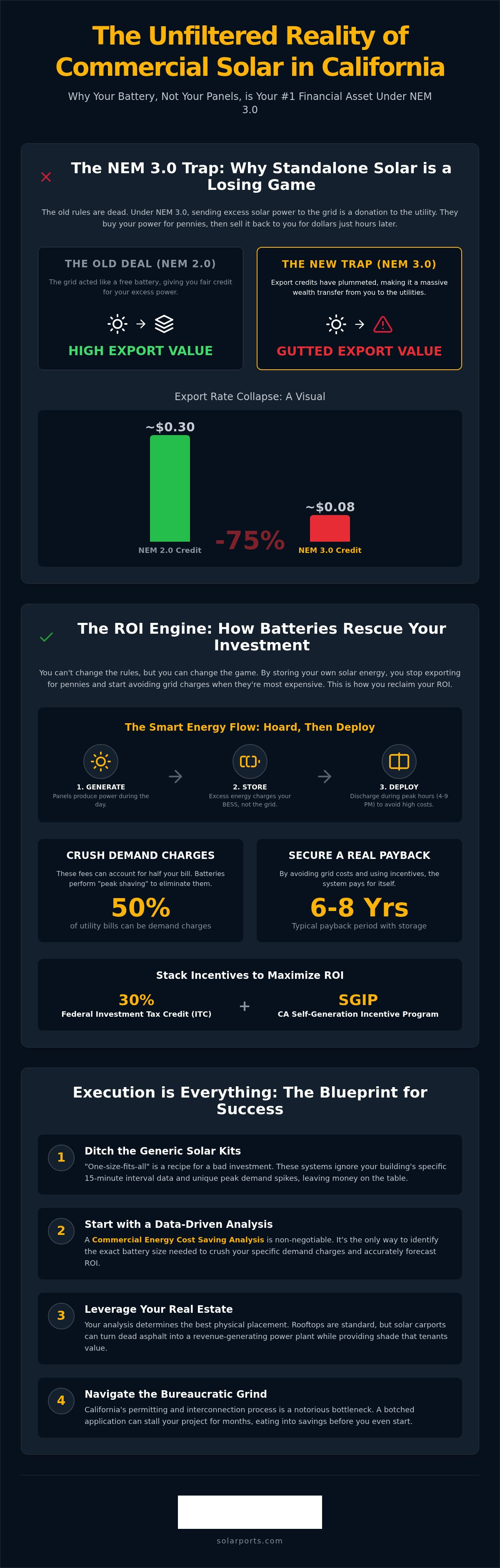
The transition from Net metering (NEM) 2.0 to 3.0 wasn't a minor policy tweak. It was a structural overhaul that gutted the value of standalone solar. Under the old rules, you could treat the grid like a free battery. Now, export credits have plummeted by roughly 75%. If your system produces excess power at noon, PG&E or SCE will credit you about $0.05 to $0.08 per kWh. Then, they’ll turn around and sell it back to you for $0.45 or more when the sun goes down. It's a massive wealth transfer from property owners to utilities.
This is the "duck curve" in action. California has too much solar during the day and not enough at 6 PM. Without a Battery Energy Storage System (BESS), you’re trapped. You’re producing power when it's worth the least and buying it when it's most expensive. Relying on standalone solar in 2026 is essentially a donation to the grid. To protect your commercial solar plus storage ROI under NEM 3.0, you have to stop exporting and start hoarding.
The Export Rate Problem in Northern California
In PG&E territory, the math is especially punishing. Midday generation is priced at a pittance while demand charges continue to climb. Your 2026 strategy has to pivot entirely toward self-consumption. Every kilowatt-hour you send to the grid is a missed opportunity to offset a peak-rate charge later. This is why a commercial energy cost saving analysis is the only logical starting point. Without it, you can't accurately forecast your commercial solar plus storage ROI under NEM 3.0. Integrated storage isn't a luxury anymore; it's the only way to make the numbers work.
The ROI Engine: Calculating Payback with Solar Plus Storage
The math for 2026 has shifted from generation volume to strategic discharge. For most California businesses, demand charges account for nearly 50% of the monthly utility bill. By utilizing a Battery Energy Storage System (BESS) for "peak shaving," you can deploy power during the 4 PM to 9 PM window when grid prices often triple. Avoided cost, which is the financial value of grid power you no longer have to purchase during peak windows, has become the primary driver of commercial solar plus storage ROI under NEM 3.0. You aren't just generating power; you're actively defending your bottom line against the most expensive hours of the day.
The official NEM 3.0 policy changes essentially forced this shift. To keep your payback period within the 6 to 8 year range, you have to stack incentives effectively. This means combining the 30% Federal Investment Tax Credit (ITC) with California's Self-Generation Incentive Program (SGIP). These financial layers transform a high-capex project into a manageable asset that pays for itself through drastic operational savings.
Leveraging the 2026 Commercial Solar Tax Credit
The 2026 commercial solar tax credit California provides a massive upfront capital reduction, but it only works if the system is sized correctly for your building's load. A generic setup will either leave money on the table or overspend on capacity you don't need. A precision-led commercial solar ROI analysis is the only way to identify the exact battery sizing required to crush your specific demand charges. If you're ready to see the actual numbers for your site, schedule a data-driven strategy session to map out your facility's potential.
Executing the Strategy: From Analysis to Turnkey Installation
Buying a generic solar kit is like buying a suit off the rack for a marathon. It won't fit. These one-size-fits-all systems fail because they don't account for your specific 15-minute interval data or unique peak demand spikes. You need a commercial energy cost saving analysis before you even look at hardware. This data determines if you should stick to the roof or leverage your parking lot with solar carports. In California, where real estate is at a premium, carports turn dead asphalt into a revenue-generating power plant while providing shade that tenants actually value.
The unfiltered reality of 2026 is that California's permitting and interconnection process remains a bureaucratic grind. It's slow. It's frustrating. If you're trying to manage the utility queue yourself, you're already behind. You need a partner who handles that friction and keeps the project moving through the PG&E or SCE bottleneck. A botched interconnection application can stall your commercial solar plus storage ROI under NEM 3.0 for months, eating away at your projected savings before the system even turns on.
The Turnkey Approach to Commercial BESS
Success in this market requires a turnkey commercial solar in CA strategy. It's the only way to avoid the "Solar Cowboy" headache where installers vanish the moment the last bolt is tightened. You need a single point of accountability from the initial feasibility study through the final utility permission to operate. Mapping out the commercial solar installation timeline early allows for precise capital allocation. Don't settle for a vendor. Find a strategic partner who views your energy infrastructure as a long-term financial asset rather than just another construction project.
Securing Your 2026 Energy Strategy
NEM 3.0 didn't destroy the case for solar; it simply forced it to evolve. The era of sending free power to the grid is over. If you want to protect your bottom line, you have to prioritize self-consumption and peak shaving. By crushing demand charges and stacking federal incentives, you can still hit a 6 to 8 year payback. But you can't guess your way to those numbers. Maximizing your commercial solar plus storage ROI under NEM 3.0 requires a granular look at your building's specific load profile and interval data.
We specialize in California's complex energy landscape through turnkey project management and data-driven ROI modeling. Don't leave your fiscal future to chance. Get a No-Nonsense Commercial Energy Cost Saving Analysis to see the unfiltered reality for your site. It's time to take control of your energy overhead.
Frequently Asked Questions
What is the average ROI for commercial solar plus storage in California under NEM 3.0?
The typical payback period for a commercial solar plus storage system under NEM 3.0 currently sits between 6 and 8 years. Standalone solar has seen its ROI stretch toward 12 years because midday export rates are so low. Adding a battery allows you to hoard your own power for use when grid prices are highest, keeping the math favorable for Northern California properties.
Can I add a battery to my existing commercial solar system to improve ROI?
You absolutely can. Retrofitting a Battery Energy Storage System (BESS) to an existing array is a smart way to modernize a legacy asset. It allows you to tackle the skyrocketing demand charges that rooftop panels alone can't fix. Most Northern California businesses find that adding storage is the only way to stop overpaying for electricity during the expensive 4 PM to 9 PM window.
How do demand charges affect the financial case for commercial BESS?
Demand charges are the silent killer of commercial margins, often making up 50% of your utility bill. A BESS uses "peak shaving" to discharge power when your building’s energy draw spikes. This lowers the peak demand level the utility sees, which directly slashes those heavy fees. This mitigation is the engine behind a strong commercial solar plus storage ROI under NEM 3.0.
What California incentives are available for commercial energy storage in 2026?
In 2026, you can still leverage the 30% Federal Investment Tax Credit (ITC) alongside California’s Self-Generation Incentive Program (SGIP). When you stack these with MACRS accelerated depreciation, the net cost of your system drops significantly. These incentives are the primary reason we can still deliver a competitive commercial solar plus storage ROI under NEM 3.0 for our clients in Northern California.
Frequently asked questions
What is the average ROI for commercial solar plus storage in California under NEM 3.0?
The typical payback period for a commercial solar plus storage system under NEM 3.0 currently sits between 6 and 8 years. Standalone solar has seen its ROI stretch toward 12 years because midday export rates are so low. Adding a battery allows you to hoard your own power for use when grid prices are highest, keeping the math favorable for Northern California properties.
Can I add a battery to my existing commercial solar system to improve ROI?
You absolutely can. Retrofitting a Battery Energy Storage System (BESS) to an existing array is a smart way to modernize a legacy asset. It allows you to tackle the skyrocketing demand charges that rooftop panels alone can't fix. Most Northern California businesses find that adding storage is the only way to stop overpaying for electricity during the expensive 4 PM to 9 PM window.
How do demand charges affect the financial case for commercial BESS?
Demand charges are the silent killer of commercial margins, often making up 50% of your utility bill. A BESS uses "peak shaving" to discharge power when your building’s energy draw spikes. This lowers the peak demand level the utility sees, which directly slashes those heavy fees. This mitigation is the engine behind a strong commercial solar plus storage ROI under NEM 3.0.
What California incentives are available for commercial energy storage in 2026?
In 2026, you can still leverage the 30% Federal Investment Tax Credit (ITC) alongside California’s Self-Generation Incentive Program (SGIP). When you stack these with MACRS accelerated depreciation, the net cost of your system drops significantly. These incentives are the primary reason we can still deliver a competitive commercial solar plus storage ROI under NEM 3.0 for our clients in Northern California.