
Commercial Solar Carports: A Strategic Financial Asset for California Property Owners in 2026

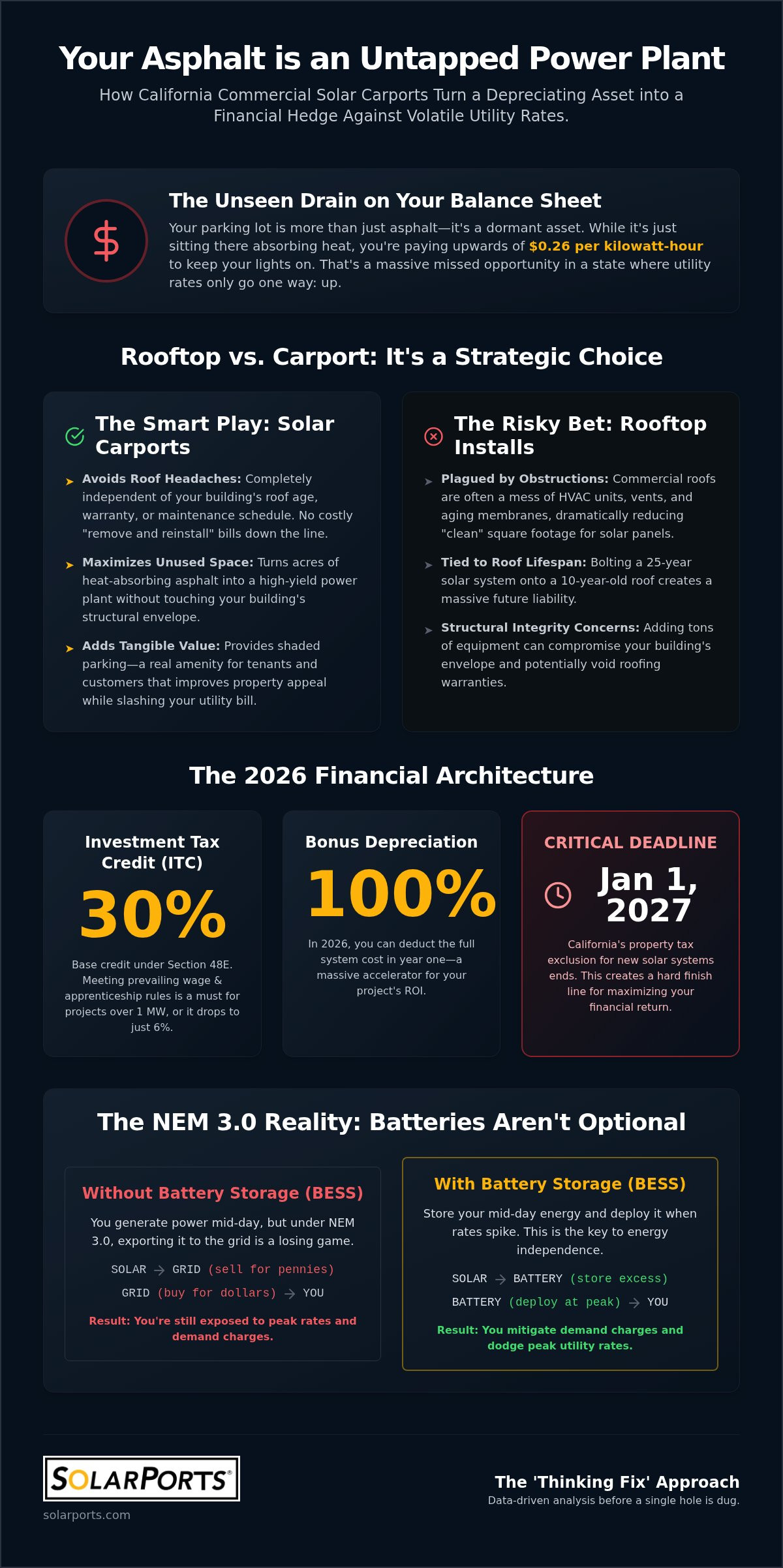
Your asphalt is likely the most underutilized asset on your balance sheet. While you're paying upwards of $0.26 per kilowatt-hour to keep the lights on, that open parking lot is just absorbing heat and depreciating. It's a missed opportunity. We can agree that California's utility rates aren't going down, and the nightmare of interconnection delays makes most owners hesitate to act. But commercial solar carports have shifted from being an "eco-friendly" luxury to a hard-nosed financial hedge against utility volatility. This guide breaks down how to transform those stagnant spaces into high-yield energy plants that lock in predictable overhead. We'll walk through the specific 2026 tax incentives, the strategic necessity of battery storage under NEM 3.0, and how to navigate the utility queue without draining your internal team's bandwidth.
Key Takeaways
- You'll see why commercial solar carports usually beat rooftop installs when you're dealing with aging structures or roof-mounted HVAC units that eat up all your usable space.
- We'll explain the 2026 Safe Harbor deadlines and why the California property tax exclusion ending on January 1, 2027, creates a hard finish line for your project.
- It's now obvious that pairing solar with a Battery Energy Storage System (BESS) is the only way to actually dodge California's peak utility rates and demand charges.
- Find out how a rigorous energy cost saving analysis prevents the expensive mistake of overbuilding a system that doesn't map to your real-world consumption.
Table of Contents
- The Strategic Case for Commercial Solar Carports in California
- Financial Architecture: ROI and Demand Charge Mitigation
- From Analysis to Interconnection: The SolarPorts Methodology
The Strategic Case for Commercial Solar Carports in California
Commercial roofs are often a mess. Between aging membranes and a forest of HVAC units, finding enough "clean" square footage for a high-yield solar array is a constant struggle. This is why commercial solar carports have become the preferred move for property owners who don't want to mess with their building's structural envelope. By moving the generation to the parking lot, you avoid the headache of coordinating solar installs with roof replacement cycles or compromising your roof's integrity.
These structures, often referred to as solar canopies, turn dormant asphalt into a revenue-generating power plant. It’s a simple trade: you provide the shade, and the system provides the offset. In the California "space race," where every square foot of real estate is scrutinized for its ROI, leaving a parking lot as just a slab of heat-absorbing material is a financial drain. You're essentially letting a high-value asset sit idle while your utility bill climbs.
Rooftop Solar vs. Carport Systems: The Spatial Strategy
A building's roof has a finite lifespan. If you bolt a 25-year solar system onto a 10-year-old roof, you'll eventually face a massive "remove and reinstall" bill when the membrane fails. Commercial solar carports are independent, long-term assets that don't care about your building's maintenance schedule. In Northern California, the secondary benefit is immediate: shaded parking. Tenants and customers notice when their cars aren't sweltering after a short meeting. It’s a tangible amenity that happens to slash your utility bill. For a broader project overview, see our turnkey commercial solar CA guide.
Financial Architecture: ROI and Demand Charge Mitigation
Electricity is no longer a fixed overhead cost you just have to accept. In 2026, the financial logic for commercial solar carports is driven by a convergence of high utility rates and aggressive federal incentives. We've moved past the era of "green projects" into a phase where solar is a strategic hedge against PG&E and SCE volatility. While historic California's solar initiatives paved the way, today's ROI is built on sophisticated load management. A rigorous commercial solar ROI analysis is the only way to see the unfiltered math behind your specific meter.
The "BESS Multiplier" has changed everything. Under NEM 3.0, exporting power to the grid is a losing game. You're getting pennies for what you sell but paying a premium for what you buy during peak hours. Deploying commercial solar carports alongside a Battery Energy Storage System (BESS) allows you to store mid-day generation and deploy it when rates spike. This isn't just about saving energy. It's about demand charge mitigation, which often accounts for half of a commercial bill. It's the difference between a project that breaks even and one that actively generates cash flow.
Leveraging the 2026 Commercial Solar Tax Credit
The 30% base Investment Tax Credit (ITC) under Section 48E is a massive lever, provided you meet labor standards. For projects over 1 MW, you must stick to prevailing wage and apprenticeship rules or watch that credit drop to 6%. We also have 100% federal bonus depreciation in 2026. This allows you to deduct the full system cost in year one. Understanding the commercial solar tax credit California specifics is vital for your CFO, especially since the state's property tax exclusion ends January 1, 2027. To avoid over-capitalizing, a granular energy cost saving analysis ensures you build exactly what you need. If you want to see the numbers for your specific site, you can schedule a financial feasibility review.
From Analysis to Interconnection: The SolarPorts Methodology
Most vendors want to start digging holes immediately. That's a mistake. We start with a "Thinking Fix" approach. This means a data-driven usage analysis to ensure the system actually fits the load. You don't want to overbuild. You want to optimize. As noted in a Solar Energy Industries Association report, major corporations have successfully scaled these assets, but for the mid-market, precision is everything. You don't want a vendor who just sells hardware; you want a partner who understands your P&L. This turnkey approach ensures your internal resources aren't drained by project management tasks that aren't your core business. Once the math is locked, we move into the commercial solar installation timeline. This usually spans several months of permitting before you see a single truck on-site. We coordinate the staging and construction so your parking lot remains functional. Your tenants shouldn't have to deal with the headache.
Solving the Interconnection Puzzle in Northern California
The utility interconnection process is often described as a black box. It's frustrating. PG&E and SCE territories have specific bottlenecks that can stall a project for months if you don't know how to navigate the bureaucracy. We don't chase massive sprawl. Instead, our projects focus on small-scale commercial efficiency in Northern California. This specialization lets us navigate local permitting and utility queues with granular detail. We handle the paperwork and the persistent follow-up. It's about getting commercial solar carports energized without the typical drama. We've seen the delays. We know how to avoid them.
Securing Your Property's Financial Future
Letting your parking lot sit as a heat-absorbing slab of asphalt is a choice. In California's current utility environment, it's a choice that costs you money every single month. We've covered how commercial solar carports offer a clean way to bypass structural roof issues while capturing the 2026 tax benefits. Pairing these with a BESS is no longer optional; it's the only way to kill those demand charges under NEM 3.0. As experts in Northern California commercial real estate, we handle everything from the first data-driven analysis to the final utility sign-off. Don't let interconnection delays or tax deadlines drain your internal resources. You can Request Your Commercial Energy Cost Saving Analysis now to see the math for your site. It's time to turn that pavement into a high-yield asset.
Frequently Asked Questions
How much does a commercial solar carport cost in California for 2026?
Total cost is a function of structural steel requirements and your specific utility's interconnection fees. We don't quote generic prices because soil conditions and existing switchgear capacity vary wildly from site to site. A professional energy cost saving analysis is the only way to get a real number. This process identifies exactly what hardware you need to offset your unique utility bill without overspending.
What is the typical ROI for a commercial solar carport installation?
ROI is currently driven by the 30% ITC and 100% federal bonus depreciation for 2026 projects. For commercial solar carports, the real value comes from slashing demand charges through integrated storage. Under NEM 3.0, the math favors on-site consumption over grid exports. Most owners find that the combination of tax credits and operational savings creates a compelling case for immediate capital deployment.
Do solar carports require significant maintenance in Northern California?
These systems are built for durability, but they do require periodic attention. In Northern California, you'll mostly deal with dust buildup and the occasional seasonal debris that can impact panel efficiency. Regular cleaning and remote monitoring of the BESS components are usually enough to keep things running. It's a much simpler maintenance profile than rooftop systems that are tethered to building membranes and HVAC units.
Can I add EV charging stations to my commercial solar carport later?
You can definitely add EV charging later, but you should plan for it now. We recommend installing the necessary conduit and sizing your electrical infrastructure during the initial build. It's much cheaper to prep for EV stations while the ground is already open. Adding commercial solar carports with EV-ready capacity makes your property significantly more attractive to high-value tenants and customers.
Frequently asked questions
How much does a commercial solar carport cost in California for 2026?
Total cost is a function of structural steel requirements and your specific utility's interconnection fees. We don't quote generic prices because soil conditions and existing switchgear capacity vary wildly from site to site. A professional energy cost saving analysis is the only way to get a real number. This process identifies exactly what hardware you need to offset your unique utility bill without overspending.
What is the typical ROI for a commercial solar carport installation?
ROI is currently driven by the 30% ITC and 100% federal bonus depreciation for 2026 projects. For commercial solar carports, the real value comes from slashing demand charges through integrated storage. Under NEM 3.0, the math favors on-site consumption over grid exports. Most owners find that the combination of tax credits and operational savings creates a compelling case for immediate capital deployment.
Do solar carports require significant maintenance in Northern California?
These systems are built for durability, but they do require periodic attention. In Northern California, you'll mostly deal with dust buildup and the occasional seasonal debris that can impact panel efficiency. Regular cleaning and remote monitoring of the BESS components are usually enough to keep things running. It's a much simpler maintenance profile than rooftop systems that are tethered to building membranes and HVAC units.
Can I add EV charging stations to my commercial solar carport later?
You can definitely add EV charging later, but you should plan for it now. We recommend installing the necessary conduit and sizing your electrical infrastructure during the initial build. It's much cheaper to prep for EV stations while the ground is already open. Adding commercial solar carports with EV-ready capacity makes your property significantly more attractive to high-value tenants and customers.