
Commercial Solar Carport Cost: A 2026 Strategic Investment Guide for California Real Estate

Table of Contents
- Estimating the Capital Investment: What Really Drives Commercial Solar Carport Cost?
- Calculating ROI in California's New Energy Landscape
- The Missing Piece: Why Your Carport Needs a Battery
- The Right Process: From Analysis to Asset Management
Estimating the Capital Investment: What Really Drives Commercial Solar Carport Cost?
Let's get straight to it. Anyone giving you a simple cost per square foot for a commercial solar carport in California is either uninformed or selling you something that won't pass inspection. The real cost is a mix of obvious hardware and the complex, invisible work that makes a project a long-term asset instead of a liability.
The total investment breaks down into a few key areas: (solar canopies)
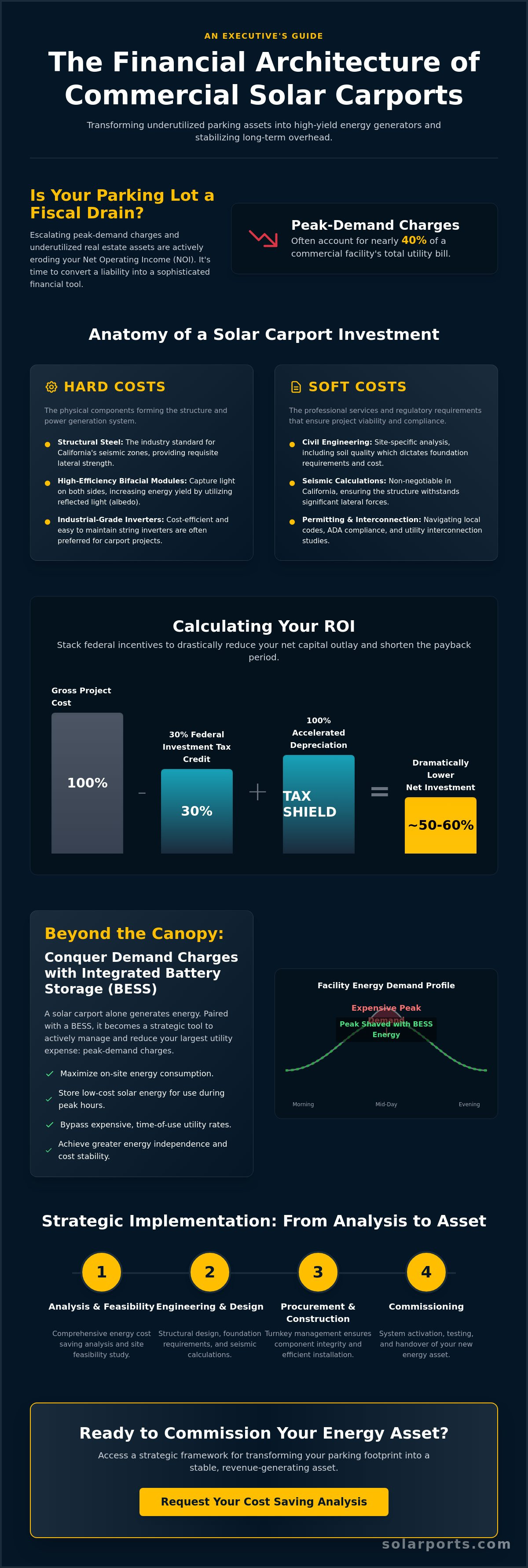
- Hard Costs: This is the steel, the panels, and the electronics. We're not talking about flimsy kits. We’re talking about high-grade structural steel engineered to handle California's seismic requirements, high-efficiency bifacial solar modules that capture reflected light from the pavement, and commercial-grade inverters built for decades of performance.
- Soft Costs: Here’s where most online calculators fail. This bucket includes civil engineering, seismic calculations, extensive permitting fees, and utility interconnection studies. In California, these "soft" costs can be a massive part of the budget, and they are non-negotiable.
- Economies of Scale: The price-per-watt drops significantly as projects get bigger. The fixed costs—mobilization, engineering, project management—get spread out over a larger system. A 20-stall carport will have a much higher cost per unit than a 200-stall installation. It’s a simple truth of commercial construction.
Material and Design Choices Matter
The decision between a cantilever design (single-post) and a T-frame (double-post) isn’t just about looks; it's a major cost variable. Cantilevers offer more parking maneuverability and a cleaner aesthetic, but they require significantly more steel and deeper concrete foundations to support the load. That engineering premium is real. For back-to-back parking stalls, a T-frame is often the more fiscally responsible choice. The structure itself is a financial decision.
Calculating ROI in California's New Energy Landscape
The payback period for a commercial solar carport isn't just about how much energy you generate. It's about how and when you use that energy, and what incentives you leverage to cut the initial capital expense.
Federal Incentives and Depreciation: Your Financial Levers
First, the big one: the 30% Federal Investment Tax Credit (ITC) is the foundation of any project's financial model. But for 2026, there are potential "bonus" credits for using domestic content or locating a project in a designated "Energy Community." These add-ons require careful planning but can be a powerful boost. (California solar carport tax incentives)
Then there's MACRS (Modified Accelerated Cost Recovery System). This allows you to aggressively depreciate the asset, with the potential for 80% bonus depreciation in the first year. It’s a massive tax benefit that significantly improves year-one cash flow. These two incentives alone fundamentally change the investment profile of a solar carport.
The NEM 3.0 Reality: Self-Consumption is Everything
Forget what you knew about selling power back to the grid. Under California's Net Billing Tariff (NEM 3.0), the value of exported solar energy has been slashed. The old model of spinning your meter backward is dead.
The new strategy is brutally simple: use the power you generate on-site. The financial value of a solar carport is now almost entirely based on its ability to offset the most expensive electricity you would otherwise buy from the utility, particularly during peak afternoon hours. A system must be meticulously designed to match your property's actual consumption patterns. For a deep dive into this critical process, see our guide on right-sizing commercial solar systems.
The Missing Piece: Why Your Carport Needs a Battery
Here's the truth most solar-only installers won't tell you: in California's current market, a commercial solar carport without a Battery Energy Storage System (BESS) is an incomplete financial asset. Why? Because of demand charges.
Demand charges are crippling fees based on your single highest peak of energy usage in a month. They can account for over 50% of a commercial utility bill. Solar carports generate immense power mid-day, but your highest demand might be later in the evening when your solar production is dropping off. The solar alone can't solve this problem. (California's Net Energy Metering Program)
Using BESS to Eliminate Peak Demand Charges
A BESS changes the game. It stores the cheap, abundant solar energy generated during the day and deploys it strategically during expensive peak hours. This "peak shaving" allows you to flatten your energy demand from the grid, directly attacking and often eliminating punitive demand charges.
A solar carport provides the fuel; the battery provides the strategic control. This synergy turns an energy-generating asset into a comprehensive cost-control machine, providing a powerful hedge against PG&E and SCE's relentless rate hikes. To understand the mechanics, explore our detailed breakdown of how BESS reduces peak demand charges.
The Right Process: From Analysis to Asset Management
Executing a commercial solar carport project correctly isn't about buying a kit. It's a strategic process that protects your investment and guarantees performance.
- Energy Cost Saving Analysis: It all starts with data. A proper analysis of your utility interval data (often called Green Button data) is the only way to model your consumption and determine the optimal system size. Over-building is just as wasteful as under-building in the NEM 3.0 era.
- Engineering & Interconnection: Once sized, the project moves into detailed structural engineering to meet California Building Code and utility interconnection applications. This is a complex, document-heavy phase that requires deep regional expertise.
- Procurement & Installation: Sourcing steel and components is followed by a carefully managed installation process designed to minimize disruption to your tenants and business operations.
- Commissioning & O&M: The final step is bringing the system online and establishing a long-term Operations and Maintenance (O&M) plan to ensure the asset performs at peak financial capacity for its 25+ year lifespan.
Ultimately, a commercial solar carport is a significant capital investment in your property's financial performance. It demands a partner who understands the nuances of California's energy market, building codes, and financial incentives. The first step is always a clear, data-driven look at the potential.
Ready to see what the real numbers look like for your property? Request a custom Commercial Property Energy Cost Saving Analysis today.