
2026 Guide to Commercial Solar for California Owners

A low price per watt on a solar bid is usually a distraction from a much bigger problem. Most owners are looking for a way to stop the bleeding from California's relentless utility rate hikes, but they're often handed sales documents instead of actual financial models. It's easy to get lost in the jargon of NEM 3.0 and battery discharge cycles. You likely already know that a solar-only approach doesn't work anymore with export rates sitting at roughly $0.05 to $0.08 per kWh. Understanding a commercial solar proposal requires you to ignore the sticker price and focus on the forensic details of the energy cost saving analysis. I'm going to show you how to audit these bids so you can find a path to lower bills without taking on operational risk. We'll start by stripping back the marketing layers to see if the technical scope actually matches your real-world demand charges.
Key Takeaways
- Spot predatory utility rate assumptions by checking if the yearly escalation rate exceeds the 4-6% standard.
- Understanding a commercial solar proposal starts with knowing the difference between simple energy production and the demand charge reduction that actually saves money.
- Don't buy a stranded asset; solar without a battery energy storage system is a losing game under 2026 export rules.
- Force a forensic look at site-specific hurdles like ADA parking compliance and utility interconnection backlogs before you sign.
Table of Contents
- The Financial Anatomy of a Solar Proposal
- Technical Scope: Carports, Rooftops, and BESS Integration
- Vetting the Execution: From Analysis to Turnkey Completion
The Financial Anatomy of a Solar Proposal
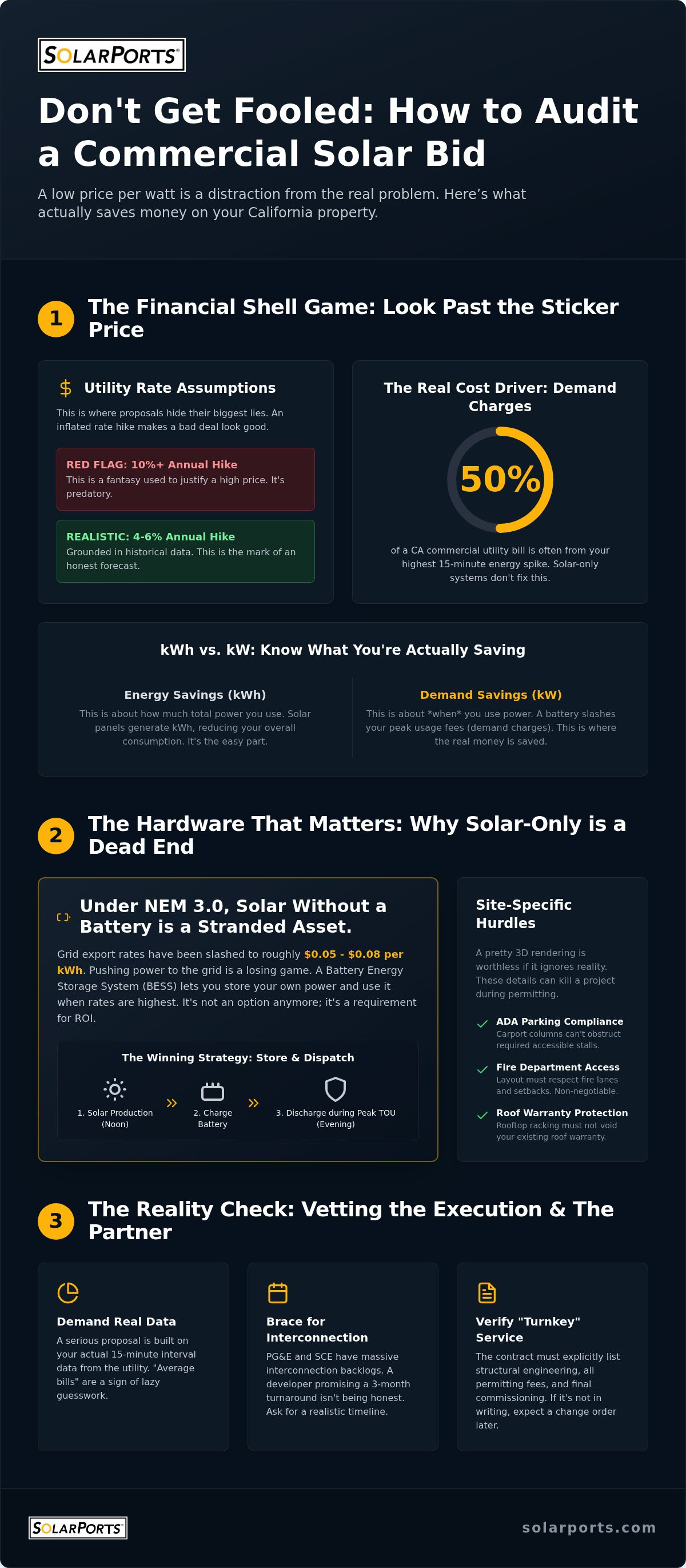
The 'Total System Cost' is usually the boldest number on the page, but it's often the one that matters least. If you're serious about understanding a commercial solar proposal, you have to look at the utility rate escalation assumption. Some vendors bake in a 10% annual hike just to make their numbers look better. That's predatory. A realistic figure is closer to 4-6%. If the math relies on utility rates doubling every few years, the proposal is a fantasy, not a financial plan.
You also need to verify the tax credits. In 2026, the federal Investment Tax Credit (ITC) sits at a 30% base, but your specific property might qualify for additional 'adders' if you're using domestic content. Whether you're considering a cash purchase or a Power Purchase Agreement (PPA), the tax accounting must be airtight. A proper commercial solar ROI analysis distinguishes between simple energy savings (kWh) and the much harder-to-get demand savings (kW).
Deciphering Utility Rate Assumptions and Demand Charges
Don't trust a proposal built on 'average' monthly bills. You need a model based on your actual 15-minute interval data from the utility. This data is the only way to map out strategies to lower commercial electricity bills through peak shaving. Demand charges are the fee for your highest 15-minute usage window, which often accounts for 50% of a CA commercial bill. Solar alone rarely fixes this. You need a battery energy storage system (BESS) to actually move the needle on those peak costs.
Technical Scope: Carports, Rooftops, and BESS Integration
Understanding a commercial solar proposal involves a deep dive into the site plan. Don't just look at the pretty 3D rendering. Look for ADA compliance and fire setbacks. If a carport design ignores the width of your parking stalls or blocks fire truck access, that 'savings' evaporates during the permitting phase. Rooftop systems have their own risks. You need to verify that the racking system won't void your existing roof warranty. Tier 1 modules are the baseline, but the structural integrity of the mount is what keeps the building dry.
Truly understanding a commercial solar proposal means looking at the hardware specs with a critical eye. In 2026 California, solar without storage is essentially a stranded asset. NEM 3.0 has slashed export rates so deeply that pushing power back to the grid at noon is a losing move. You need a Battery Energy Storage System (BESS) sized to your specific load profile. Check the proposal for a dispatch strategy. It should show exactly how the battery will discharge during your most expensive Time of Use (TOU) windows.
Why BESS and Carports are Strategic for 2026 California Properties
Solar carports turn underutilized parking lots into power plants while giving tenants shade they actually value. It's a dual-purpose asset. To make it work, your provider's services must include handling the nightmare of California's multi-agency permitting process. If you are looking at financing options, the EPA's Guide to Solar PPAs provides a solid foundation for how these third-party ownership models function. If you want to see how these systems fit your specific site, you can book a technical review to get a second opinion on your current bids.
Vetting the Execution: From Analysis to Turnkey Completion
A proposal is a promise, but the execution is where you actually see a return. Understanding a commercial solar proposal means looking past the glossy PDF and demanding the raw data behind the numbers. If the provider can't show you the 15-minute interval data they used, the math is just a guess. Every successful build starts with a rigorous commercial energy cost saving analysis that accounts for the specific nuances of your site and load profile.
The biggest bottleneck in 2026 isn't the hardware; it's the utility company. PG&E and SCE are currently dealing with massive interconnection backlogs. You need a developer who provides a realistic timeline for this, not one who promises a three-month turnaround that isn't possible. True turnkey service has to include structural engineering, all permitting fees, and a final commissioning report. If these aren't explicitly listed, expect a change order later that erodes your ROI.
Validating the Developer's Track Record in California
Experience in California matters because the regulations are unique. You should ask to see projects of a similar scale in your specific utility territory. General Commercial Solar Information and Resources can help you understand standard procurement, but the local details are what determine if a project succeeds.
Don't just settle for a manufacturer's warranty. You need operations and maintenance (O&M) terms that ensure the system actually performs over twenty years. Finally, ask the thinking fix question: if the grid goes down, does this BESS keep your critical loads running? Many systems just shut off unless they're specifically configured for backup. If you're paying for a battery, it should do more than just shift your TOU window; it should protect your operations.
Securing Your Energy Strategy
A solar bid isn't just a quote; it's a financial forecast that dictates your operational overhead for the next two decades. Understanding a commercial solar proposal requires you to look beyond the upfront cost and scrutinize the utility rate assumptions and BESS dispatch strategies. If the math doesn't account for the current utility interconnection backlogs or the reality of NEM 3.0 export rates, the project is a liability. You need a partner who provides data-driven recommendations for right-sized systems and manages the turnkey execution from start to finish. Our Northern California experts specialize in BESS integration to mitigate demand charges. Don't leave your ROI to chance with generic estimates. Request a forensic Energy Cost Saving Analysis for your California property to see what's actually possible. The savings are there if you know where to look.
Frequently Asked Questions
What is the most common 'fake' number in a commercial solar proposal?
The utility rate escalation factor is the most manipulated figure in the industry. While 4% to 6% is a realistic historical average for Northern California, some developers plug in 10% or more to inflate the projected ROI. Understanding a commercial solar proposal means checking this assumption first. If the model relies on extreme utility hikes to pencil, the project's financial foundation is built on a guess.
How does NEM 3.0 change the way I should read my solar proposal in 2026?
Under NEM 3.0, you have to ignore the total generation number and focus on self-consumption. Because the value of exported energy has dropped by roughly 75% to about $0.05 per kWh, a 2026 proposal is worthless if it doesn't center on a Battery Energy Storage System (BESS). You're looking for how much energy you can keep behind the meter to avoid peak demand charges.
Is a solar carport more expensive than rooftop solar in the long run?
While solar carports have a higher installation cost per watt, they often outperform rooftop systems by utilizing space that doesn't require roof repairs or warranties. They provide dual value through vehicle shade and tenant retention. In the long run, the ability to install a larger, more efficient system in a parking lot can lead to deeper demand charge reductions than a space-constrained roof allows.
What happens to my commercial solar proposal if I sell the building in five years?
A solar and storage system is a transferable asset that typically increases the property's valuation. In California, these systems are excluded from property tax reassessment; you get the benefit of the infrastructure without the tax hit. When you sell, the remaining incentives and the lower operational costs are passed to the new owner, often making the building more attractive in a competitive Northern California commercial market.
Frequently asked questions
What is the most common 'fake' number in a commercial solar proposal?
The utility rate escalation factor is the most manipulated figure in the industry. While 4% to 6% is a realistic historical average for Northern California, some developers plug in 10% or more to inflate the projected ROI. Understanding a commercial solar proposal means checking this assumption first. If the model relies on extreme utility hikes to pencil, the project's financial foundation is built on a guess.
How does NEM 3.0 change the way I should read my solar proposal in 2026?
Under NEM 3.0, you have to ignore the total generation number and focus on self-consumption. Because the value of exported energy has dropped by roughly 75% to about $0.05 per kWh, a 2026 proposal is worthless if it doesn't center on a Battery Energy Storage System (BESS). You're looking for how much energy you can keep behind the meter to avoid peak demand charges.
Is a solar carport more expensive than rooftop solar in the long run?
While solar carports have a higher installation cost per watt, they often outperform rooftop systems by utilizing space that doesn't require roof repairs or warranties. They provide dual value through vehicle shade and tenant retention. In the long run, the ability to install a larger, more efficient system in a parking lot can lead to deeper demand charge reductions than a space-constrained roof allows.
What happens to my commercial solar proposal if I sell the building in five years?
A solar and storage system is a transferable asset that typically increases the property's valuation. In California, these systems are excluded from property tax reassessment; you get the benefit of the infrastructure without the tax hit. When you sell, the remaining incentives and the lower operational costs are passed to the new owner, often making the building more attractive in a competitive Northern California commercial market.