
Commercial Solar for California Offices: 2026 Guide

The solar pitch sounds familiar by now: install panels, save money, feel good about it. But for office building owners across California, that pitch has been missing the most expensive line item on the utility bill entirely. Peak demand charges, not raw kilowatt-hour consumption, are what's actually gutting your operating budget. And most commercial solar vendors aren't sizing systems to fix that problem. They're sizing them to sell you more panels.
If you've been skeptical of the one-size-fits-all approach to commercial solar for office buildings in California, that instinct is worth trusting. The 2026 landscape is genuinely different. NEM 3.0 changed the economics of grid export, the federal Investment Tax Credit has real teeth for qualifying projects, and battery storage has crossed a threshold where it's no longer a premium add-on. It's the core of a defensible energy strategy.
This guide cuts through the noise. You'll get a clear-eyed look at how to right-size solar and storage for your specific property, what 2026 incentives actually apply to California office assets, and why solar carports deserve a serious look if you're sitting on underutilized parking. No fluff. Just the financial logic you need to make a decision you won't regret.
Key Takeaways
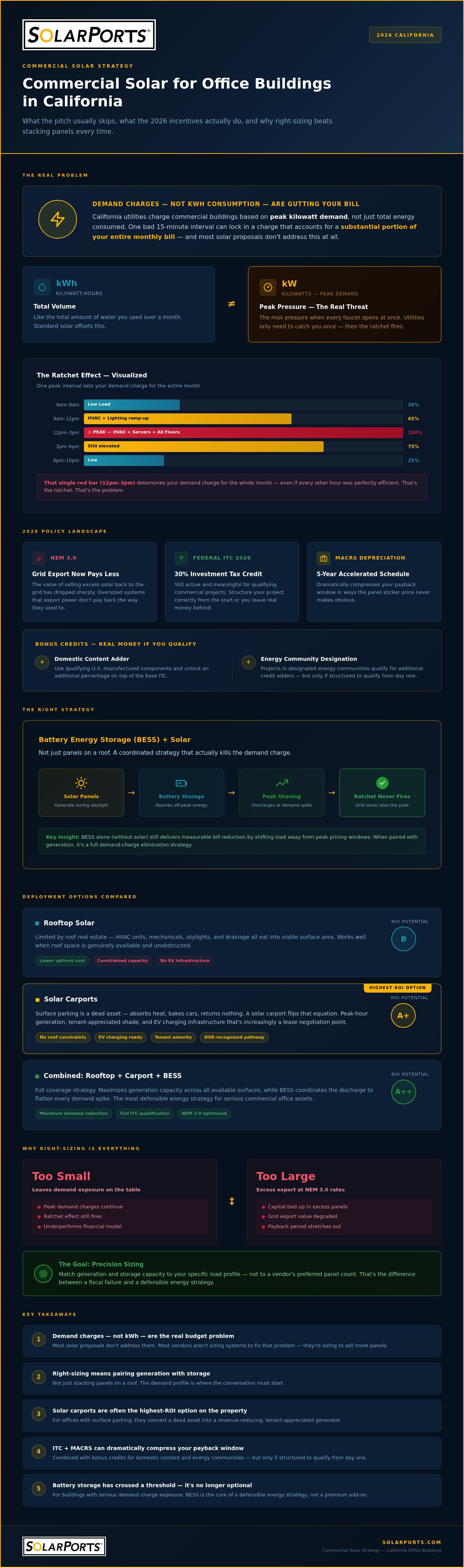
- Peak demand charges—not kilowatt-hour consumption—are the real budget problem for California office buildings, and most solar proposals don't address them at all.
- Right-sizing commercial solar for office buildings California means pairing generation with battery storage, not just stacking panels on a roof and calling it done.
- Solar carports aren't a niche add-on—for offices with surface parking, they're often the highest-ROI deployment option on the property.
- The 2026 federal ITC, combined with MACRS depreciation, can dramatically compress your payback window in ways the sticker price of a solar install doesn't make obvious.
- Bonus credits for domestic content and energy community designations are real money—but only if your project is structured to qualify from the start.
Table of Contents
- The 2026 Reality of California Office Energy Costs
- Right-Sized Solutions: Rooftop, Carports, and Integrated Storage
- The CFO Guide to Solar ROI and Incentives
The 2026 Reality of California Office Energy Costs
California utilities didn't just raise rates. They restructured how commercial customers get charged, and the shift has been brutal for office building owners who haven't adjusted their thinking. The question on your bill isn't just how many kilowatt-hours you consumed last month. It's when you pulled them from the grid, and how hard you hit it at the worst possible moment.
Office buildings are sitting in a particularly exposed position here. The loads that define a typical workday — HVAC systems ramping up mid-morning, server rooms running full tilt, lighting across multiple floors — all converge during the same window that solar power in California was supposed to solve. Except rooftop solar alone doesn't solve it. Generation offsets consumption, but it does almost nothing to flatten the demand spikes that are actually driving your bill. That's the gap most commercial solar proposals quietly ignore.
Why Demand Charges Are Killing Your Bottom Line
Here's the mechanic worth understanding: utilities measure your peak demand in kilowatts (kW), not kilowatt-hours (kWh). Think of kWh as the total volume of water you used over a month. kW is the pressure you hit when you opened every faucet at once. Utilities set your demand charge based on that peak pressure reading, and they only need to catch you once. A single 15-minute interval where your building pulls hard can lock in a demand charge that accounts for a substantial portion of your total monthly bill. That's the ratchet effect, and it doesn't care how efficiently you ran the rest of the month.
For any serious analysis of commercial solar for office buildings California, this is where the conversation has to start. Not panel count. Not annual kWh offset. The demand profile.
The Role of BESS in Peak Shaving
A Battery Energy Storage System doesn't generate anything. That's not what it's for. It absorbs energy during low-rate periods and discharges it precisely when your demand would otherwise spike, effectively flattening the curve your utility sees. The grid never registers the peak. The ratchet never fires. Understanding how BESS works in a commercial context makes clear why storage has stopped being optional for buildings with serious demand charge exposure. Paired with solar generation, it's a coordinated strategy. Standalone, it still delivers measurable bill reduction. That's a meaningful distinction when you're building a financial case for your asset.
Right-Sized Solutions: Rooftop, Carports, and Integrated Storage
Office buildings aren't warehouses. That sounds obvious, but it's the thing most commercial solar proposals completely ignore. A 400,000 square foot distribution center has the roof real estate to throw panels at the problem until it goes away. A three-story professional office building in Sacramento or San Jose doesn't. You've got HVAC units, mechanical equipment, skylights, and drainage infrastructure eating into every viable surface. The math is different. The strategy has to be different too.
Right-sizing is the actual discipline here. A system that's too small leaves demand exposure on the table. A system that's too large generates excess power you can't sell back at meaningful rates under NEM 3.0, which means you've just tied up capital in panels that don't pay back. Both are fiscal failures. The goal is precision: matching generation and storage capacity to your specific load profile, not to a vendor's preferred panel count.
Maximizing Real Estate with Solar Carports
Surface parking lots are an underutilized asset on most office properties. They absorb heat, bake cars, and generate zero return. A solar carport flips that equation. The structure generates power during peak production hours, provides shade that tenants actually notice and appreciate, and opens the door to EV charging infrastructure, which is increasingly a lease negotiation point for commercial tenants. The U.S. Department of Energy Solar Energy Technologies Office recognizes carport-integrated systems as a legitimate pathway for commercial properties where rooftop space is constrained. For a deeper look at the mechanics, this breakdown of how commercial solar works is worth reading before you evaluate any proposal. If you want to think through what this looks like for your specific property, scheduling a site analysis is the logical next step.
Rooftop Solar for Complex Office Structures
Rooftop deployment on an office building isn't a plug-and-play operation. Roof warranties, structural load ratings, and the maze of existing mechanical equipment all require engineering review before a single panel goes up. This is where rooftop solar for office buildings in CA demands a genuinely specialized approach, not a residential installer who scaled up. Northern California's interconnection requirements add another layer; PG&E and SMUD have distinct processes, timelines, and technical standards. The "turnkey" label gets thrown around loosely in this industry. What it should actually mean is a partner who owns the engineering, permitting, and utility coordination from start to finish, not one who hands you a packet of paperwork and disappears.
For commercial solar for office buildings California to actually pencil out, the system design has to reflect your building's real constraints, not an idealized scenario. That requires specificity from day one.
The CFO Guide to Solar ROI and Incentives
The 30% federal Investment Tax Credit is real. But "up to 40%" claims you'll see in competitor proposals? Those numbers require your project to clear specific hurdles that most vendors don't explain upfront. The base ITC for 2026 sits at 30% for projects meeting prevailing wage and apprenticeship requirements. Stack a domestic content bonus on top and you can push that figure higher, but only if your equipment sourcing is structured to qualify from the design phase. Energy community designations add another potential layer. The point is: these aren't automatic. They're engineered into a project or they're not.
MACRS depreciation is where a lot of CFOs leave money on the table simply because their solar vendor didn't bring it up. Under the Modified Accelerated Cost Recovery System, commercial solar assets qualify for accelerated depreciation, typically over five years. The tax shield generated in years one and two can meaningfully compress your effective net cost, often more than the ITC itself on a cash-flow basis. Run the numbers with your tax counsel before you evaluate any proposal on sticker price alone.
One thing that doesn't get said enough: California commercial electricity rates have consistently outpaced general inflation over the past decade, and projections from the CPUC suggest that trajectory isn't reversing. Every year you wait, the baseline you're comparing solar savings against gets worse. Equipment costs have been declining; utility rates haven't. That asymmetry is the actual risk calculus, and it favors moving sooner.
Calculating the Payback Period
Simple payback is a blunt instrument. It tells you how many years until cumulative savings equal your upfront cost, and it ignores the time value of money entirely. IRR is the number that actually matters for a commercial asset, because it accounts for the timing of cash flows, tax benefits, and the compounding effect of avoided escalating utility costs over a 20-plus year system life. For commercial solar for office buildings California, IRR figures that look modest on a simple payback basis often look considerably stronger when modeled correctly.
The "what if I sell in five years" objection is legitimate. It's also largely answered by appraisal data. Solar assets with documented utility savings are increasingly reflected in income-approach valuations for commercial office properties. A system that demonstrably reduces operating expenses improves NOI. Improved NOI improves asset value. That's not a solar pitch; that's basic cap rate math.
Next Steps for Property Owners
Before any proposal means anything, you need 12 months of interval data from your utility. Green Button data, available through PG&E, SCE, or SMUD, gives you 15-minute demand readings across a full year. Without it, any payback projection is a guess dressed up as a forecast. That data is the foundation of a real analysis.
Vetting a provider comes down to a few non-negotiables: engineering done in-house, demonstrated experience with California interconnection processes, and a clear explanation of how they handle permitting and utility coordination. "Turnkey" should mean they own the entire process. Ask specifically who manages the interconnection application and what happens if it stalls.
The logical next move is a commercial energy cost saving analysis built on your actual interval data, not industry averages. For any California office asset carrying meaningful demand charge exposure, that analysis is where the real numbers live. Everything else is speculation.
The Window to Act Is Narrower Than It Looks
Here's what this guide comes down to: demand charges are the real problem, rooftop solar alone doesn't fix them, and the 2026 incentive stack is genuinely worth engineering your project around. Those three things together change the math on commercial solar for office buildings California in ways that a surface-level proposal will never show you.
What separates a project that performs from one that disappoints is specificity. Twelve months of interval data. Storage sized to your actual demand profile. Incentives structured in from day one, not bolted on after the fact. SolarPorts handles all of it: permitting, interconnection, utility coordination. Turnkey isn't a marketing word here. It's the whole model, built specifically for Northern California commercial real estate.
The utility rate trajectory isn't reversing. Every month you're running on unoptimized energy costs is a month you don't get back. The analysis is where the real numbers live, and it starts with your data, not industry averages.
Request your commercial energy cost saving analysis and find out exactly what your property is leaving on the table.
Frequently Asked Questions
Is solar worth it for office buildings in California after NEM 3.0?
Yes, but the calculus has shifted. NEM 3.0 made grid export less valuable, which means systems designed primarily to sell excess power back to the utility are harder to justify. The projects that still pencil out strongly are the ones targeting demand charge reduction through paired solar and storage, not raw generation volume. That's actually a better fit for office buildings anyway, since your peak load and peak solar production hours overlap in ways that make self-consumption the smarter play.
For commercial solar for office buildings California, NEM 3.0 didn't kill the economics. It killed the lazy version of the economics. A system right-sized to your actual load profile, with storage handling demand shaving, can still deliver compelling returns. The federal ITC and MACRS depreciation haven't changed. Utility rates haven't come down. The fundamental case is intact; the design just has to be smarter.
How much roof space does a commercial solar system actually need?
A rough rule of thumb is around 100 square feet per kilowatt of installed capacity using standard commercial panels, but that number gets complicated fast on an office building. HVAC equipment, structural setbacks, drainage infrastructure, and roof warranty requirements all eat into usable area in ways that a satellite image won't reveal. A three-story office building in a dense urban corridor might have 40% of its apparent roof area actually available for panels once engineering takes a real look.
This is exactly why rooftop capacity alone often can't carry the full load for an office property, and why surface parking deserves a serious look. A solar carport doesn't compete with HVAC units or drainage slopes. It uses space that's currently generating zero return, and it can often deploy more generation capacity than a constrained rooftop can deliver. The right answer for your property depends on your specific site, not an industry average.
What are the maintenance requirements for a commercial solar carport?
Carport systems are lower-maintenance than most property owners expect. The panels themselves typically need periodic cleaning, with frequency depending on local dust and debris conditions. Inverters and electrical components should be inspected annually by a qualified technician. The structural canopy requires the same routine checks you'd apply to any covered parking structure: fastener integrity, drainage function, and surface condition. None of this is operationally intensive, and most of it can be folded into existing property maintenance schedules.
If the carport includes EV charging infrastructure or battery storage, those components add some monitoring requirements, but modern systems handle most of that through remote diagnostics. The practical reality is that a well-installed carport system is largely a set-and-monitor asset, not an ongoing operational burden. Confirm with your installer what's covered under any service agreement and what falls to you before the project closes.
Can I install solar on a building with multiple tenants and separate meters?
It's possible, but the structure matters enormously. If you're a landlord with tenants on separate utility meters, a standard solar installation feeding into a single master meter works cleanly for common area loads, HVAC, elevators, and shared building systems. Allocating solar benefits to individual tenant meters is more complex and typically requires a virtual net metering arrangement or a specific lease structure that accounts for energy cost pass-throughs.
The cleaner play for multi-tenant office buildings is usually to target the landlord-controlled loads first: common areas, parking, base building systems. That's where you have direct control over the utility account and can capture the full economic benefit without navigating tenant lease complications. If you want to extend benefits to tenants, get your legal counsel involved early. The structure has to be right from the start, or you'll be renegotiating leases mid-project.
Frequently asked questions
Is solar worth it for office buildings in California after NEM 3.0?
Yes, but the calculus has shifted. NEM 3.0 made grid export less valuable, which means systems designed primarily to sell excess power back to the utility are harder to justify. The projects that still pencil out strongly are the ones targeting demand charge reduction through paired solar and storage, not raw generation volume. That's actually a better fit for office buildings anyway, since your peak load and peak solar production hours overlap in ways that make self-consumption the smarter play. For commercial solar for office buildings California, NEM 3.0 didn't kill the economics. It killed the lazy version of the economics. A system right-sized to your actual load profile, with storage handling demand shaving, can still deliver compelling returns. The federal ITC and MACRS depreciation haven't changed. Utility rates haven't come down. The fundamental case is intact; the design just has to be smarter.
How much roof space does a commercial solar system actually need?
A rough rule of thumb is around 100 square feet per kilowatt of installed capacity using standard commercial panels, but that number gets complicated fast on an office building. HVAC equipment, structural setbacks, drainage infrastructure, and roof warranty requirements all eat into usable area in ways that a satellite image won't reveal. A three-story office building in a dense urban corridor might have 40% of its apparent roof area actually available for panels once engineering takes a real look. This is exactly why rooftop capacity alone often can't carry the full load for an office property, and why surface parking deserves a serious look. A solar carport doesn't compete with HVAC units or drainage slopes. It uses space that's currently generating zero return, and it can often deploy more generation capacity than a constrained rooftop can deliver. The right answer for your property depends on your specific site, not an industry average.
What are the maintenance requirements for a commercial solar carport?
Carport systems are lower-maintenance than most property owners expect. The panels themselves typically need periodic cleaning, with frequency depending on local dust and debris conditions. Inverters and electrical components should be inspected annually by a qualified technician. The structural canopy requires the same routine checks you'd apply to any covered parking structure: fastener integrity, drainage function, and surface condition. None of this is operationally intensive, and most of it can be folded into existing property maintenance schedules. If the carport includes EV charging infrastructure or battery storage, those components add some monitoring requirements, but modern systems handle most of that through remote diagnostics. The practical reality is that a well-installed carport system is largely a set-and-monitor asset, not an ongoing operational burden. Confirm with your installer what's covered under any service agreement and what falls to you before the project closes.
Can I install solar on a building with multiple tenants and separate meters?
It's possible, but the structure matters enormously. If you're a landlord with tenants on separate utility meters, a standard solar installation feeding into a single master meter works cleanly for common area loads, HVAC, elevators, and shared building systems. Allocating solar benefits to individual tenant meters is more complex and typically requires a virtual net metering arrangement or a specific lease structure that accounts for energy cost pass-throughs. The cleaner play for multi-tenant office buildings is usually to target the landlord-controlled loads first: common areas, parking, base building systems. That's where you have direct control over the utility account and can capture the full economic benefit without navigating tenant lease complications. If you want to extend benefits to tenants, get your legal counsel involved early. The structure has to be right from the start, or you'll be renegotiating leases mid-project.