
Commercial Solar Financing in Southern California: A Strategic 2026 Framework

What if your utility bill wasn't an inevitable expense, but a liability you could actually restructure? You've probably watched SCE's 12.9% rate hikes or SDG&E’s new tiered demand charges eat into your margins. It's frustrating. The dense jargon surrounding commercial solar financing Southern California usually makes things worse, leaving you stuck between volatile grid costs and terms that feel designed to confuse rather than help. You need a strategy that protects your property's cash flow without draining your operating capital. This guide provides a clear framework for 2026. We'll cut through the noise to compare C-PACE against traditional loans and detail how to stack the 30% ITC to maximize your ROI. Stop reacting to the grid. Start treating your power like a calculated investment that actually works for your bottom line.
Key Takeaways
- Stop treating utility bills like they're set in stone. Moving to solar is a hedge against the 12.9% rate hikes SCE and SDG&E have planned, turning an unpredictable expense into a fixed asset.
- Compare C-PACE against traditional loans to see what actually protects your cash flow. The right commercial solar financing Southern California structure can fund 100% of your project while keeping debt off your main balance sheet.
- Stack the 30% federal ITC with MACRS depreciation to maximize your 2026 capital stack. You can effectively wipe out nearly half the project cost through tax savings in the first year alone.
- Don't ignore battery storage (BESS) if you want a real ROI. It's the only way to avoid the brutal 4 p.m. to 9 p.m. peak-demand charges that make standard utility power so expensive for SoCal properties.
Table of Contents
- The Southern California Rate Trap: Why Financing is a Strategic Hedge
- Debt vs. Equity: Comparing C-PACE, Loans, and PPAs
- Maximizing the 2026 Capital Stack: Incentives and Depreciation
The Southern California Rate Trap: Why Financing is a Strategic Hedge
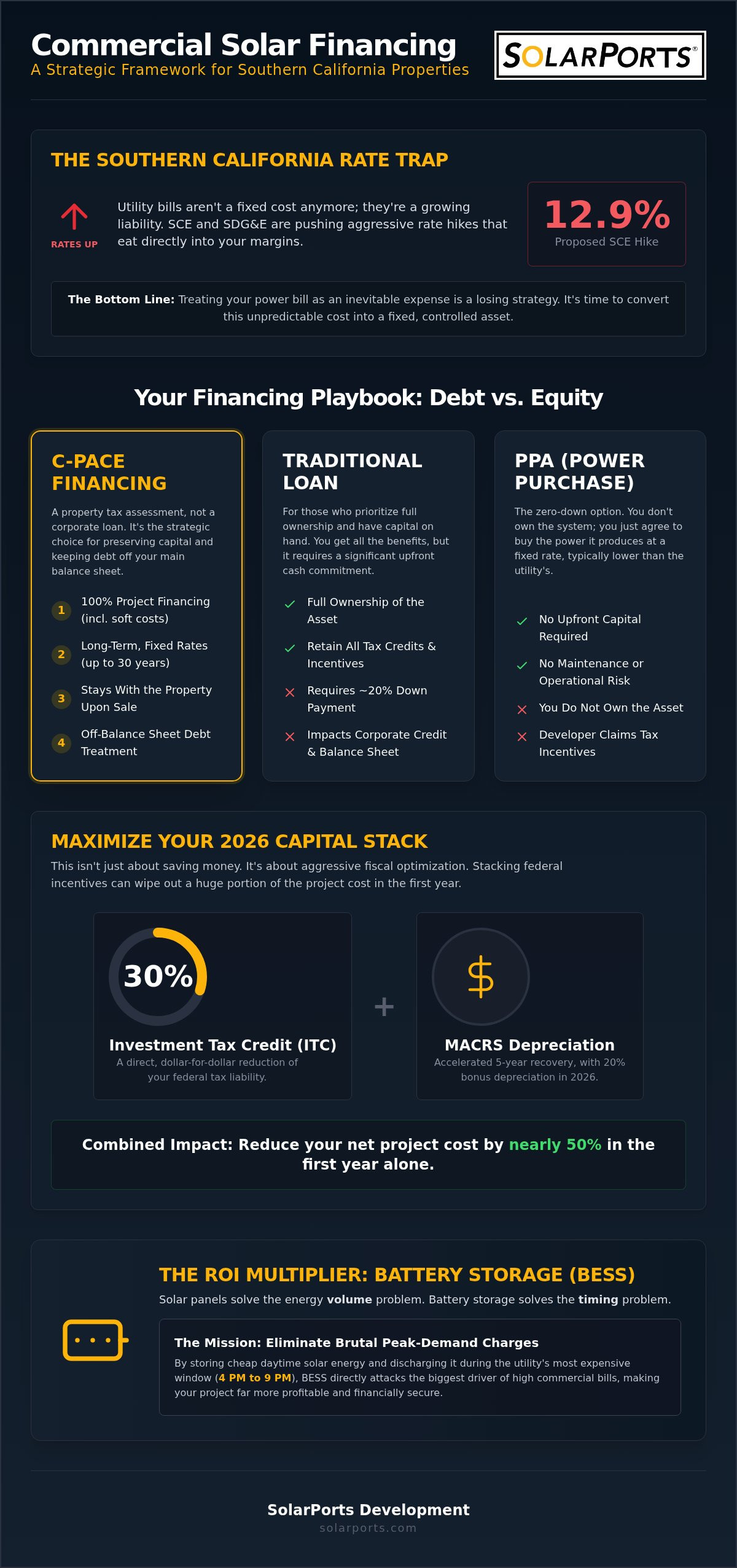
Southern California businesses are currently caught in a fiscal vice. SCE and SDG&E have pushed rates to some of the highest levels in the country, with SCE recently proposing a 12.9% hike to cover grid hardening and infrastructure costs. In this environment, commercial solar financing Southern California isn't just a way to buy hardware. It's a strategic tool to convert a volatile utility liability into a fixed asset. By leveraging specialized structures like Commercial Property Assessed Clean Energy (C-PACE), Power Purchase Agreements (PPAs), or SBA loans, you can fund these systems with minimal upfront cash.
The logic has moved past simple "green" branding. It's now about the cold math of demand charges on commercial meters. If your utility rates are climbing 10% annually, waiting for "better technology" is a losing bet. You're losing money every day you wait. Every month of delay is another month of overpaying for power you could have produced yourself with a structured plan for commercial solar financing Southern California. The cost of inaction is a guaranteed financial loss that no future efficiency gain can realistically recover.
The Role of BESS in Financing Your Energy Independence
Standard solar panels solve the energy volume problem, but Battery Energy Storage Systems (BESS) solve the timing problem. By discharging stored power during the expensive 4 p.m. to 9 p.m. window, you effectively bypass the peak-demand charges that drive up commercial bills. Our turnkey services show how we integrate these storage solutions into the total project cost to maximize your ROI. From a lender’s perspective, BESS significantly improves the debt-coverage ratio by ensuring the savings generated consistently exceed the monthly loan payment. This makes the entire project more attractive to underwriters and far safer for your property's cash flow.
Debt vs. Equity: Comparing C-PACE, Loans, and PPAs
Choosing the right structure for commercial solar financing Southern California depends on how you want to manage your balance sheet. Traditional loans offer full ownership and control, but they usually demand a 20% down payment and a pristine credit profile. Interest rates currently hover between 6% and 12%, making them a significant commitment of capital. On the other hand, Power Purchase Agreements (PPAs) are the zero-down alternative. You don't own the hardware; you just buy the power it produces. It's clean, but you're effectively handing over the Federal Business Energy Investment Tax Credit to the developer in exchange for that low entry cost.
C-PACE is different. It's a property tax assessment, not a corporate loan. This means you can fund 100% of the project without a massive cash outlay. Because it's tied to the land, the debt often stays off your main balance sheet. It's a pragmatic way to preserve your borrowing capacity for other operational needs while still locking in energy security. With terms extending up to 30 years and rates typically between 5% and 7%, it's often the most logical fit for properties in Orange or San Diego counties.
Why C-PACE is Winning in Southern California Commercial Real Estate
Developers love C-PACE because it's transferable. If you sell the building, the assessment stays with the property. It also covers soft costs that other lenders won't touch, like the initial commercial energy cost saving analysis. This flexibility is vital when you're trying to figure out how each model fits into your commercial solar ROI analysis. If you aren't sure which path fits your specific tax situation, you can book a strategy session with us to look at the numbers.
Maximizing the 2026 Capital Stack: Incentives and Depreciation
Tax season shouldn't be a surprise; it should be a payday. In 2026, the Investment Tax Credit (ITC) remains a powerhouse at a 30% base rate. If your property is in a designated energy community, that credit can jump even higher. Successful commercial solar financing Southern California strategies rely on this "capital stack" approach, combining the ITC with MACRS (Modified Accelerated Cost Recovery System). MACRS allows for a five-year recovery period, and since bonus depreciation is at 20% for 2026, you can write off a massive chunk of the system cost almost immediately. This isn't just about looking green; it's about aggressive fiscal optimization.
Southern California properties have a unique advantage when it comes to layering incentives. You can often stack solar credits with local rebates for EV charging infrastructure or the Self-Generation Incentive Program (SGIP) for battery storage. These additional layers drive down the net cost of solar carport systems significantly. This is where commercial solar financing Southern California turns into a multi-functional revenue asset rather than just a utility hedge. To verify every available local rebate in your specific zip code, use the Database of State Incentives for Renewables & Efficiency (DSIRE).
How to Layer Your Solar Financing for Maximum ROI
- Step 1: Start with a data-driven commercial property energy cost saving analysis. Don't guess. Right-size the system to avoid over-capitalizing on hardware you don't need.
- Step 2: Secure a C-PACE or loan commitment based on projected savings. Use the utility's own rate hike projections to prove your debt-coverage ratio to lenders.
- Step 3: Execute the project and claim the ITC and MACRS in the same tax year. This creates the fastest path to a break-even point and protects your immediate cash flow.
Take Control of Your Operational Capital
The SoCal utility landscape isn't getting any simpler. With double-digit rate hikes becoming the standard, your property’s cash flow depends on moving from a passive consumer to an active producer. We covered how commercial solar financing Southern California turns high utility liabilities into predictable, fixed-cost assets. If you go with the balance-sheet-friendly C-PACE structure or a traditional loan, the goal is the same: stack the 30% ITC and MACRS depreciation to front-load your returns. Our team focuses exclusively on the California commercial market, bringing specialized BESS integration and turnkey management to small-scale properties. You don't have to navigate these banking terms alone. Let's look at your actual meter data and build a structure that makes sense for your specific bottom line. Get a No-Nonsense Energy Cost Saving Analysis for Your Property today. It's time to stop overpaying for power you can own.
Frequently Asked Questions
Is commercial solar financing worth it with current interest rates in 2026?
Yes, financing remains a strategic move because utility rate hikes are currently outpacing the cost of capital. While interest rates for commercial loans sit between 6% and 12%, SCE’s proposed 12.9% increase for 2026 makes borrowing cheaper than doing nothing. You're essentially trading a variable, escalating utility bill for a fixed, predictable debt payment that eventually disappears.
What is the typical payback period for commercial solar in Southern California?
Payback periods for SoCal commercial properties typically land between 3 and 6 years. This timeline is driven by the 30% ITC and the ability to stack MACRS depreciation, including the 20% bonus available in 2026. Because SDG&E and SCE have some of the highest rates in the country, the avoided cost of energy pays for the system hardware faster than in most other states.
Can I finance a solar carport and BESS together under one loan?
Absolutely. Bundling a solar carport and BESS into one commercial solar financing Southern California package is often the most efficient route. Lenders prefer this because the battery storage mitigates expensive peak-demand charges, making the project's savings more consistent. It turns a simple shade structure into a high-yield energy asset that protects your property's overall cash flow.
How does C-PACE financing differ from a traditional commercial mortgage?
C-PACE is a property tax assessment, while a mortgage is a traditional corporate debt. This distinction is vital for balance sheet management. C-PACE stays with the land, meaning the obligation can transfer to a new owner if you sell the building. It also covers 100% of project costs, including soft costs like our energy cost saving analysis, without requiring a large down payment.
Frequently asked questions
Is commercial solar financing worth it with current interest rates in 2026?
Yes, financing remains a strategic move because utility rate hikes are currently outpacing the cost of capital. While interest rates for commercial loans sit between 6% and 12%, SCE’s proposed 12.9% increase for 2026 makes borrowing cheaper than doing nothing. You're essentially trading a variable, escalating utility bill for a fixed, predictable debt payment that eventually disappears.
What is the typical payback period for commercial solar in Southern California?
Payback periods for SoCal commercial properties typically land between 3 and 6 years. This timeline is driven by the 30% ITC and the ability to stack MACRS depreciation, including the 20% bonus available in 2026. Because SDG&E and SCE have some of the highest rates in the country, the avoided cost of energy pays for the system hardware faster than in most other states.
Can I finance a solar carport and BESS together under one loan?
Absolutely. Bundling a solar carport and BESS into one commercial solar financing Southern California package is often the most efficient route. Lenders prefer this because the battery storage mitigates expensive peak-demand charges, making the project's savings more consistent. It turns a simple shade structure into a high-yield energy asset that protects your property's overall cash flow.
How does C-PACE financing differ from a traditional commercial mortgage?
C-PACE is a property tax assessment, while a mortgage is a traditional corporate debt. This distinction is vital for balance sheet management. C-PACE stays with the land, meaning the obligation can transfer to a new owner if you sell the building. It also covers 100% of project costs, including soft costs like our energy cost saving analysis, without requiring a large down payment.