
Commercial Solar Carport Financing in California: A Strategic 2026 Guide to Capital Allocation

In 2026, an empty parking lot is a fiscal leak that grows wider with every utility rate hike. It's a reality that Northern California property owners face as SCE and PG&E continue to squeeze margins. You likely recognize the need for energy independence but fear the weight of long term debt on your balance sheet. It's a valid concern for any strategic executive. This guide explains how to leverage commercial solar carport financing California to transform your property into a high yield energy asset without a heavy upfront capital burden.
We'll show you how to align specific financing structures with your tax appetite to secure an immediate reduction in operating expenses. You'll get a clear view of the 2026 tax credit environment and a methodology for turnkey execution. It's time to stop viewing solar as a construction project and start seeing it as a sophisticated hedge against utility volatility.
Key Takeaways
- Utility rates are no longer a stable line item but a volatile risk factor. You need to understand why the post-NEM 3.0 landscape makes storage-linked financing the new standard for California commercial properties.
- Deciding between direct ownership and leasing depends entirely on your tax appetite. We explore how commercial solar carport financing California can turn a massive capital expense into a predictable, manageable operating cost.
- The financing is only as solid as the data behind the project. A rigorous energy cost saving analysis is the necessary anchor to ensure your system is right-sized for maximum funding and ROI.
- Focus on the dual-purpose advantage to maximize your margins. Integrating Battery Energy Storage Systems (BESS) with carports allows you to aggressively target peak-demand charges while providing shade for your tenants.
Table of Contents
- The 2026 California Landscape: Why Carport Financing Requires a Strategic Shift
- Choosing Your Vehicle: PPAs, Leases, and Direct Ownership Models
- Moving from Analysis to Installation: Securing Your ROI
The 2026 California Landscape: Why Carport Financing Requires a Strategic Shift
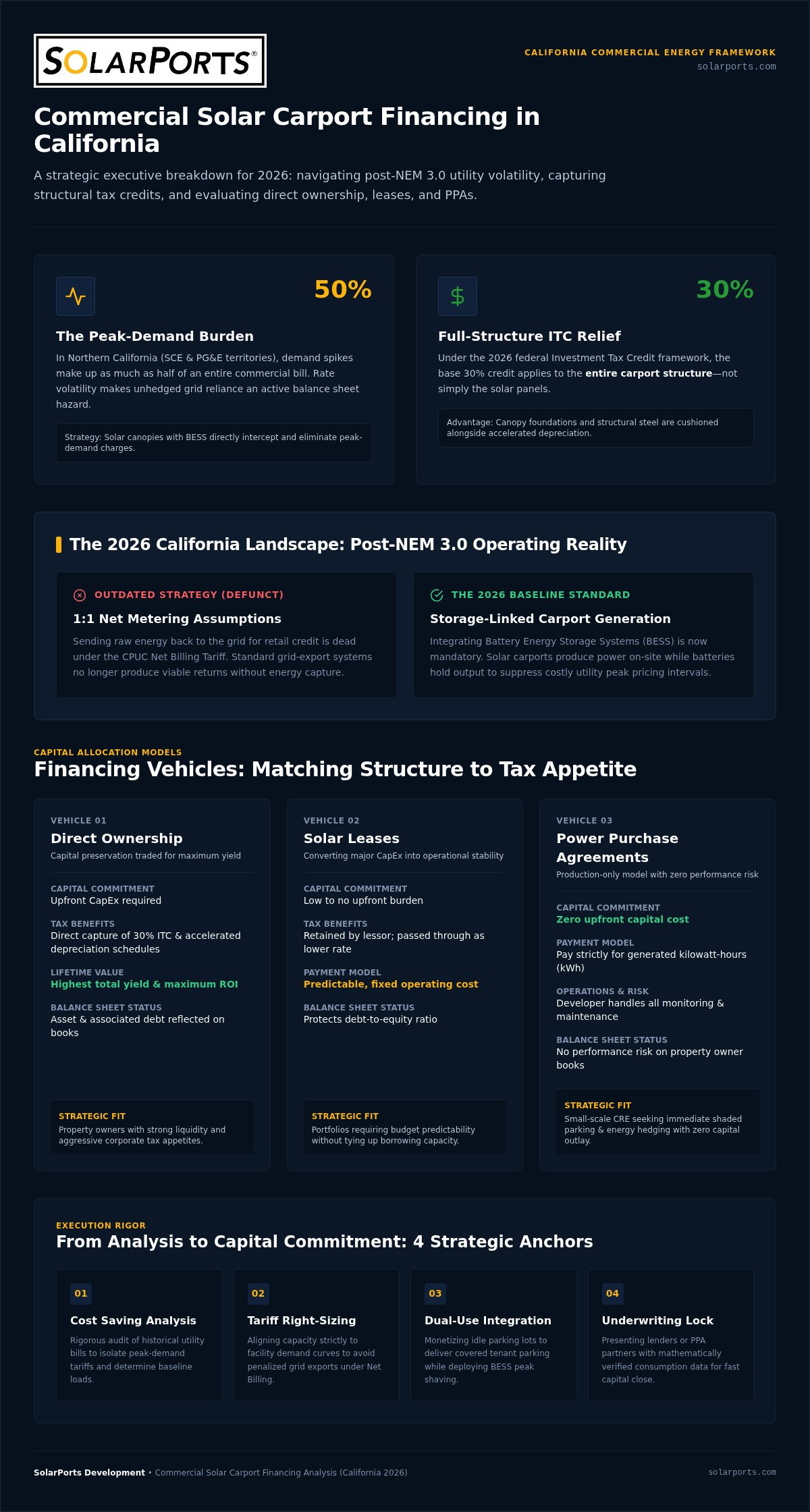
Utility rates in California have shifted from a predictable line item to a volatile risk factor. For property owners in Northern California, relying on the grid without a hedge is a gamble that rarely pays off. The "Post-NEM 3.0" reality has killed the simplicity of net metering; sending power back to the grid for a 1:1 credit is a relic of the past. Today, storage-linked financing is the baseline requirement for any project that actually pencils out.
Financing a carport isn't just about paying for a structure. It's about capturing the delta between skyrocketing utility rates and your solar levelized cost of energy (LCOE). When you evaluate commercial solar carport financing California, you're looking at a strategic capital allocation designed to eliminate peak-demand charges. These solar canopy systems provide a unique advantage by utilizing underperforming real estate while simultaneously generating power where it's consumed.
Navigating the 2026 ITC and California-Specific Incentives
The 2026 fiscal landscape offers a base 30% Investment Tax Credit (ITC) that provides a significant tailwind for these projects. Crucially, this credit applies to the entire carport structure, not just the panels. This makes the structural costs of carports much easier to digest compared to traditional ground mounts. Northern California businesses are increasingly prioritizing these installations to combat specific operational pains:
- Immediate mitigation of peak-demand charges that often make up 50% of a commercial bill.
- Monetizing parking lots through dual-purpose shade and power generation.
- Capturing maximum depreciation benefits through accelerated schedules.
Without a data-driven commercial property energy cost saving analysis, you're leaving capital on the table. The goal is to match the financing structure to your specific tax appetite, ensuring the project is cash-flow positive from day one through a refined CFO-level strategy. You shouldn't view this as a construction expense, but as a sophisticated financial instrument.
Choosing Your Vehicle: PPAs, Leases, and Direct Ownership Models
Selecting a financing structure is a choice between capital preservation and long-term yield. There isn't a "standard" answer; the right move depends entirely on your current liquidity and tax position. When evaluating commercial solar carport financing California, those with available capital often find that direct ownership delivers the highest lifetime value. It allows you to capture all federal incentives and depreciation benefits, which are essential for an accurate commercial solar ROI analysis.
If you need to keep your debt-to-equity ratio clean, solar leases are a predictable alternative. They turn a major capital expense into a fixed operating cost that's easy to budget. However, many California property owners are moving toward solar power purchase agreements (PPAs). This "no-upfront-cost" model means you only pay for the kilowatt-hours the system actually produces, shifting the performance risk to the provider.
The Strategic Advantage of PPAs for Small-Scale Commercial Real Estate
PPAs are a "thinking fix" for owners who want energy independence without the operational burden. The developer handles the maintenance and monitoring. They're the ones responsible for making sure the system hits its targets. You get the shaded parking and lower rates. The performance risk stays off your books. Understanding how commercial solar works in this context is the most streamlined path to 2026 goals. It's often the fastest way to secure commercial solar carport financing California without a massive capital outlay. If you're weighing these options, it helps to request a data-driven cost analysis to see which vehicle fits your property's profile.
Moving from Analysis to Installation: Securing Your ROI
Financing doesn't happen in a vacuum; it requires a project that is mathematically bulletproof. If your system isn't right-sized for your actual load, lenders and PPA providers won't commit the capital. Under the California Public Utilities Commission Net Billing Tariff, the value of sending power back to the grid has dropped significantly. This shift means your ROI now depends almost entirely on onsite consumption. You need to use every kilowatt-hour you produce to offset expensive utility power in real time.
This is where Battery Energy Storage Systems (BESS) become the engine of the project. BESS allows you to store solar energy and deploy it when peak-demand charges are at their highest, typically in the late afternoon and evening. It's the most effective way to make commercial solar carport financing California pencil out in a post-NEM 3.0 environment. Without storage, you're essentially leaving the most profitable part of the project on the table. It's the difference between a simple parking structure and a sophisticated financial hedge.
Turnkey execution is the only way to protect your margins during the construction phase. California's permitting and grid interconnection processes are notoriously complex and prone to delays. If you're juggling multiple vendors, these delays turn into hidden costs that erode your projected returns. A single point of accountability ensures that the transition from analysis to physical asset is seamless, keeping the project on schedule and within the parameters required by your financing agreement.
Why an Energy Cost Saving Analysis is Your First Financing Step
Lenders require a verified energy profile before they'll sign off on any capital allocation. They want to see the data that proves your property can support the debt service or PPA payments. SolarPorts Development uses granular analytics to identify the exact scale of carport and storage needed for your specific facility. We don't guess at the size; we let your utility data dictate the design. If you're ready to see the math, schedule your free solar consultation to get a project analysis and secure your ROI from the start.
Executing Your 2026 Energy Strategy
The era of passive energy management is over. In 2026, your parking lot should be more than just asphalt; it needs to be a high yield asset that actively defends your margins. We've explored how the right financing vehicle depends entirely on your specific tax position and liquidity needs. However, the math only truly pencils out when you anchor the project in a rigorous energy cost saving analysis and integrate BESS to blunt those aggressive peak charges. Successfully navigating commercial solar carport financing California requires a shift from viewing solar as a construction project to seeing it as a strategic financial hedge. By prioritizing turnkey California project management and data backed scaling, you eliminate the operational friction that usually stalls these initiatives. It's time to turn utility volatility into a competitive advantage.
Secure your 2026 energy strategy with a free cost-saving analysis and see exactly how these numbers look for your property. You've got the space; let's make it work for you.
Frequently Asked Questions
How does a commercial solar PPA differ from a standard lease in California?
A PPA is an agreement to buy the power the system generates, while a lease is a fixed payment for the hardware itself. With a PPA, the provider owns the system and you only pay for the kilowatt-hours delivered. It's a performance-based model. Leases are more like a vehicle payment; you pay the same amount regardless of how much energy the system actually produces.
Can I include battery storage in my carport financing package?
You absolutely can, and in 2026, you probably should. Most commercial solar carport financing California packages now integrate Battery Energy Storage Systems (BESS) to capture maximum value. Adding storage allows you to "shave" peak-demand charges by using stored energy when utility rates are highest. It turns a simple shade structure into a sophisticated, 24-hour energy management tool for your property.
What are the specific tax benefits for solar carports in 2026?
The primary benefit is the federal Investment Tax Credit (ITC), which sits at a base of 30% for 2026. Because carports are functional structures, the credit often applies to the entire construction cost, not just the solar modules. You can also leverage accelerated depreciation to front-load the tax savings. It's a massive fiscal lever that significantly reduces the net cost of the asset from day one.
Do solar carports increase the property value of California commercial real estate?
They definitely move the needle on valuation. A solar carport reduces operating expenses, which directly increases your Net Operating Income (NOI). Higher NOI leads to a higher property valuation during a cap rate appraisal. Beyond the math, shaded parking is a premium amenity for tenants in the Northern California heat, making your real estate more competitive and helping with long-term tenant retention.
Frequently asked questions
How does a commercial solar PPA differ from a standard lease in California?
A PPA is an agreement to buy the power the system generates, while a lease is a fixed payment for the hardware itself. With a PPA, the provider owns the system and you only pay for the kilowatt-hours delivered. It's a performance-based model. Leases are more like a vehicle payment; you pay the same amount regardless of how much energy the system actually produces.
Can I include battery storage in my carport financing package?
You absolutely can, and in 2026, you probably should. Most commercial solar carport financing California packages now integrate Battery Energy Storage Systems (BESS) to capture maximum value. Adding storage allows you to "shave" peak-demand charges by using stored energy when utility rates are highest. It turns a simple shade structure into a sophisticated, 24-hour energy management tool for your property.
What are the specific tax benefits for solar carports in 2026?
The primary benefit is the federal Investment Tax Credit (ITC), which sits at a base of 30% for 2026. Because carports are functional structures, the credit often applies to the entire construction cost, not just the solar modules. You can also leverage accelerated depreciation to front-load the tax savings. It's a massive fiscal lever that significantly reduces the net cost of the asset from day one.
Do solar carports increase the property value of California commercial real estate?
They definitely move the needle on valuation. A solar carport reduces operating expenses, which directly increases your Net Operating Income (NOI). Higher NOI leads to a higher property valuation during a cap rate appraisal. Beyond the math, shaded parking is a premium amenity for tenants in the Northern California heat, making your real estate more competitive and helping with long-term tenant retention.