
2026 Commercial Energy Cost Saving Guide for CA Owners

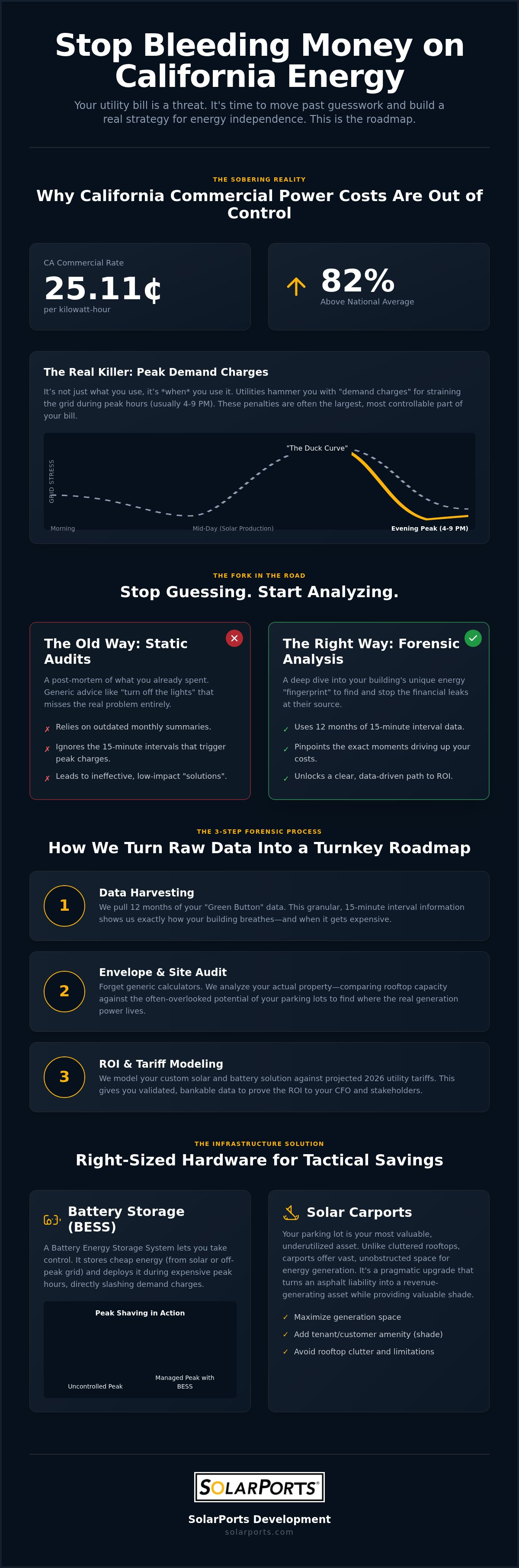
California commercial electricity rates reached 25.11 cents per kilowatt-hour this year, putting them 82% above the national average. It's a staggering reality that transforms a standard utility bill into a genuine operational threat. You're likely dealing with opaque billing structures and peak demand charges that feel more like penalties than prices. Most generic solar calculators are useless because they ignore the specific nuances of your actual property. That skepticism is earned.
A rigorous commercial energy cost saving analysis is a forensic audit of your waste. This guide shows you how to deconstruct your bill and identify the specific BESS and solar configurations that stop energy leaks in California real estate. We're moving past the marketing hype to provide a clear roadmap for energy independence. You'll get the validated data needed to prove the ROI to your stakeholders and finally stabilize your operational expenses.
Key Takeaways
- Stop relying on monthly utility summaries. A professional commercial energy cost saving analysis uses 15-minute interval data to expose the hidden demand charges that actually drive your California energy costs.
- Evaluate your property's physical potential beyond the roof. Many owners overlook solar carport systems, which can turn underutilized parking space into a primary source of energy generation.
- Prioritize "right-sizing" over hardware volume. Matching a Battery Energy Storage System (BESS) to your building's specific usage fingerprint is critical for stopping waste rather than just adding expensive equipment.
- Secure the data needed to satisfy stakeholders. Learn how to move from raw utility numbers to a turnkey roadmap that justifies the ROI to your CFO and sets a clear path for energy independence.
Table of Contents
- Beyond the Utility Bill: Why Static Energy Audits Fail California Businesses
- Deconstructing the Analysis: From Interval Data to Physical Infrastructure
- Turning Data into Infrastructure: Implementing Your Custom Energy Strategy
Beyond the Utility Bill: Why Static Energy Audits Fail California Businesses
Standard energy audits are often just a post-mortem of your expenses. They look at what you spent last month, but they rarely tell you why the bill spiked on a Tuesday at 4:00 PM. In the California market, a basic energy audit isn't enough to protect your bottom line. You need a commercial energy cost saving analysis that functions as a forensic investigation into your 15-minute interval data. This isn't about general consumption reduction anymore; it's about sophisticated load shifting.
Most owners focus on turning off lights or upgrading HVAC units. Those are fine, but they don't solve the underlying structural issue of the "Duck Curve" and volatile pricing. Since 2018, annual electricity rates for some medium-sized commercial customers in California have increased by as much as 100%. If you aren't looking at the granular "fingerprint" of your building's usage, you're just guessing. You need to know exactly when your demand peaks to stop the bleeding.
The High Cost of Peak Demand in the California Market
California utilities don't just charge for the energy you consume. They penalize you for the strain you put on the grid during peak hours, often between 4 p.m. and 9 p.m. Peak demand charges are the single largest controllable expense in a California commercial utility bill. Reducing these charges requires a tactical approach. By integrating a Battery Energy Storage System (BESS), you can "shave" these peaks. The system discharges stored power when rates are highest, effectively decoupling your operational needs from the utility's most expensive time windows. It's a strategic move from being a passive consumer to an active grid participant. This mindset of proactive planning is similar to how business owners manage international transitions, often relying on Portugal D7 visa assistance to ensure their residency status is secured with the same strategic foresight.
Deconstructing the Analysis: From Interval Data to Physical Infrastructure
A real commercial energy cost saving analysis starts with the raw data you already have but probably aren't using. We pull 12 months of Green Button data to map the usage fingerprint of your facility. This granular view is essential for analyzing commercial building energy performance because it reveals exactly how your building breathes throughout the day.
- Data Harvesting: We identify the specific 15-minute intervals where your building strains the grid and triggers high demand charges.
- Envelope Audit: We compare rooftop capacity against parking lot square footage to find where the real generation potential lives.
- ROI Modeling: We run the numbers against 2026 utility tariffs to ensure the projected savings translate to your bottom line.
We use this commercial energy cost saving analysis to model how BESS and solar systems offset your most expensive hours. It's not just about how much sun hits the panels. If you're skeptical of generic calculators, you should be. Every building has unique shading, structural limits, and load profiles that require a custom model to be accurate. This is particularly true for specialized commercial facilities, such as those featuring high-end storage solutions from Wine Rack Concepts, LLC, where climate-control loads must be precisely modeled. We look at the actual physics of your site to ensure the projected savings aren't just theoretical math on a spreadsheet.
Mapping the Property Footprint: The Strategic Value of Solar Carports
Parking lots are often the most valuable real estate you own for energy generation. Unlike roofs, they aren't cluttered with mechanical equipment or structural vents that limit panel placement. Solar carport systems for commercial properties offer a dual benefit that rooftops simply can't match. They provide vehicle shade for your tenants while generating clean power for the property owner. It's a pragmatic use of space that turns an asphalt liability into a revenue-generating asset. If you're ready to see how your specific site stacks up, you can schedule a site-specific data review to get a clear picture of your potential.
Turning Data into Infrastructure: Implementing Your Custom Energy Strategy
Theoretical models from academic sources often fail because they don't account for the brutal reality of California's permitting and interconnection queues. You can't afford to get stuck in "analysis paralysis." Once your commercial energy cost saving analysis is complete, the focus must shift to turnkey execution. This means working with a partner who handles everything from the initial data audit to the final utility sign-off. Whether you are in the California market or require a licensed contractor like Satrack Electric for commercial electrical upgrades in other regions, professional oversight is the only way to ensure your project stays on track for the July 4, 2026 Safe Harbor deadline, which is critical for securing the maximum tax benefits.
CFOs are naturally skeptical of projected returns, and they should be. To bridge the gap between a spreadsheet and reality, you have to prioritize "right-sizing." A professional commercial energy cost saving analysis prevents the common mistake of over-building. Over-investing in massive battery arrays or oversized solar fields just creates expensive hardware that won't pay for itself. We use your specific interval data to ensure every kilowatt of capacity is working to offset a specific, high-cost demand charge. It's about precision, not volume.
A thorough analysis does more than size your hardware. It identifies exactly how you qualify for the 2026 Commercial Solar Tax Credit in California. With the federal ITC at 30% and a 20% bonus depreciation available this year, the financial justification is stronger than ever. You can browse our past projects to see how these data-driven strategies turn into physical assets. Before you sign a construction contract, a final commercial solar ROI analysis acts as the ultimate validation. It's about moving forward with a plan that is built on verified performance data, not just optimistic sales projections.
Secure Your Energy Independence Before 2026 Deadlines
The era of passive utility spending is over for California commercial real estate. You've seen how a forensic commercial energy cost saving analysis moves the needle from guesswork to data-backed ROI. It's not just about slapping panels on a roof; it's about right-sizing BESS and carport systems to target the specific demand charges that drain your operating budget. We focus exclusively on the California market because we know generic models fail to account for our unique grid pressures.
Federal tax incentives and Safe Harbor deadlines are fast approaching. Don't let another quarter of record-high rates erode your property's value. You can request your custom commercial energy cost saving analysis from SolarPorts Development to get a clear, turnkey roadmap for your facility. It's time to stop paying for utility inefficiency and start investing in your own infrastructure. We're ready to help you take control of your energy future.
Frequently Asked Questions
How much can a commercial energy cost saving analysis actually save my business?
Savings vary based on your specific load profile and utility tariff, but many California businesses see significant reductions in demand charges. Since state rates are 82% higher than the national average, even small shifts in usage timing lead to major fiscal optimization. A professional commercial energy cost saving analysis identifies these specific opportunities by matching solar or BESS output to your peak consumption windows. For businesses with UK-based operations looking for similar fiscal clarity, they can explore Commission-based energy brokerage and consultancy fees to see how expert procurement management can further reduce overhead.
You don't need to replace your HVAC system first, though efficiency upgrades can influence the final sizing of your solar array. We analyze your current usage to build a baseline. If you plan on upgrading to heat pumps later, we can model those future loads into the project. It's better to get the data now rather than waiting for a major renovation.
What data do I need to provide for an accurate commercial energy audit in California?
You need to provide 12 months of Green Button interval data and your recent utility bills from PG&E or your Northern California provider. This data allows us to see your usage in 15-minute increments. Without this granular detail, a commercial energy cost saving analysis is just a guess. We also look at site maps to determine the physical feasibility of carports.
Is a battery storage system (BESS) always necessary for commercial solar projects?
A BESS isn't mandatory, but it's often the most effective way to combat high peak demand charges. Solar alone helps with daytime consumption, but demand charges often peak in the late afternoon. Batteries allow you to shift your clean energy to those expensive windows. For many Northern California properties, including specialized local businesses like North Bay Electrology, the ROI of a combined solar and storage project is significantly higher when it comes to stabilizing overhead.
Frequently asked questions
How much can a commercial energy cost saving analysis actually save my business?
Savings vary based on your specific load profile and utility tariff, but many California businesses see significant reductions in demand charges. Since state rates are 82% higher than the national average, even small shifts in usage timing lead to major fiscal optimization. A professional commercial energy cost saving analysis identifies these specific opportunities by matching solar or BESS output to your peak consumption windows.
Do I need to replace my entire HVAC system before doing a solar analysis?
You don't need to replace your HVAC system first, though efficiency upgrades can influence the final sizing of your solar array. We analyze your current usage to build a baseline. If you plan on upgrading to heat pumps later, we can model those future loads into the project. It's better to get the data now rather than waiting for a major renovation.
What data do I need to provide for an accurate commercial energy audit in California?
You need to provide 12 months of Green Button interval data and your recent utility bills from PG&E or your Northern California provider. This data allows us to see your usage in 15-minute increments. Without this granular detail, a commercial energy cost saving analysis is just a guess. We also look at site maps to determine the physical feasibility of carports.
Is a battery storage system (BESS) always necessary for commercial solar projects?
A BESS isn't mandatory, but it's often the most effective way to combat high peak demand charges. Solar alone helps with daytime consumption, but demand charges often peak in the late afternoon. Batteries allow you to shift your clean energy to those expensive windows. For many Northern California properties, the ROI of a combined solar and storage project is significantly higher.